深圳溯源
Couldn't load pickup availability
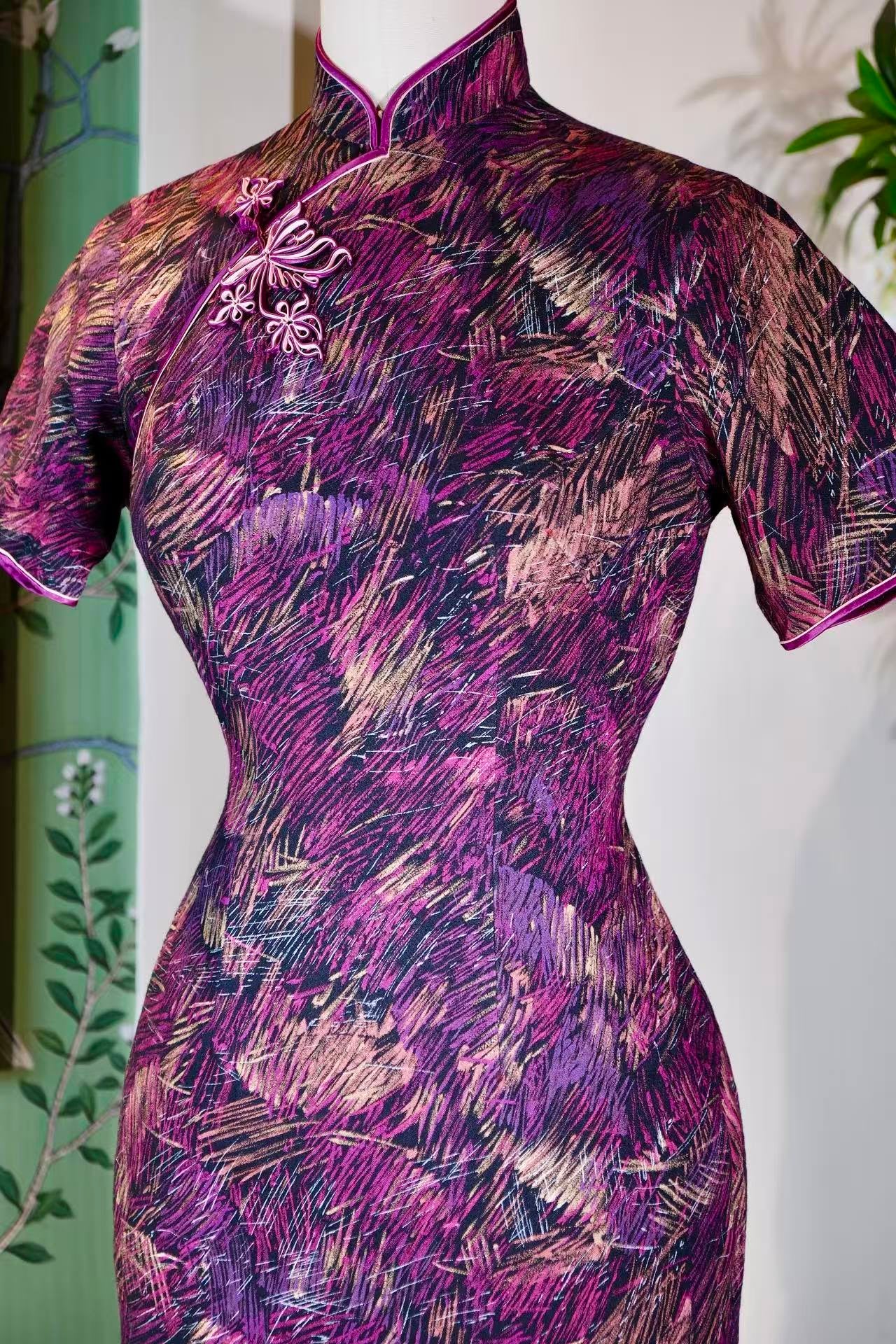
深紫如暮霭沉江,酒红似晚霞熔金,墨绿若远岫含黛,
1949年前后,上海裁缝挟“海派旗袍”之精魂南渡香江,
从艺术史维度观之,
抽象油画纹样需手工描稿、多次套印,稍有偏差即废,
此件旗袍,非衣也,乃半世纪风云的凝缩,中西美学的交响,
这件旗袍与另一件旗袍“《永恒优雅的轻语》—— 上世纪五十年代香港产古董旗袍” 源出自同一位主人, 以下是另一件的链接:
Deep purple like twilight mists settling on a river; wine-red like evening clouds melting into gold; ink-green like distant peaks shrouded in mist; and silvery-grey threads scattered like stardust—the fabric of this 1950s Hong Kong antique cheongsam takes the soul of abstract oil painting brushstrokes and fuses the wildness of Western modern art with the precision of Oriental weaving.
What appear to be spontaneous palette-knife textures are, in fact, poetic lines interwoven through warp and weft. The deep purple base evokes the profound mystery of "the dark blue of your collar" from the Classic of Poetry; the wine-red splashes suggest the lingering romance of Li Qingzhao’s "secret fragrance filling one’s sleeves"; the ink-green gradients mirror the ethereal clarity of Wang Wei’s "empty mountains after fresh rain." The gold and silver threads resemble the flowing ribbons of Feitian (flying apsaras) in Dunhuang murals, sketching a hazy realm on the cloth that is "like a flower yet not a flower, like a landscape yet not a landscape." The light purple piping at the collar and cuffs is as warm and refined as the ice-crackle glaze of Song ceramics, while the hand-wound crabapple-shaped buttons (pankou) echo the elegance of the "Crabapple Poetry Society" in Dream of the Red Chamber. This piece seamlessly blends the "scattered form" of Western abstraction with the "concentrated spirit" of Oriental restraint.
Around 1949, Shanghai tailors carried the soul of the "Haipai" (Shanghai-style) cheongsam across the waters to Hong Kong to take up their needles once more. Hong Kong at that time was both a sanctuary for Oriental culture and a laboratory for Western modern thought. The birth of this cheongsam coincided with the "Golden Fission" of Hong Kong’s qipao industry—Shanghai tailors retained traditional techniques like "flat-cutting" and "piping and bordering" while boldly introducing the visual language of Western abstract art. After half a century, the fabric’s luster remains unfaded and the patterns as clear as ever, standing as an eternal witness to the sentiment in The Song of Everlasting Sorrow: "Heaven and earth may endure long, but they will pass away; this regret shall linger on forever without end."
From an art history perspective, the motifs of this cheongsam resonate with 1950s Western Abstract Expressionism: Pollock’s "drip paintings" are transformed here into the flow of silk threads, and De Kooning’s "palette-knife strokes" are condensed into the texture of the textile. However, this is not a simple case of "Western learning spreading East"; it is a fusion of the "free brushstroke" of Western modernism with the "atmosphere-building" (yijing) of traditional Chinese aesthetics.
As Eileen Chang noted in Chronicle of Changing Clothes: "The constant innovation of qipao patterns reflects the self-reinvention of Chinese women amidst changing times." The abstract patterns of this cheongsam are a visual manifesto of Hong Kong women in the 1950s seeking their identity amidst the collision of East and West. Unwilling to abandon Oriental grace yet eager to embrace Western modernity, they transformed this contradiction and fusion into the "Fragrance Congealed on Purple Paths" upon their lapels.
Abstract oil painting patterns required hand-drawn drafts and multiple overprinting sessions; even the slightest deviation would result in a ruined piece. Its technical complexity far exceeds that of traditional flower-and-bird motifs. It is the material carrier of Hong Kong as the "Pearl of the Orient" during a unique historical window, witnessing the subtle process of Sino-Western cultures moving from collision to fusion. These designs predate modern art movements in Mainland China—such as "Scar Art" or the "85 New Wave"—by nearly thirty years, serving as a "prelude" to Chinese modern art history.
This cheongsam is not merely a garment; it is a condensation of half a century of shifting winds, a symphony of Eastern and Western aesthetics, and an awakening of female consciousness. It stands silently in the depths of time, as the Preface to the Orchid Pavilion Collection says: "Future generations looking at the present will feel just as we do looking at the past." It allows every gaze to touch the heartbeat of that "Modern Orient."
Note on Provenance: It is a rare privilege to present two garments from the same private wardrobe. Together, they offer a complete narrative of the aesthetic world inhabited by a 1950s Hong Kong socialite—revealing a woman who moved seamlessly between quiet classicism and avant-garde artistry.
Here below is the link of the other Qipao: