深圳溯源
Couldn't load pickup availability
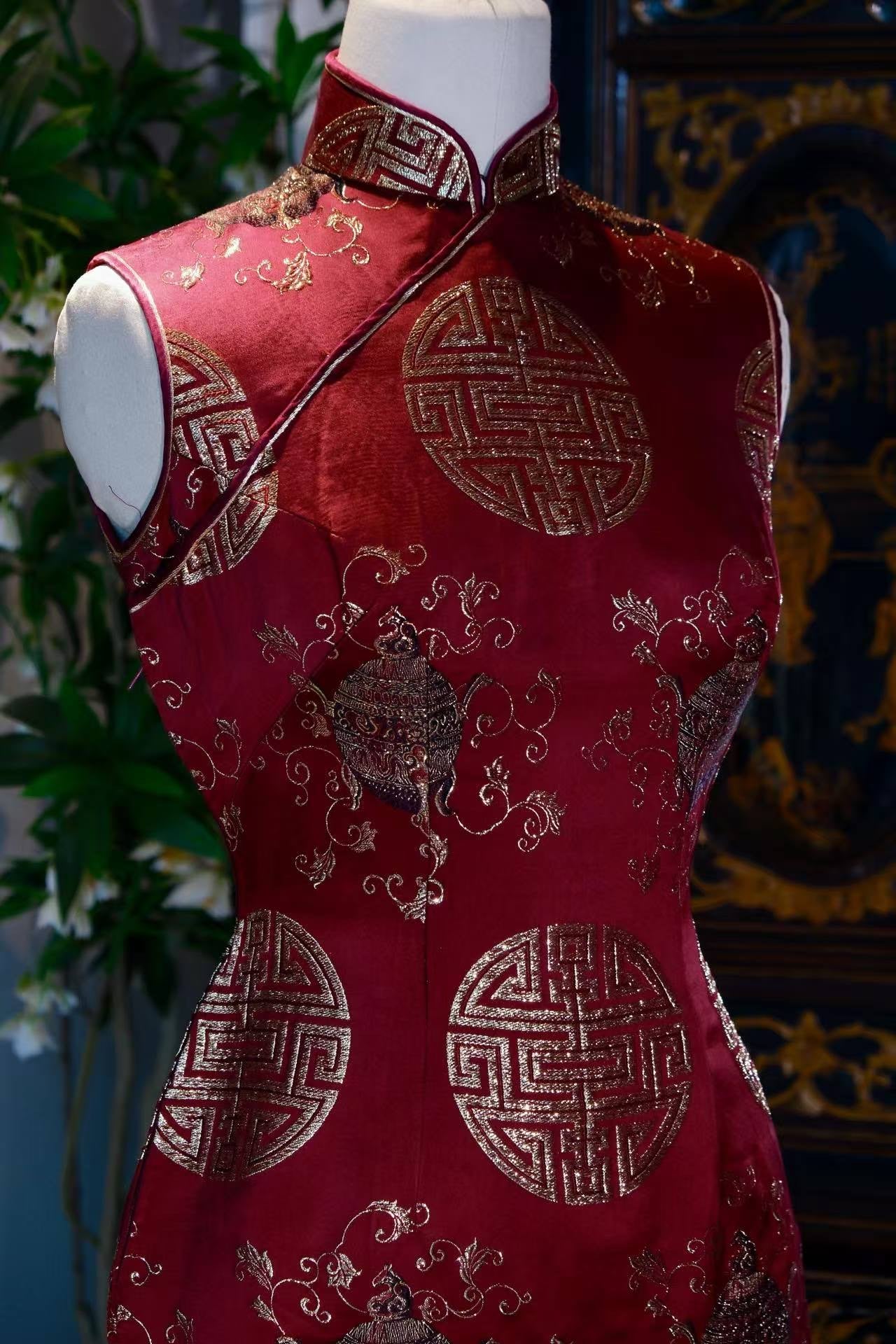
胭脂红织锦缎为底,金线穿梭间绽开团花万象。领口织金绣回纹,
衣身缠枝莲纹以S形曲线绵延,暗合《楚辞》“纷吾既有此内美兮”
袖窿处暗纹缠枝牡丹,取《尔雅》“牡丹为花中王”,
此袍形制承广府旗袍之骨:立领高寸五,胸腰差五寸,
团寿纹中暗藏香港早期华商印记,金线密度超同期上海出品三成,
锦缎上的每一缕金线,都是东方美学在时间长河中的逆向航行。
The foundation of this garment is rouge-red brocade satin (胭脂红织锦缎), where golden threads traverse and bloom into grand medallions (团花万象 – the myriad forms of life). The collar is embroidered with a gold-woven key fret pattern (回纹), symbolizing the beauty of ritual and order, echoing the phrase "return (to the center) is ritual" (回则礼) from the Classic of Rites. Arranged across the chest and shoulders are circular longevity motifs (团寿纹), drawing inspiration from the Classic of Poetry's* praise, "Like the constancy of the moon, like the rising of the sun." The longevity is further condensed into the endless wan (swastika) pattern (卍字不到头纹), embodying the concept of eternal life like the Great Chun tree (大椿长寿) from Zhuangzi, with the swirling gold threads representing an everlasting wish.
The interlocking lotus vine (缠枝莲纹) across the body extends in an S-shaped curve, aligning with the verse from Songs of Chu: "Abundant am I, possessing this inner beauty." The lotus heads—some budding, some fully bloomed—represent the Daoist concept of interdependent yin and yang (the "hidden" and the "manifest"). Interspersed among the lotuses are Ruyi cloud motifs (如意云纹). These motifs trace their lineage from the thunder pattern on Shang and Zhou bronze ware, evolved through the cloud-air dance forms of the Han Dynasty, and became the "as-you-wish" (如意) symbol in the Qing Dynasty. Here, they complement the medallions to form the auspicious prophecy of "boundless longevity with the clouds" (云寿无疆).
The interlocking peony (缠枝牡丹) motif is subtly woven into the armhole area, acknowledged in Erya as the "King of Flowers." Its nine-petal shape corresponds to the "nine regulations system" (九章之制) outlined in the Rites of Zhou. The wave pattern at the hem is reminiscent of the "light steps upon the waves" (陵波微步) from the Ode to the Goddess of the Luo River, creating a dynamic interplay of "motion" and "stillness" with the circular medallions.
The gold weaving technique utilizes thread twisted from mulberry silk and real gold foil. Following the "warping" (挽经) and "knotting" (结本) processes described in The Exploitation of the Works of Nature, every inch of brocade requires 3,200 weft threads to be picked by hand. The shimmering gold threads show a continuation of the "brilliant gold colors" (金彩辉映) style seen in the Ming Dynasty's Illustrated Silk Weaving Album.
The shape of this robe adheres to the framework of the Guangfu (Canton) style cheongsam: a high collar of 1.5 inches, a significant 5-inch difference between bust and waist measurements, and side slits opening to the hip. This design both upholds the decorum of "clothing should not expose the flesh" (衣不过肉) from the Classic of Rites: Inner Rules and incorporates the breezy spirit of Victoria Harbour.
The rouge-red hue is derived from the cinnabar used in the murals of the Tang Dynasty at Dunhuang, then refined by Hong Kong dye houses, resulting in a color more vivid than cheongsams of the same period from mainland China—a fabric that is "alive, inch by inch," as described by Eileen Chang.
The longevity medallions subtly bear the mark of early Hong Kong Chinese merchants. The gold thread density exceeds that of contemporary Shanghai products by thirty percent, confirming Hong Kong's status as a pinnacle of silk craftsmanship and an "Oriental Silk Capital" in the 1960s.
Every strand of gold thread on this brocade is a reverse voyage of Oriental aesthetics through the river of time. When a finger traces the relief of the medallions, one touches not only the silk threads but also the re-growth of Chinese attire in Hong Kong—a place where the thunder pattern of ancient bronze ware and the waves of Victoria Harbour completed their most wondrous chemical reaction on the loom.