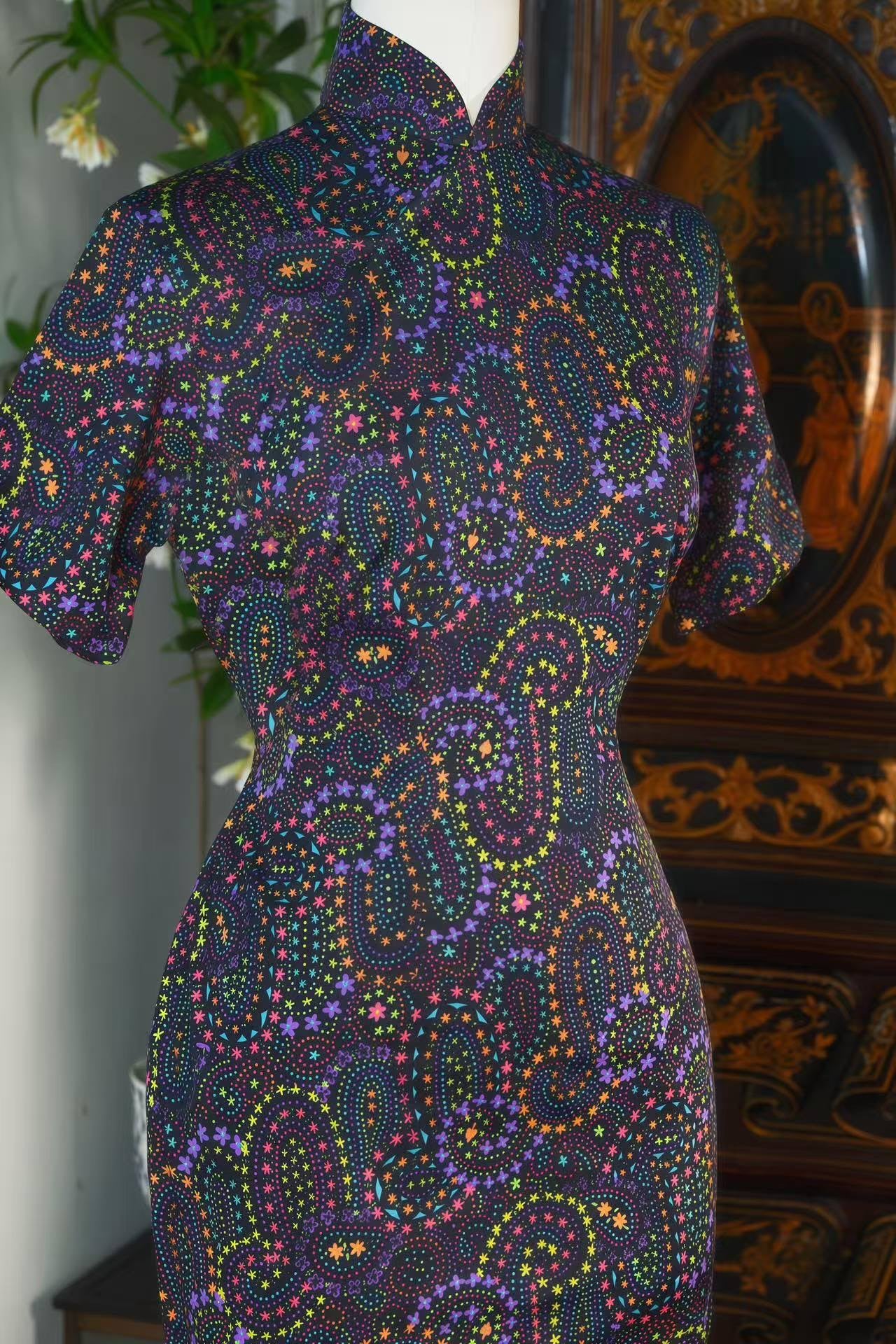
五十年代佩斯利古董旗袍:波普艺术的先声
此件旗袍的佩斯利纹样,虽根植于19世纪的克什米尔传统,但其呈现方式已暗合1960年代波普艺术(Pop Art)的视觉语言。其特征可概括为三:高饱和度撞色、重复性几何单元、平面化装饰趣味。深紫底上,星形、点彩、螺旋线以近乎“丝网印刷”的方式密集排布,与安迪·沃霍尔的《金宝汤罐头》在视觉节奏上异曲同工——均以“非写实”“高识别度”“消费性美感”解构了传统艺术的精英主义。
此袍制于1950年代,早于波普艺术在西方的正式崛起(1956年英国独立团体首提“Pop”概念)。这正凸显了其珍贵性:它并非对波普的模仿,而是无意识的先声。彼时香港作为东西方贸易枢纽,其纺织品设计已率先吸收了现代主义平面构成与商业广告的视觉策略。这种“前卫性”使其在同时期旗袍中独树一帜,成为东方服饰史中罕见的“超前实验品”。
纹样中大量使用的四角星、五角星,是波普艺术中“流行符号”的典型代表,常被用于表现消费社会的狂欢与疏离。以红、黄、蓝、绿等原色小圆点填充漩涡轮廓,形成类似罗伊·利希滕斯坦漫画网点的效果,在平面中营造出微妙的立体感与动感。整个面料被切割为无数微小单元(每个单元包含一个完整的佩斯利漩涡与星群组合),这种模块化重复正是波普艺术的核心语法之一,暗示着工业化量产时代的美学秩序。
这件旗袍的价值不仅在于年代久远或工艺精湛,更在于它无意间预言了一场席卷全球的艺术运动。它证明,在西方尚未命名“波普”之前,东方工匠已在面料上完成了类似的视觉革命——将传统纹样转化为一种充满活力、拥抱大众文化的当代符号。
收藏此袍,即是收藏一段未被书写的“前波普”历史。它提醒我们,艺术的变革往往并非自上而下,而是在日常器物的纹路中悄然萌发。
🌟 A Prelude to Pop Art: A 1950s Vintage Paisley Cheongsam
While the Paisley motifs of this cheongsam are rooted in 19th-century Kashmiri tradition, their presentation already aligns with the visual language of 1960s Pop Art. Its characteristics can be summarized in three points: high-saturation color clashing, repetitive geometric units, and a flattened decorative charm. On a deep purple base, stars, pointillism, and spirals are densely arranged in a manner akin to "screen printing." This creates a visual rhythm strikingly similar to Andy Warhol’s Campbell's Soup Cans—both deconstruct the elitism of traditional art through "non-realistic," "high-recognition," and "consumerist aesthetics."
Crafted in the 1950s, this robe predates the formal rise of Pop Art in the West (the term "Pop" was first coined by the Independent Group in Britain in 1956). This timing highlights its extraordinary value: it is not an imitation of Pop Art, but an unconscious precursor. As a hub of East-West trade at the time, Hong Kong’s textile designs had already begun to absorb the visual strategies of modernist planar composition and commercial advertising. This "avant-garde" nature makes it unique among contemporary cheongsams, marking it as a rare "proleptic experiment" in Oriental fashion history.
The visual narrative is constructed through several key elements:
-
Symbolic Motifs: The heavy use of four-pointed and five-pointed stars represents the "popular icons" typical of Pop Art, often used to express the carnival-like joy and alienation of a consumer society.
-
Ben-Day Dot Technique: Primary colors—red, yellow, blue, and green—are used as small dots to fill the swirling contours, creating an effect similar to Roy Lichtenstein’s comic book dots, adding a subtle sense of depth and motion to the flat surface.
-
Modular Repetition: The fabric is divided into countless micro-units (each containing a complete Paisley vortex and star cluster). This modular repetition is a core grammar of Pop Art, suggesting the aesthetic order of the era of industrial mass production.
The value of this cheongsam lies not just in its age or craftsmanship, but in its accidental prophecy of a global art movement. It proves that before the West named "Pop," Oriental craftsmen had already completed a similar visual revolution on fabric—transforming traditional patterns into vibrant, contemporary symbols that embrace popular culture.
To collect this robe is to collect an unwritten history of "Pre-Pop." It reminds us that artistic transformation often does not happen from the top down, but quietly germinates within the textures of everyday objects.