深圳溯源
Couldn't load pickup availability
金线织就的北方传奇:五十年代加拿大制织金提花古董旗袍
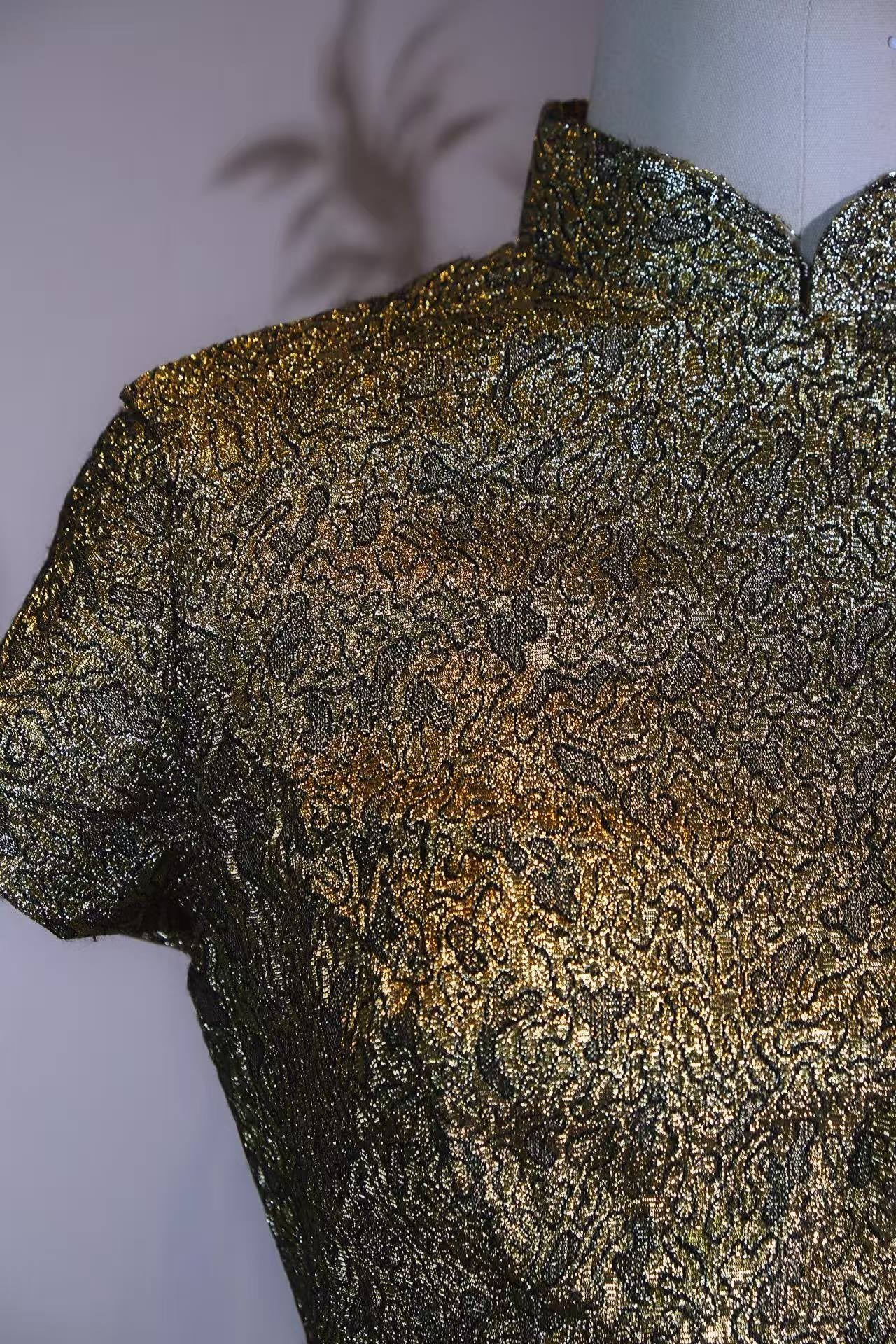
这件上世纪五十年代中期由加拿大的香港裁缝制作的织金抽象提花古
旗袍面料采用高密度织金工艺,真丝为经,金线为纬,
此袍稀缺性在于其“双重孤品”属性:一是产地孤品——
从艺术风格看,这件旗袍可视为“新中式”美学的早期雏形——
今日观之,这件旗袍不仅是五十年代北美华裔女性身份认同的物证,
The Golden Loom of the North: A Late 1950s Canadian-Made Bespoke Gold-Woven Cheongsam
A Rare Specimen of Cross-Cultural Identity Crafted in the mid-1950s by a Hong Kong tailor in Canada, this gold-woven abstract jacquard cheongsam is a peerless treasure of East-West fusion. Its label—"Ye Lang Du Standard Fashion, Canada"—is more than a mark of origin; it is a profound testament to how the mid-century North American Chinese community precisely interpreted and reshaped Oriental aesthetics.
The Alchemy of Silk and Gold The fabric utilizes a high-density gold-weaving technique (Zhijin), with silk as the warp and gold thread as the weft. The body is covered in an abstract jacquard that flows like celestial mist, embodying the principle from the ancient Kao Gong Ji (The Record of Trades): "Heaven has its seasons, Earth has its Qi, materials have their beauty, and craftsmanship has its skill." It seamlessly fuses traditional Chinese weaving with modern tailoring. Moving away from representational dragons or flowers, the pattern employs abstract lines—variations of cloud and water motifs—that preserve Oriental spirit while aligning with the 1950s Western Modernist aesthetic. The classic high collar paired with short sleeves reflects the daily dressing habits of North American women of the era, while the fitted silhouette celebrates the brand’s "Beauty in the Fit" philosophy.
A "Dual Rarity": Geographic and Technical This piece possesses a "Dual Rarity." First, it is a Geographic Rarity: surviving Canadian-made cheongsams are scarce, as most were produced by small family workshops rather than organized brands. Second, it is a Technical Rarity: high-density gold-woven jacquard was a luxury bespoke fabric requiring specialized looms and highly skilled weavers—a craft nearly impossible to replicate today. A hidden mark of ingenuity lies within: the vibrant orange satin lining, which creates a warm, sophisticated contrast to the golden exterior.
The "Neo-Chinese" Aesthetic: Wearable Art Artistically, this cheongsam is an early prototype of the "New Chinese" (Neo-Chinese) aesthetic. It neither clings to the heavy ornamentation of the Republican era nor blindly follows the structure of Western dresses. Instead, it facilitates a dialogue between Eastern fabric and Western cut—as the garden treatise Yuan Ye suggests: "Though made by human hands, it appears as if created by nature." Its abstract jacquard mirrors the "Negative Space" (Liubai) and "Expressive Brushwork" (Xieyi) of Chinese landscape painting, achieving a state of "Likeness in Unlikeness." It transcends fashion to become a piece of wearable art.
An Immigrant’s Silent Narrative Today, this garment stands as more than a witness to the identity of 1950s Chinese-Canadian women; it is a precious sample of "Transcultural Design" in global fashion history. Resting quietly upon a complex Persian rug, it whispers a forgotten immigrant story—of artisans who upheld tradition while embracing innovation in a foreign land, weaving their own "Oriental Legend" with threads of silk and gold.