深圳溯源
Couldn't load pickup availability
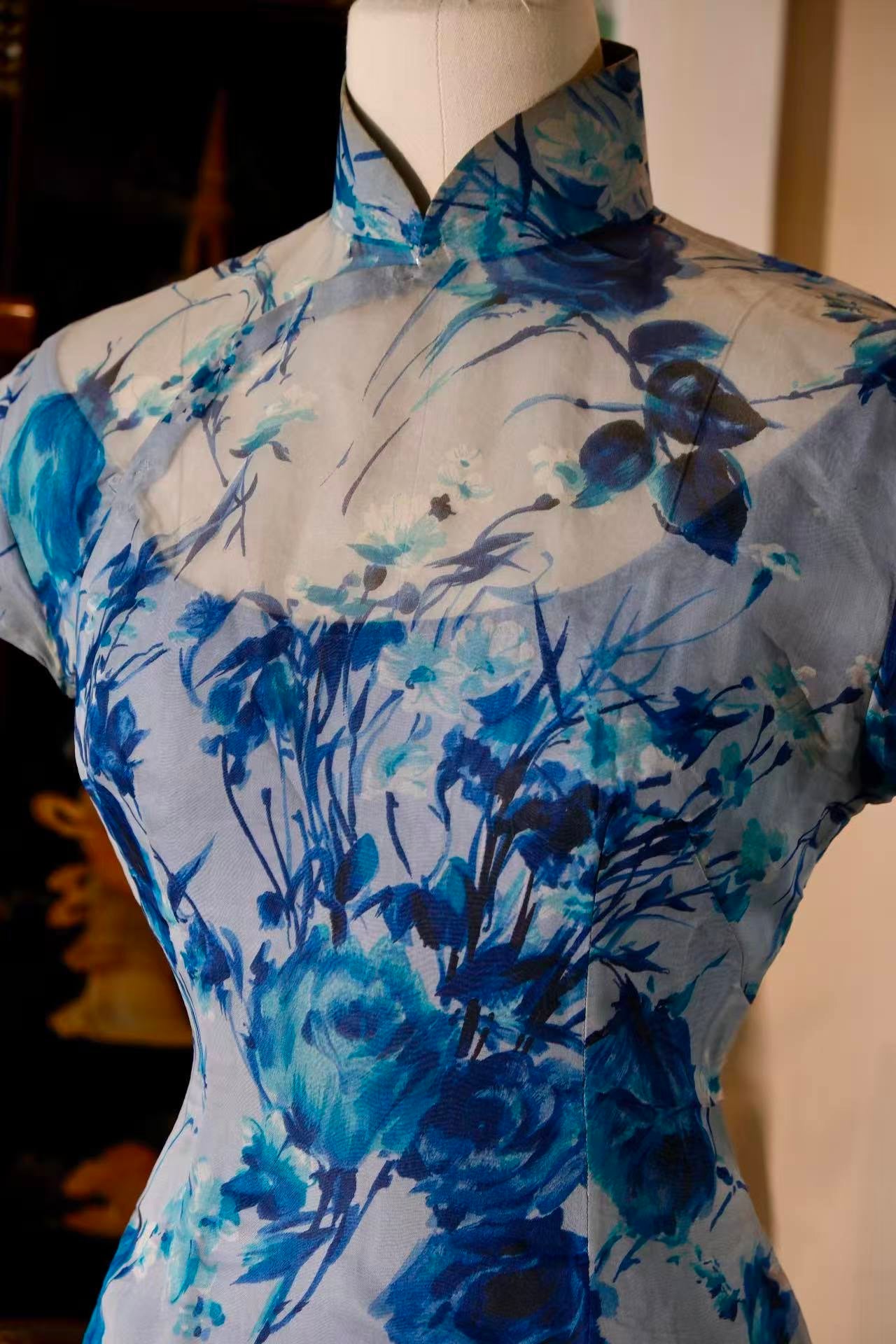
分享一件私藏多年的上世纪五十年代薄纱挖胸蓝玫瑰十字袖古董香港
以月白轻纱为笺,遍染靛蓝花卉。主纹以大写意笔法绘就玫瑰,
此袍突破传统旗袍的平面剪裁,采用“挖胸十字袖”结构——
薄纱印花工艺堪称“寸锦寸纱”:真丝纱经纬细密如蝉翼,
这件旗袍曾属于某个沪港名媛的衣橱,
此袍之美,胜在“蓝墨写意”的艺术气韵,胜在“挖袖裁剪”
Sharing a cherished vintage Hong Kong cheongsam from the 1950s, made of light organza (thin silk gauze) featuring a cutout bust and cross-sleeves (挖胸十字袖) and adorned with blue roses.
The garment uses the moon-white light gauze (月白轻纱) as its base canvas, upon which indigo blue floral patterns are widely printed. The main motif, the rose, is rendered in a grand, freehand style (大写意), with the petals bleeding out like ink washes. The varying concentrations of color reveal a "texturing technique" (皴法) texture, capturing the wild vitality of Xu Wei's Grapes in Ink. Interspersed among the roses are smaller blue flowers, with vines threaded through like "orchid leaf brushstrokes" (兰叶描), creating a composition of "ordered hierarchy" between the main and secondary elements. This subtly aligns with the aesthetic principle from the Mustard Seed Garden Manual of Painting: "The arrangement of flower branches should be well-spaced and dense in an artful manner."
The indigo blue hue inherits the elegance of the Song Dynasty's "Sky Water Blue" (天水碧), while the blue-and-white color scheme echoes the glazed aesthetics of blue and white porcelain. This translates the calligraphic concept of "ink distinguishing five colors" (墨分五色) into the language of clothing. Every thread and pattern is an Eastern aesthetic practice of "expressing meaning through lines."
This robe breaks away from traditional flat cheongsam tailoring, employing a "cutout bust and cross-sleeve" structure (挖胸十字袖). The cuffs feature a cross-slit opening, and the shoulder lines drape naturally, retaining the traditional genetic code of the stand collar while integrating the Western concept of fitted, three-dimensional tailoring. Cheongsams of the 1950s were in a "period of modification and transition"; this specific style uses a sleeveless design to project modernity, while the high slit and cinched waist cut accentuate the feminine silhouette.
The light gauze printing technique is a masterpiece of "inch-brocade, inch-gauze" (寸锦寸纱) craftsmanship: the silk gauze is as fine and dense as a cicada's wing. The printing requires "three dips and nine fixations" (三染九固) to achieve clear blue-and-white delineation. The nuanced gradations of the rose pattern's ink wash must be applied manually through hand-registration (手工套色); the intensity of each petal is controlled by the artisan's experience, yielding a more lively spirit than machine-printed flowers. Due to the fabric's fragility and the complexity of the craft, 1950s organza cheongsams were mostly high-end bespoke pieces, making their surviving quantity rare.
This cheongsam once belonged to the wardrobe of a famous socialite from Shanghai and Hong Kong, bearing witness to the neon lights of the Bund dance halls and the glow of the Lyceum Theatre. The blue-and-white patterns flow within the sheer shadow of the gauze, reflecting the life background that Eileen Chang described as "magnificent yet desolate." The passion of the roses and the transparency of the gauze implicitly represent the struggle and blossoming of women in the 1950s caught between tradition and modernity. It is not just attire, but a "touchable social and cultural history": the refined elegance of blue and white is an inheritance of Republican-era grace, while the modernity of the cross-sleeve is a response to Western fashion. Every stitch and thread is engraved with the fission and fusion of the era.
The beauty of this robe triumphs in the artistic spirit of "blue ink freehand," the innovative audacity of the "cutout sleeve" tailoring, and, most importantly, the scarcity value of the "organza print." It is a microcosm of 1950s Oriental aesthetics, a precursor to cross-cultural garment design, and an eternal classic refined by time. As the sheer gauze gently brushes and the blue ink flows, we seem to hear the lingering, elegant charm of that era resonating eternally through the long river of history.