深圳溯源
Couldn't load pickup availability
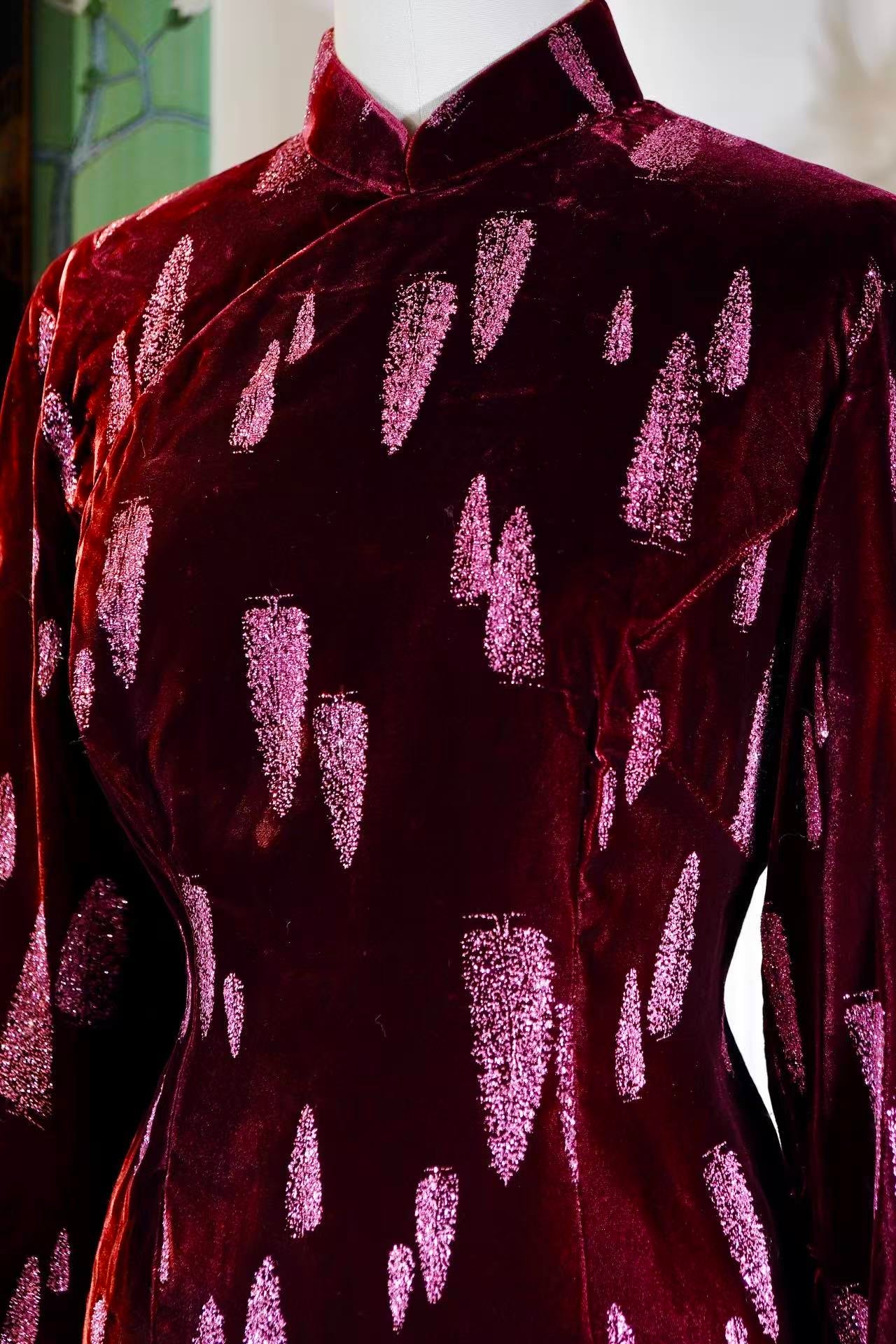
这件藏品是上世纪六十年代台湾产的金丝绒手绘闪片古董旗袍,
这并非简单的装饰,而是六十年代台湾手工艺巅峰的见证。
从历史的维度看,六十年代的台湾正处于传统与现代的交汇点。
这件旗袍的稀缺性,不仅在于其年代久远、保存完好,
This antique qipao, crafted in Taiwan during the 1960s, is far more than a mere garment; it is a meticulously stitched segment of history—a silent poem celebrating Oriental aesthetics and the romantic flair of a bygone era. The deep burgundy golden velvet base is as mellow as aged wine, shimmering with a subtle luster under the light, as if it has distilled the tenderness and solemnity of the passing years. Scattered across it are hand-painted sequin motifs created by artisans, resembling abstract pine needles or slender raindrops. Interweaving pale purple and silver-pink, these sequins leap and glimmer against the deep red backdrop like falling stars in the night sky or early snow drifting silently in winter, breathing fluid vitality and dreamlike poetry into the entire piece.
This is no simple decoration, but a testament to the pinnacle of Taiwanese craftsmanship in the 1960s. In an age without digital printing or assembly-line speed, every single sequin was outlined, adhered, and tinted with the warmth and patience of an artisan's fingertips. This "hand-painted sequin" technique preserves the delicacy of traditional Chinese weaving and embroidery while integrating the abstract aesthetics of Western modern art—an elegant encounter between East and West upon fabric. Unlike the elaborate realism of Su embroidery or the opulent grandeur of Cantonese embroidery, it conveys a reserved yet sophisticated Oriental aesthetic through minimalist forms and restrained colors. As noted in The Literary Mind and the Carving of Dragons: "As emotion goes out, it is like a gift; as inspiration comes, it is like a response." Every stroke on this qipao is a soulful response to beauty by the artisan.
From a historical dimension, 1960s Taiwan stood at the crossroads of tradition and modernity. The qipao, a sartorial symbol originating from the early Republican era, had by this time shed its complex borders and heavy embroideries, turning instead toward a pursuit of tailored fit and material texture. The slim cut of this garment hugs the feminine silhouette, showcasing the unique modesty and grace of Oriental women, while the choice of golden velvet reflects the era's pursuit of "nobility" and "modernity." To what kind of woman did it once belong? Perhaps a literary lady sipping coffee in a cafe on Yongkang Street in Taipei, or a socialite attending a banquet under the cover of night. Wearing it amidst a changing era, she used this magnificent attire to silently narrate her own story and dignity.
The scarcity of this qipao lies not only in its age and impeccable preservation but also in the irreplicable nature of its craftsmanship. In today’s world of mechanized production, it is nearly impossible to find such dedicated hand-painted sequin work. It is a fluid work of art, carrying the artisanal spirit and aesthetic of 1960s Taiwan—a precious gift bestowed upon us by time. As Eileen Chang wrote in Chronicle of Changing Clothes: "The chariot of the era rumbles forward... yet in the quiet of a night filled with starlight, we can always hear that ancient and gentle sigh." This qipao is the incarnation of that sigh, hanging quietly on the rack of time, waiting for someone who understands it to listen to the tales sealed within the velvet and sequins.