深圳溯源
Couldn't load pickup availability
衣服尺寸:
胸围/腰围/臀围:84/70/92 厘米
衣长:104 厘米
细节描述:
图案解构:祥云的诗意叙事
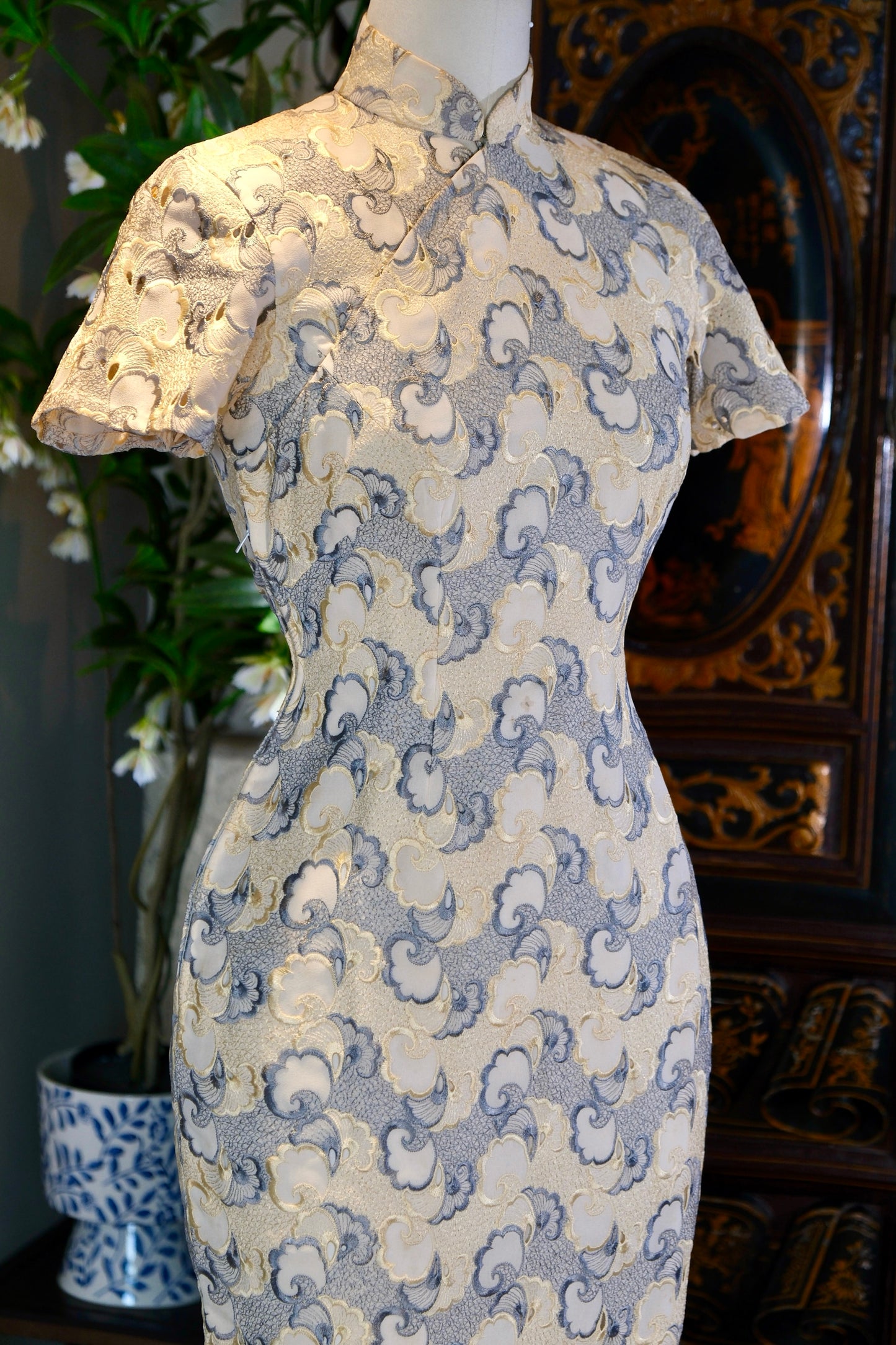
此件旗袍通体以米白色为底,其上铺陈着连绵不绝的如意云纹——这种源自商周青铜器“云雷纹”的古典母题,在六十年代台湾纺织工艺的革新中被赋予了新的生命。设计师以机绣蕾丝工艺,将云纹拆解为“勾卷”与“晕染”两种形态:主体云纹以浅灰蓝色丝线勾勒轮廓,边缘缀以细密的蕾丝镂空,仿若云雾缭绕时的虚实相生;而云纹间的留白处,则以极细的金线绣出“流云纹”暗纹,行走间光影流转,恰似《考工记》所言“天有时,地有气,材有美,工有巧,合此四者,然后可以为良”。
值得注意的是,云纹的排列并非机械重复,而是遵循“起承转合”的节奏:领口处云纹紧凑如“祥云捧日”,象征尊贵;腰身处云纹舒展似“行云流水”,暗合女性曲线之美;裙摆处云纹渐疏,形成“云卷云舒”的视觉留白,恰如中国山水画中的“计白当黑”,于方寸间见天地。
历史钩沉:台湾旗袍的黄金时代
上世纪六十年代,台湾正处于传统与现代的交汇点。彼时,大陆的纺织技术随移民传入,与本土的闽南刺绣、日本蕾丝工艺碰撞融合,催生出独特的“台湾旗袍”风格。此件旗袍正是这一时期的典型产物:它摒弃了传统旗袍繁复的手工盘扣,改用简洁的暗门襟设计;面料选用当时台湾最先进的“机绣蕾丝”——这种工艺以机械模拟手工刺绣的针法,既保留了蕾丝的轻盈通透,又通过精密的提花织机实现了云纹的立体浮雕效果,堪称“工业时代的诗意”。
据台湾纺织史学者考证,六十年代台湾能生产此类机绣蕾丝的工坊不足十家,且多服务于上层社会与外交场合。此件旗袍的云纹图案,实则暗含政治隐喻:祥云纹在传统文化中象征“祥瑞”,而六十年代台湾社会正处于“中华文化复兴运动”初期,此类服饰常被用作文化认同的载体。正如学者王宇清在《中国服装史》中所言:“台湾旗袍的精髓,在于以现代工艺重构传统符号,于方寸衣料间寄托家国之思。”
艺术风格与稀缺性:不可复制的时代标本
从艺术风格而言,此件旗袍完美诠释了“新古典主义”的精髓:它以西方立体剪裁(如收腰、短袖)塑造现代女性的身体意识,却以东方云纹图案传递传统美学精神。这种“中西合璧”并非简单的拼贴,而是通过图案的节奏、面料的质感、剪裁的比例,实现了文化基因的深层融合——正如美学家宗白华所言:“中国艺术的最高境界,是‘舞’的境界,是动态的和谐。”此件旗袍的云纹随身体起伏而流动,恰是这种“动态和谐”的绝佳注脚。
其稀缺性更不言而喻:首先,六十年代台湾机绣蕾丝旗袍的存世量极少,因当时多作为“嫁妆”或“礼服”珍藏,日常穿着者寥寥;其次,此件旗袍的云纹图案为工坊定制设计,未见诸其他现存藏品,具有“孤品”属性;再者,其面料历经六十年仍保持良好弹性与光泽,足见当时台湾纺织工业的精湛水准。正如古物收藏家所言:“一件真正的古董衣,不仅是衣物,更是凝固的历史、流动的艺术。”
结语:穿在身上的文化记忆
这件旗袍,是六十年代台湾社会的精神切片:它以云纹为笔,书写着对传统的眷恋;以机绣蕾丝为墨,记录着工业时代的创新;以立体剪裁为纸,承载着女性意识的觉醒。当指尖抚过那细密的蕾丝镂空,仿佛能触摸到那个年代的脉搏——那是传统与现代的对话,是东方与西方的和鸣,更是一个时代留给我们的、不可复制的文化记忆。
Measurements / Size Guide:
Bust / Waist / Hips: 84/70/92 cm
Total Length: 104 cm
Detailed Description:
This qipao features an off-white base entirely adorned with continuous Ruyi cloud motifs—a classical motif originating from the "cloud and thunder" patterns of Bronze Age artifacts, revitalized here through the innovation of 1960s Taiwanese textile craftsmanship. Using machine-embroidered lace, the designer deconstructed the clouds into two forms: "coiling" and "gradient." The primary clouds are outlined with pale grey-blue silk threads, their edges adorned with delicate lace openwork to create an interplay of void and solid, much like mist swirling in the air. In the negative spaces between clouds, ultra-fine gold threads embroider "drifting cloud" patterns as hidden details. As the wearer moves, the shifting light and shadow evoke the wisdom of the Kao Gong Ji: "Heaven has its seasons, Earth its vitality, materials their beauty, and craftsmen their skill. When these four combine, a masterpiece is born."
Notably, the arrangement of the clouds is not a mechanical repetition but follows a rhythmic progression: at the collar, the clouds are dense, symbolizing "auspicious clouds cradling the sun" (nobility); at the waist, they stretch out like "flowing clouds and water," harmonizing with the female silhouette; and at the hem, they gradually thin out, creating a visual "opening and closing" of clouds. This mirrors the Chinese landscape painting principle of "treating white space as black," revealing a vast universe within a limited space.
The 1960s placed Taiwan at the intersection of tradition and modernity. At that time, textile techniques brought by immigrants merged with local Hokkien embroidery and Japanese lace technology, giving birth to the unique "Taiwanese Qipao" style. This piece is a quintessential product of that era: it abandons complex traditional handmade pankou buttons in favor of a sleek concealed placket. The fabric utilizes what was then Taiwan's most advanced "machine-embroidered lace"—a process that simulated hand-stitching with mechanical precision. It preserved the lightness and transparency of lace while achieving the 3D relief effect of clouds through sophisticated jacquard looms, earning the title "poetry of the industrial age."
According to Taiwanese textile historians, fewer than ten workshops in the 1960s were capable of producing this grade of machine-embroidered lace, primarily serving high society and diplomatic circles. The cloud patterns also carried political metaphors: auspicious clouds represent "good omens," and during the early stages of the "Chinese Cultural Renaissance Movement" in 1960s Taiwan, such garments were used as carriers of cultural identity. As scholar Wang Yuqing noted in History of Chinese Costume: "The essence of the Taiwanese qipao lies in reconstructing traditional symbols with modern technology, embedding a longing for cultural heritage within the fabric."
Artistically, this qipao perfectly interprets the essence of "Neoclassicism": it uses Western 3D tailoring (such as the cinched waist and short sleeves) to shape modern female body consciousness, while transmitting traditional aesthetic spirits through Oriental cloud motifs. This "East-meets-West" is not a simple collage but a deep fusion of cultural genes through rhythm, texture, and proportion. As aesthetician Zong Baihua said: "The highest realm of Chinese art is the realm of 'dance'—a dynamic harmony." The clouds on this qipao flow with the body’s movements, serving as a perfect footnote to this "dynamic harmony."
Its scarcity is self-evident: first, very few 1960s Taiwanese machine-embroidered lace qipaos survive, as they were mostly kept as "dowries" or "formal wear" rather than daily attire; second, this specific cloud design was a custom workshop commission not found in other known collections, giving it a "unique specimen" (Gupin) status; third, the fabric has maintained excellent elasticity and luster after sixty years, showcasing the superb standards of the Taiwanese textile industry at the time. As antique collectors say: "A true antique garment is not just clothing; it is solidified history and fluid art."
This qipao is a spiritual slice of 1960s Taiwanese society: it uses clouds as a pen to write of a longing for tradition, machine-embroidered lace as ink to record industrial innovation, and 3D tailoring as paper to carry the awakening of female consciousness. When your fingertips brush the fine lace openwork, it feels as if you can touch the pulse of that era—a dialogue between tradition and modernity, a harmony between East and West, and an irreproducible cultural memory left to us by time.