深圳溯源
Couldn't load pickup availability
衣服尺寸:
胸围/腰围/臀围:94/74/100 厘米
衣长:95 厘米
细节描述:
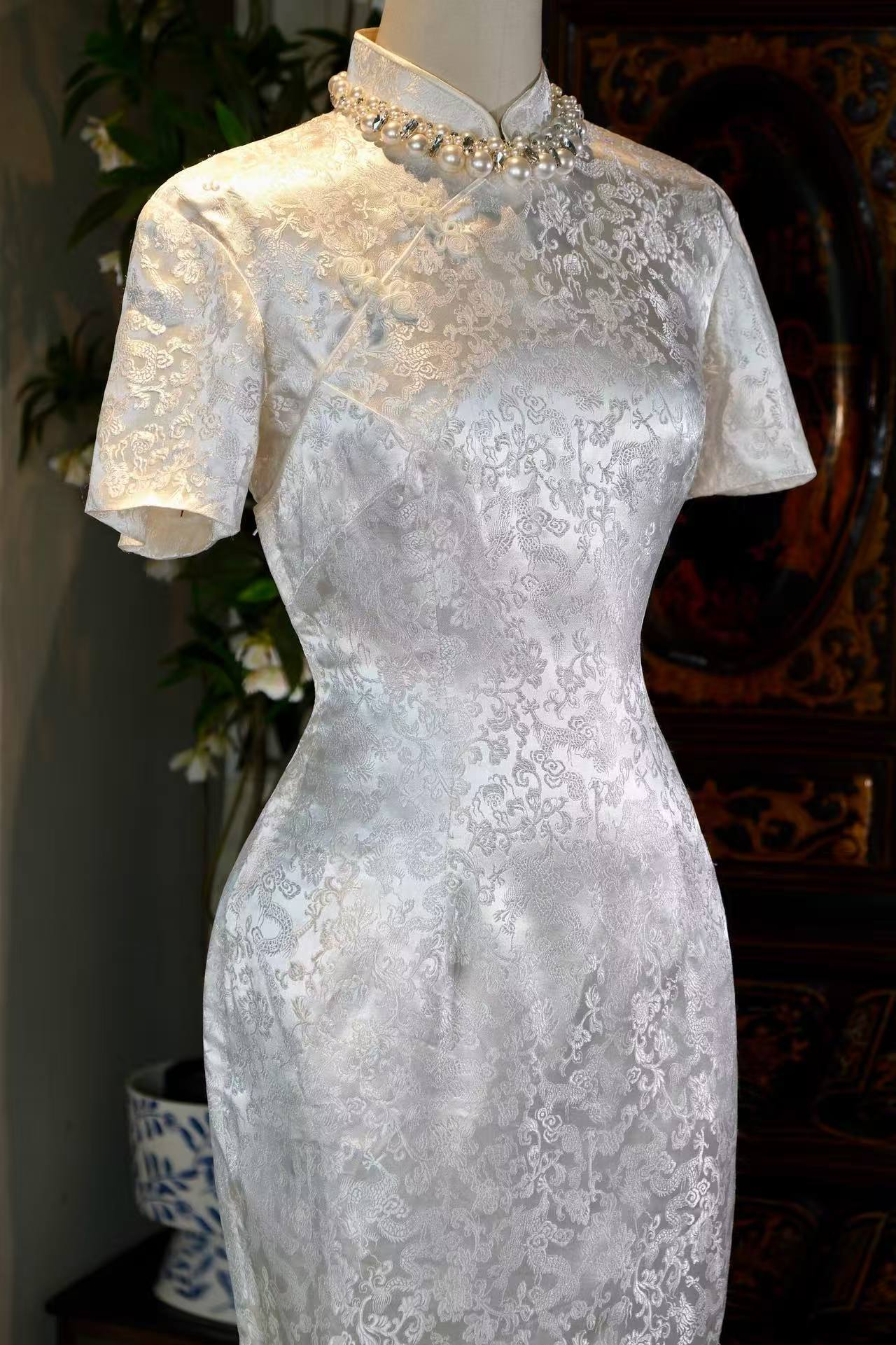
在时光的褶皱里,总有一些衣物承载着文明的密码。这件上世纪六十年代台湾产的祥云龙纹织锦缎旗袍,恰似一轴流动的历史长卷,将东方美学的精魂与匠人的虔诚,织进了每一寸经纬。
一、龙翔云海,纹藏乾坤
旗袍通体以银白织锦缎为料,缎面光泽如月华流转,触手生温。最引人注目的,是遍布衣身的祥云龙纹——
- 龙纹:五爪金龙或腾跃于云间,或潜游于浪底,龙首昂扬,龙鳞细密如粟,龙须飘逸若丝。古人云“龙,鳞虫之长,能幽能明,能细能巨”,此处的龙纹既承袭了明清官服的威仪,又融入了民间艺术的灵动,每一处转折都暗合“S”形曲线,暗喻“九五至尊”的祥瑞,却又因旗袍的剪裁而多了几分女性的柔婉。
- 云纹:龙身周围,祥云缭绕,卷舒开合间似有仙气氤氲。云纹采用“如意云头”与“流云”交织的技法,既有“云从龙”的传统意象,又以缠枝莲纹为底,暗合“连绵不绝”的吉祥寓意。银线绣出的云纹在光线下若隐若现,恰如《诗经》所言“如云如霞,如日之升”,将天地间的祥瑞之气凝于方寸。
二、时光的针脚,岁月的低语
这件旗袍的故事,要从六十年代的台湾说起。彼时,大陆的传统织锦工艺随匠人迁台,在台北大稻埕的工坊里,老匠人以古法织机复刻明清贡缎,将宫廷纹样与民间审美熔于一炉。旗袍的剪裁则融合了海派旗袍的修身线条与台湾本土的温婉气质——高领微斜,领口缀以盘扣,袖口收至肘上,下摆开衩至膝,既显女性曲线之美,又不失端庄典雅。
据考证,六十年代台湾织锦缎旗袍多为达官显贵或富商之家定制,因面料昂贵、工艺复杂,存世量极少。这件旗袍历经半世纪流转,缎面仍光洁如新,纹样未褪分毫,足见当年用料之考究、保存之精心。它曾见证过怎样的盛宴?又曾陪伴哪位佳人走过怎样的岁月?那些未言说的故事,都藏在龙纹的鳞爪间,藏在云纹的褶皱里。
三、稀缺性:文明的孤本,艺术的绝唱
在当代快时尚的浪潮中,这样的古董旗袍早已成为“文明的孤本”。其稀缺性体现在:
- 工艺绝唱:古法织锦技法因耗时耗力,如今已鲜有人传承,现存的老织机多已停用,使得此类面料成为不可复制的“活化石”。
- 纹样正统:祥云龙纹作为传统等级制度的象征,在当代服饰中已极少使用,而这件旗袍的纹样既符合历史规制,又突破了性别界限,是传统与现代碰撞的罕见实例。
- 时代印记:六十年代的台湾正处于文化转型期,这件旗袍既是传统工艺的延续,也是本土审美的萌芽,承载着特殊历史时期的文化记忆。
四、艺术风格:东方美学的极致表达
这件旗袍的艺术风格,可概括为“典雅中见磅礴,细腻处藏乾坤”——
- 色彩:银白为底,象征纯洁与高贵,龙纹与云纹以同色系银线织就,通过光影变化呈现层次,恰如中国水墨画的“墨分五色”,含蓄而深邃。
- 构图:纹样布局疏密有致,龙纹作为主体,或隐或现于云纹之间,形成“藏露相生”的意境,暗合道家“虚实相济”的哲学。
- 气质:整体造型既具宫廷服饰的华贵,又有文人画的清雅,穿上它,仿佛能听见《长恨歌》中“云想衣裳花想容”的吟唱,又能感受到《洛神赋》里“翩若惊鸿,婉若游龙”的风姿。
结语:让历史穿在身上
这件祥云龙纹织锦缎旗袍,不仅是一件衣物,更是一部穿在身上的文明史。它让我们看见,六十年代的匠人如何以针为笔、以线为墨,将天地祥瑞、人文情怀织进经纬;也让我们触摸到,东方美学中“天人合一”的至高境界。
如今,它静静陈列于此,等待着懂得欣赏的人,去续写它的新故事。或许,当你穿上它的那一刻,便成了历史与当下的桥梁,让那些沉睡的龙纹与云纹,再次在时光中苏醒,绽放出跨越半个世纪的光芒。
衣服尺寸:
胸围/腰围/臀围:94/74/100 厘米
衣长:95 厘米
细节描述:
In the folds of time, certain garments carry the codes of civilization. This 1960s Taiwan-made qipao, featuring auspicious clouds and dragon motifs in heavy brocade, is like a fluid historical scroll—weaving the soul of Eastern aesthetics and the devotion of master artisans into every inch of its warp and weft.
The qipao is crafted from silver-white brocade (Zhinan), with a luster that ripples like moonlight and a texture that warms to the touch. Its most arresting feature is the all-over motif of auspicious clouds and soaring dragons:
The Dragon Motif: Five-clawed golden dragons leap through clouds or dive beneath waves. The heads are held high, scales are as fine as millet, and whiskers flow like silk. These motifs inherit the majesty of Ming and Qing dynasty official robes while injecting the vitality of folk art. Every turn follows a rhythmic "S" curve, implying the "Nine-Five Supremacy" of royal auspiciousness, yet softened by the feminine silhouette of the qipao.
The Cloud Motif: Surrounding the dragons are auspicious clouds that curl and unfurl as if imbued with celestial mist. Utilizing the "Ruyi Cloud Head" and "Flowing Cloud" techniques, the design evokes the traditional imagery of "clouds following the dragon." Beneath the clouds lies a subtle "Continuous Lotus" pattern, symbolizing an endless lineage of blessings. The silver-threaded clouds shimmer under light, echoing the Classic of Poetry: "Like clouds, like mists, like the rising sun."
The story of this qipao begins in 1960s Taiwan. During this era, traditional weaving techniques from mainland China migrated to the island with master craftsmen. In workshops across Taipei’s Dadaocheng district, artisans used ancient looms to replicate Ming and Qing imperial satins, fusing palace patterns with folk sensibilities.
The tailoring combines the slim lines of the Shanghai style with the gentle temperament of Taiwan—a high collar slightly tilted, accented with handcrafted frog buttons (Pankou), sleeves reaching just above the elbow, and a knee-length side slit. Records suggest these brocade qipaos were primarily custom-made for the families of dignitaries or wealthy merchants. To remain as pristine as new after half a century is a testament to the supreme quality of the materials and the care of its previous keepers.
In the wave of modern fast fashion, such an antique qipao has become a "lone copy of civilization." Its scarcity is reflected in:
The End of a Craft: Ancient brocade weaving is incredibly time-consuming and labor-intensive. With many traditional looms now decommissioned, this fabric has become an irreproducible "living fossil."
Orthodox Iconography: The auspicious cloud and dragon motif, once a symbol of a strict social hierarchy, is rarely used in contemporary fashion. This piece bridges the gap between historical regulation and modern feminine expression.
A Historical Timestamp: 1960s Taiwan was a period of cultural transition. This qipao represents both the continuation of ancient craft and the budding of a localized aesthetic identity.
The style of this qipao can be summarized as "majestic within elegance, the universe hidden in the details":
Color: The silver-white base symbolizes purity and nobility. The motifs are woven with tonal silver threads, creating depth through light and shadow—much like the "five colors of ink" in Chinese wash painting.
Composition: The layout is intentionally balanced. The dragons, as the primary subject, appear and disappear among the clouds, creating an artistic realm of "hiding and revealing" (Zanglu Xiangsheng), aligning with Taoist philosophies of void and substance.
Temperament: It possesses both the opulence of court attire and the refinement of literati painting. To wear it is to evoke the poetic grace of the Ode to the Goddess of the Luo River: "Fluttering like a startled swan, graceful as a swimming dragon."
This auspicious cloud and dragon brocade qipao is more than a garment; it is a wearable history of civilization. It allows us to see how the artisans of the 1960s used needles as brushes and silk as ink to weave the world’s blessings and human sentiments into the very warp and weft of the fabric. It offers a tangible touch of the supreme Eastern aesthetic—the harmony between man and nature.
Today, it stands in quiet repose, waiting for a connoisseur to continue its story. Perhaps, the moment you put it on, you become the bridge between history and the present, allowing those dormant dragons and clouds to awaken once more in the light of time, radiating a brilliance that spans half a century.