深圳溯源
Couldn't load pickup availability
衣服尺寸:
胸围/腰围/臀围:100/84/110 厘米
衣长: 108 厘米
细节描述:
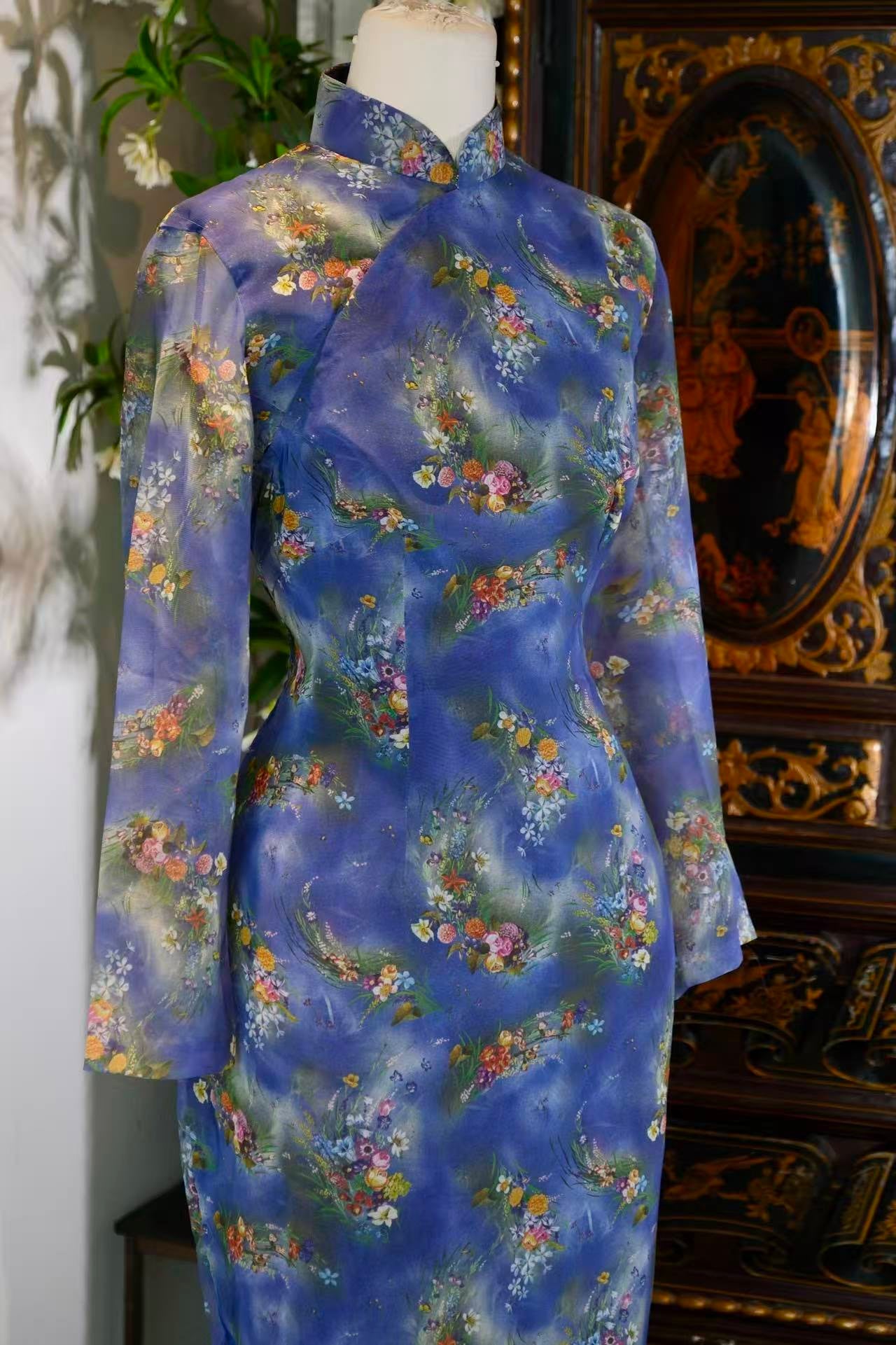
深蓝底色似仲夏夜幕,繁花如林间精灵的魔法,
这件旗袍的印花图案,堪称“可穿戴的油画”。
1960年代的香港,恰似一个“文化仲夏”:战后经济腾飞,
Measurements / Size Guide:
Bust / Waist / Hips: 100/84/110 cm
Total Length: 108 cm
Detailed Description:
The deep navy base resembles a midsummer night sky, the flourishing blossoms are like the magic of woodland sprites, and the ethereal chiffon gauze flows like moonlight. "Midsummer" echoes the seasonal rhythm in the Book of Songs: "In the seventh month, the Fire Star passes the meridian; in the ninth month, clothes are handed out," hiding a tribute to the vitality of high summer. "A Night’s Dream" calls upon the philosophical imagery of Zhuangzi: "While they dreamt, they did not know they were dreaming," sublimating the qipao’s misty beauty into a surrealist poetic vision.
The print on this qipao is a "wearable oil painting." The navy base is not a flat indigo but utilizes oil-painting gradient techniques to present layers from ink blue to cobalt, mimicking the flow of light and shadow as moonlight pierces through clouds. The clustered blossoms are woven with Impressionist pointillism and freehand brushstrokes: bright yellow marigolds, pink roses, and snow-white lilies of the valley, punctuated by a few pale purple forget-me-nots. They are not arranged in rigid order but grow wildly across the fabric, as if seeds scattered by a Shakespearean sprite. The blurred edges of the petals simulate the natural seepage of oil pigments on canvas, making each flower seem to tremble in the night breeze. Deep green leaves are outlined with varying intensities, and the "white space" left at the veins adds a "Xieyi" (freehand) charm of traditional ink painting. This design is a unique interpretation of "East meets West" by 1960s Hong Kong designers—preserving the chromatic tension of Western art while aligning with the Oriental aesthetic of "the interplay between void and solid."
Hong Kong in the 1960s was itself a "Cultural Midsummer": a post-war economic takeoff where Eastern and Western cultures clashed fiercely yet merged quietly. As a symbol of female identity, the qipao was transitioning from "formal attire" to "daily fashion." This qipao is a quintessential specimen of this transition. The choice of chiffon gauze broke the traditional dependence on silk and brocade, catering to the modern woman’s need for lightness and breathability while using translucency to align with the Western modernist pursuit of "bodily liberation." The oil-painting style reflects the society's fascination with Western art; in the 1960s, the Hong Kong Museum of Art was established, and Western exhibitions became frequent, allowing the aesthetics of Impressionism and Expressionism to penetrate local design. This print may have been inspired by the "New Ink Movement" led by Lui Shou-kwan, melting Western realism and Eastern ink-wash imagery into a single furnace—a unique hallmark of "Made in Hong Kong."
The use of chiffon makes this qipao a "walking dream." This material arrived in Hong Kong in the early 1960s and quickly became a favorite for its mist-like lightness and wind-like breathability. The tailoring continues the "bespoke" essence: the mandarin collar stands as firm as a pine or cypress in a midsummer night, sketching the dignity of the Oriental woman. The cinched waist fits the feminine curve, yet because of the chiffon's drape, it presents a restrained beauty that is "soft but not coquettish." When the wearer walks, the gauze flutters, and the patterns flicker in the light like a sprite’s magic, truly achieving the realm where "the person is in the garment, and the garment is in the dream."
The scarcity of this piece manifests in three dimensions:
Technical Uniqueness: Printing technology was in a transition from manual to semi-mechanical. This oil-painting print, with its rich layers and strong brushstroke feel, required multiple color overlays and manual mixing, far exceeding the complexity of ordinary prints.
Preservation Difficulty: Chiffon is prone to aging and damage. An antique qipao that remains vivid and intact after sixty years is extremely rare.
Irreplaceable Cultural Symbol: It carries the collective memory of 1960s Hong Kong’s cultural fusion, serving as a "living fossil" for studying post-war social change and female fashion. As Harold Bloom noted: "Classic works are those that are constantly reread in the river of history, yet always provide new meaning." This qipao is such a "wearable classic"—every gaze decodes a new era cipher.
Conclusion: Shakespeare wrote in A Midsummer Night’s Dream: "All that is solid melts into air." However, this 1960s antique qipao uses fabric to solidify the dreams and poetry of an era. It is not just a qipao, but a poem of a midsummer night, a walking oil painting, and a microcosm of Hong Kong fashion history. When we gaze upon it today, we can almost hear the Hong Kong streets of sixty years ago—the ding-ding of the trams, the flickering neon—and see a woman in this qipao walking out of a Central coffee shop, her hem fluttering like a dream. This is the eternal charm of A Midsummer Night’s Dream.
雪纺薄纱的选用,使这件旗袍成为“行走的梦境”。
作为六十年代香港产的古董旗袍,其稀缺性体现在三重维度:其一,
莎士比亚在《仲夏夜之梦》中写道:“