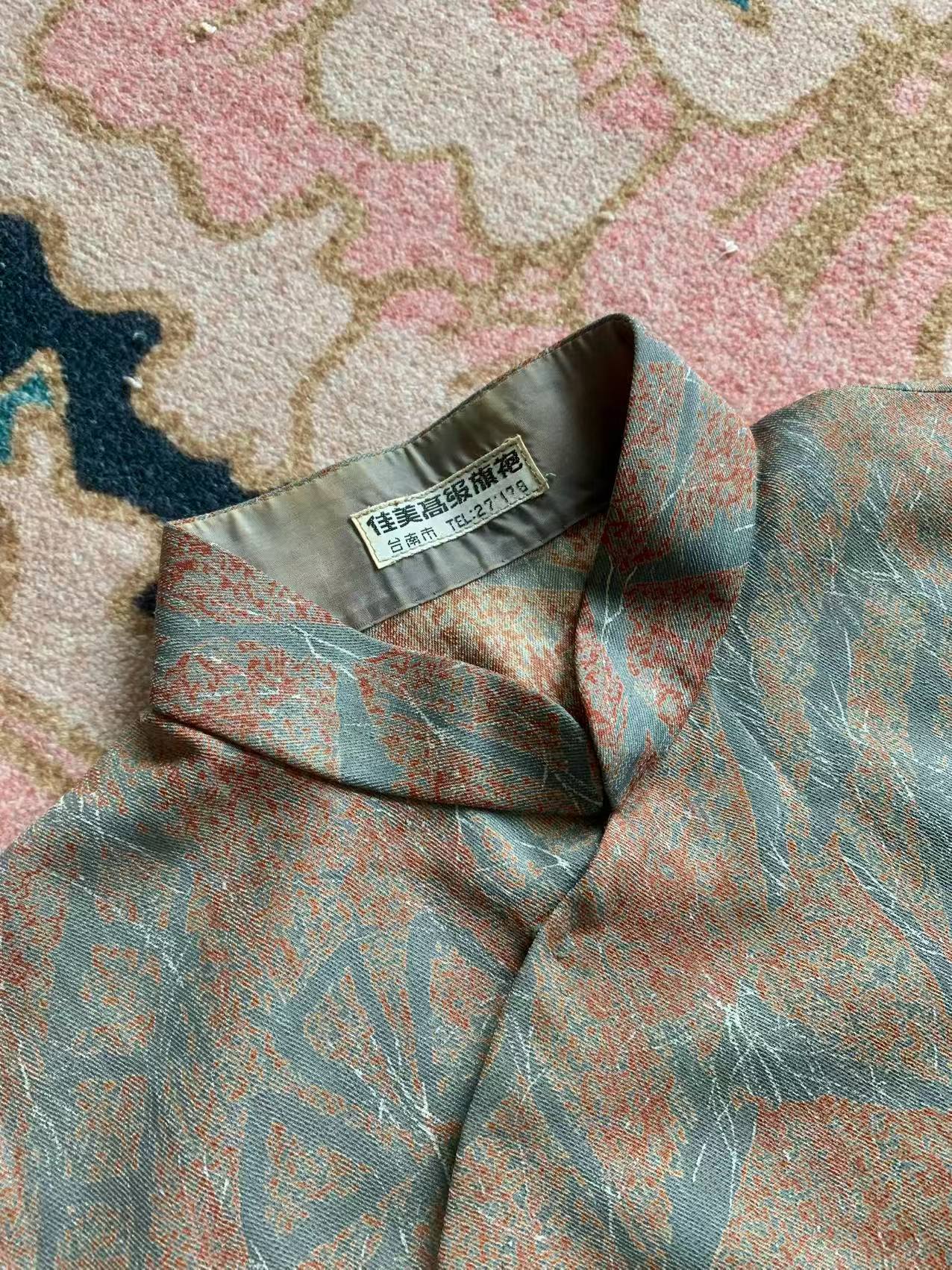
佳美高级旗袍出品:抽象水墨里的六十年代风华
衣服尺寸:
胸围/腰围/臀围:100/94/102 厘米
衣长:109 厘米
细节描述:
这件产自台湾的佳美高级旗袍,以抽象水墨般的几何纹样为骨,暗合了六十年代全球现代主义浪潮下的东方美学实验。其图案以灰蓝与暖橙为主调,交织出如《考工记》所言“青与赤谓之文,赤与白谓之章”的古典配色逻辑,却又以解构主义手法将传统花卉纹样拆解为放射状几何图形——花瓣化作三角与弧线的组合,枝叶蜕变为交错的直线,恰似吴冠中笔下“风筝不断线”的抽象意境,在传统与现代间架起一座视觉桥梁。
细观其纹样,灰蓝色底布上,暖橙色斑点如墨点晕染,其间穿插的几何花卉似开未开,既有“疏影横斜水清浅”的含蓄,又具“大珠小珠落玉盘”的韵律。这种“似与不似之间”的图案设计,暗合六十年代台湾纺织业对西方抽象艺术的本土化转译,堪称“东方的蒙德里安”——用几何秩序重构自然意象,让传统旗袍的温婉中透出先锋气质。
标签上的“佳美高级旗袍”,是六十年代台湾高端成衣业的缩影。彼时台湾作为亚洲纺织重镇,以“佳美”为代表的本土品牌,既承袭了上海旗袍的剪裁精髓,又融入在地审美创新。这件旗袍的稀缺性,在于它见证了“海派旗袍”向“台湾改良旗袍”的转型——收腰更贴合东方女性曲线,袖长七分恰露皓腕,既非完全西化,亦非固守传统,恰如余光中《乡愁》中“小小的邮票”般,承载着特定时代的工艺记忆。
从艺术史维度看,这件旗袍的抽象图案与同期欧美“太空时代”设计形成跨文化呼应,却以东方水墨的写意性消解了机械感,正如宗白华所言“中国艺术意境的创成,既须得屈原的缠绵悱恻,又须得庄子的超旷空灵”。如今,它作为可穿着的文物,不仅是一件服饰,更是一本打开的六十年代美学史——每一道褶皱里,都藏着那个时代对传统的温柔叛逆,对未来的诗意想象。
在快时尚泛滥的当下,这件佳美高级旗袍的稀缺性,不仅在于其保存完好的品相,更在于它凝结了“传统工艺现代化”的早期探索。它提醒我们:真正的经典,从不是对过去的复刻,而是用当代语言重述永恒之美。
Produced by Jiamei High-End Qipao: 1960s Grace within Abstract Ink Wash
Measurements / Size Guide:
Bust / Waist / Hips: 100/94/102 cm
Total Length: 109 cm
Detailed Description:
This high-end cheongsam (qipao) from Taiwan’s "Jiamei" label uses abstract, ink-wash-like geometric motifs as its backbone, subtly aligning with the Eastern aesthetic experiments under the global modernist wave of the 1960s. Its palette, dominated by greyish-blue and warm orange, intertwines according to the classical logic of "Green and red form patterns; red and white form elegance" (from Kao Gong Ji). Yet, it employs a deconstructive approach to dismantle traditional floral motifs into radial geometric shapes—petals become combinations of triangles and arcs, while stems evolve into intersecting straight lines. It mirrors the abstract concept of "the kite string never breaks" found in Wu Guanzhong’s paintings, bridging tradition and modernity.
A closer look at the patterns reveals warm orange spots dappled like ink drops on a grey-blue base. The interspersed geometric flora, appearing both in bloom and in bud, possesses the subtlety of "sparse shadows slanting across clear shallow water" and the rhythm of "large and small pearls falling onto a jade plate." This design, existing in the "realm between likeness and unlikeness," represents the localized translation of Western abstract art by Taiwan’s textile industry in the 60s. It is a "Mondrian of the East"—reconstructing natural imagery through geometric order, infusing the traditional qipao's gentleness with an avant-garde temperament.
The "Jiamei High-End Qipao" label is a microcosm of Taiwan’s premium ready-to-wear industry in the 1960s. During its time as an Asian textile powerhouse, local brands like Jiamei inherited the cutting essence of Shanghai qipaos while integrating local aesthetic innovations. The scarcity of this piece lies in its witness to the transition from "Haipai Qipao" to "Taiwanese Reformed Qipao"—the waistline contours more closely to the Eastern female silhouette, and the three-quarter sleeves elegantly reveal the wrist. It is neither fully Westernized nor stubbornly traditional; like the "tiny postage stamp" in Yu Kwang-chung’s poem Nostalgia, it carries the artisanal memories of a specific era.
From an art history perspective, the abstract patterns of this qipao resonate cross-culturally with the "Space Age" designs of Europe and America from the same period, yet it dissolves mechanical coldness through the expressive nature of Eastern ink wash. As philosopher Zong Baihua said, "The creation of Chinese artistic conception requires both Qu Yuan’s lingering melancholy and Zhuangzi’s transcendent emptiness." Today, as wearable heritage, it is not just clothing but an open book of 1960s aesthetics—every fold hides a gentle rebellion against tradition and a poetic imagination of the future.
In an era of rampant fast fashion, the scarcity of this Jiamei qipao lies not only in its pristine condition but in its embodiment of early explorations in "modernizing traditional craft." It reminds us that a true classic is never a replica of the past, but a retelling of eternal beauty through contemporary language.