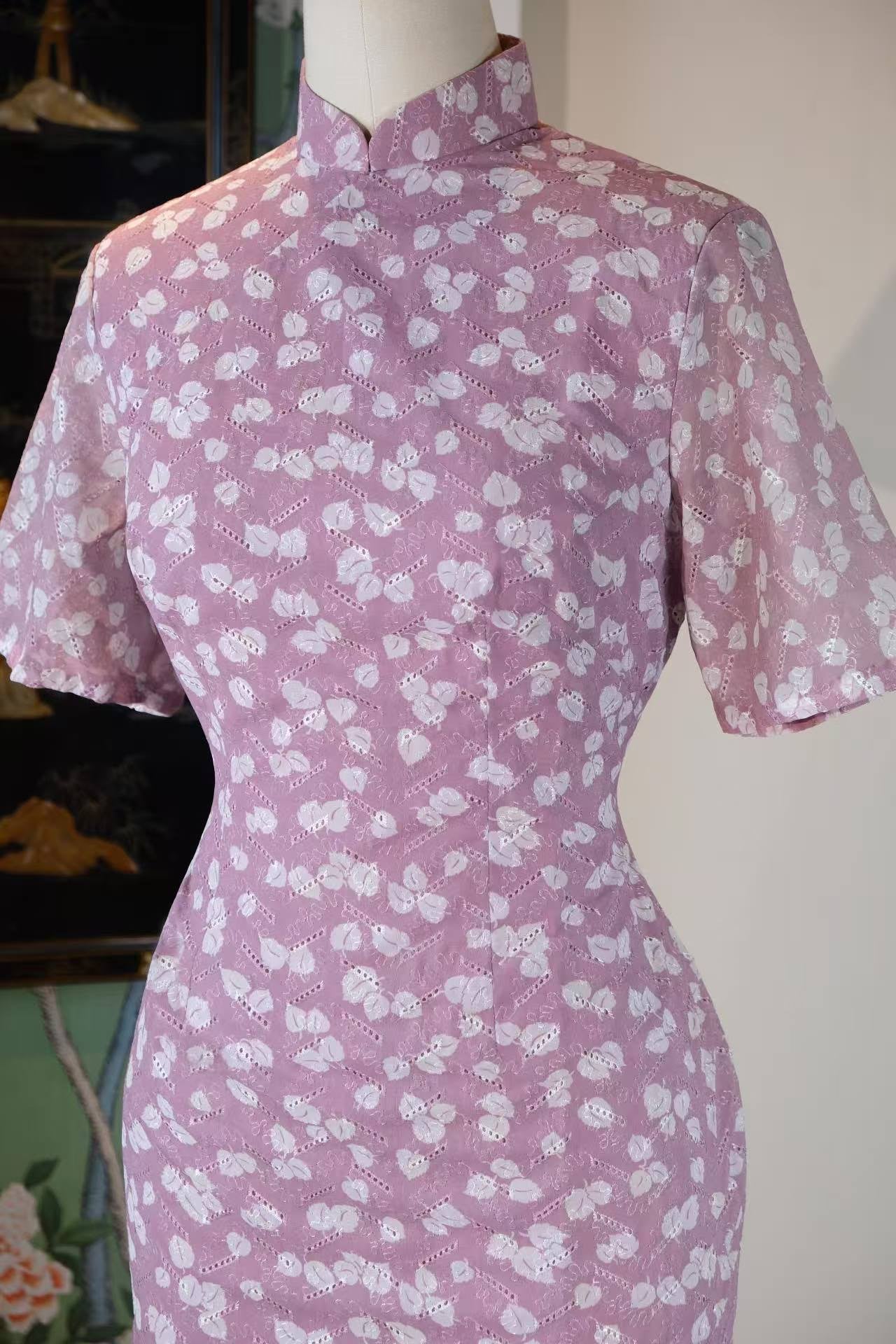
1960s Taiwan-Made Chiffon Printed Qipao: Whispers of Time in Dried Rose
The Palette of "Dusk Spring Cherry" "Her garments are exquisite, following the rhythm of the times." This 1960s antique qipao from Taiwan encodes the secrets of an era within its textures. Using "Dried Rose" as its canvas and machine-embroidered prints as its ink, it composes a narrative of Oriental aesthetics upon a base of light chiffon. This hue is not a vulgar pink, but a muted, gentle gray-tone—a result of crushing blooming roses into the folds of time. In the archives of Taiwan’s textile history, this specific shade is known as "Dusk Spring Cherry" (Mu-chun-ying), produced only in small batches between 1963 and 1967. Due to the scarcity of pigments and complex low-temperature fixing processes, it accounts for less than 5% of surviving qipaos from that period.
The Rhythms of Nature and Tradition The printed patterns outline the veins of white birch leaves, appearing with a hand-drawn asymmetry. The branching angles of the veins follow the "Golden Ratio," creating a visual rhythm described in traditional aesthetics as "Spacious enough to gallop a horse, yet dense enough to exclude a needle." Interspersed among the leaves are embroidered fractured fret motifs—variants of the ancient "Thunder Motif" (Lei-wen). While symbolizing "endless vitality" in the Book of Rites, in 1960s Taiwan, they served as cultural metaphors for "cherishing the past and looking toward the future."
Conclusion: An Amber of Frozen Time This dried-rose qipao is more than a pinnacle of 1960s Taiwanese textile craft; it is an amber of frozen time. It encapsulates the modern translation of Oriental beauty and the collective memory of a society finding its identity amidst the collision of East and West. When the fabric flutters, one can almost hear the rhythmic clatter of sewing machines on the streets of 1960s Taipei—a testament to a bygone elegance that makes history tactile and every leaf vein a vessel for an eternal Oriental story.