深圳溯源
Couldn't load pickup availability
织金刺玫瑰,暗夜绽芳华
这件旗袍的图案设计,是一场关于“光影与刺绣”的视觉游戏。
- 立体织金玫瑰:面料上盛开的并非平面的印花,而是以“织金”
- 烧花工艺的“虚实相生”:运用了六十年代经典的“烧花”技术,
- 缠枝构图:玫瑰花并非孤立存在,而是以“缠枝”的形式布满全身。
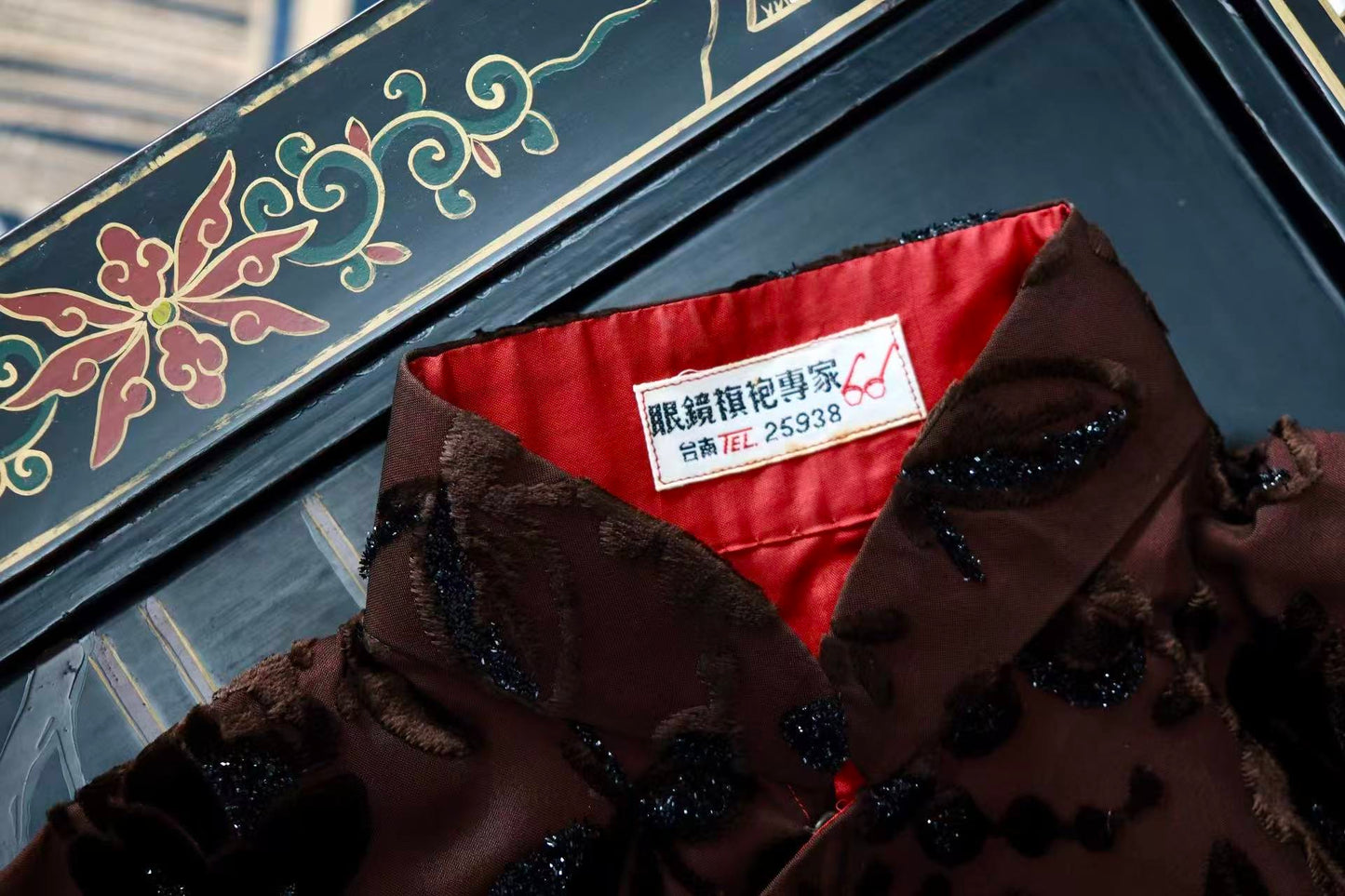
这件旗袍的领标——“眼镜旗袍专家”,
- “专家”的隐喻:在五六十年代的台湾,旗袍是女性衣橱中的“
- 面料的时代烙印:六十年代,台湾纺织业开始腾飞,这种“
若要用一句诗来形容这件旗袍,“夜色温柔藏刺骨,
- 稀缺性:这种高密度的织金烧花丝绒,如今已极难复刻。
- 故事感:这件旗袍的主人,想必是一位有故事的女性。
这是一件“穿在身上的艺术品”。
Golden-Woven Thorns, Roses Blooming in the Deep of Night
The pattern design of this cheongsam is a visual game of "light, shadow, and embroidery."
Three-Dimensional Golden-Woven Roses: The blossoms on the fabric are not flat prints but three-dimensional black roses crafted through a "Golden-Weaving" (Zhi Jin) process. Utilizing the unique properties of velvet, the artisan has rendered the curl of each petal and the veins of every leaf with lifelike precision. These black roses are not a flat, static black; they are infused with gradients of deep navy and ink-green. Under the light, they emit a profound luster akin to obsidian—like thorned roses blooming quietly in the dead of night.
The Interplay of "Void and Substance" via Devoré: This piece employs the classic 1960s "Burn-out" (Devoré) technique. The background velvet retains its long pile, presenting a matte, dark umber base. In contrast, the roses and foliage have undergone a "pile-burning" process where the fibers are shortened, leaving the metallic threads exposed. This contrast between the "long pile (substance)" and the "short pile (void)" makes the roses appear to float upon a dark brown midnight sky, achieving a texture reminiscent of an oil painting.
The "Entwined Branch" Composition: The roses do not exist in isolation; they cover the garment in a "Trailing Branch" (Chanzhi) motif. The vines meander and twist, linking the blossoms into a continuous scroll, symbolizing "endless vitality" and "uninterrupted prosperity."
The collar label—"Spectacles Qipao Expert" (Yanjing Qipao Zhuanjia)—is a microcosm of the craftsmanship of that era.
The Metaphor of the "Expert": In 1950s and 60s Taiwan, the cheongsam was a woman's "battle armor." The term "Spectacles Expert" typically referred to those veteran tailors who wore glasses, hunched over their cutting tables, obsessing over the precision of every millimeter. They were masters not only of traditional iron-work techniques like "pushing, stretching, and shrinking" (Tui, Gui, Ba) but were also adepts at "bespoke tailoring" based on the specific curves of a client's body.
The Imprint of an Era: As the Taiwanese textile industry began to soar in the 1960s, this "Burn-out Velvet" became the darling of high-end custom tailoring. It was more modern than traditional brocade and more opulent than cotton or linen. By choosing a deep brown base with black golden-woven roses, this cheongsam abandoned the pastel tones of the 1950s in favor of a mature, mysterious, and slightly exotic "Vintage Luxury" style.
If one were to use a poem to describe this cheongsam, it would be: "The night is tender, hiding bone-deep thorns; a magnificent gown for a dream that never ends."
Rarity: This high-density golden-woven devoré velvet is extremely difficult to replicate today. The machinery and dye processes of that era created a unique colorfastness and luster that has not faded or whitened after half a century—a truly rare find.
The Sense of Story: The original owner of this cheongsam must have been a woman with a storied past. Perhaps she was a socialite dancing in a ballroom on Taipei’s Zhongshan North Road, or a hostess entertaining guests in her parlor. This garment has witnessed the prosperity and transformation of Taiwanese society; every fold hides a whisper of old times.
This is a "wearable work of art." It is more than a testament to the high-end bespoke craftsmanship of 1960s Taiwan; it is a visual poem dedicated to the "Black Rose." In an age of rampant fast fashion, such an antique piece—condensing the heart of the artisan and the beauty of time—is undoubtedly a unique treasure to be cherished.