深圳溯源
Couldn't load pickup availability
衣服尺寸:
胸围/腰围/臀围:94/78/100 厘米
衣长:98 厘米
细节描述:
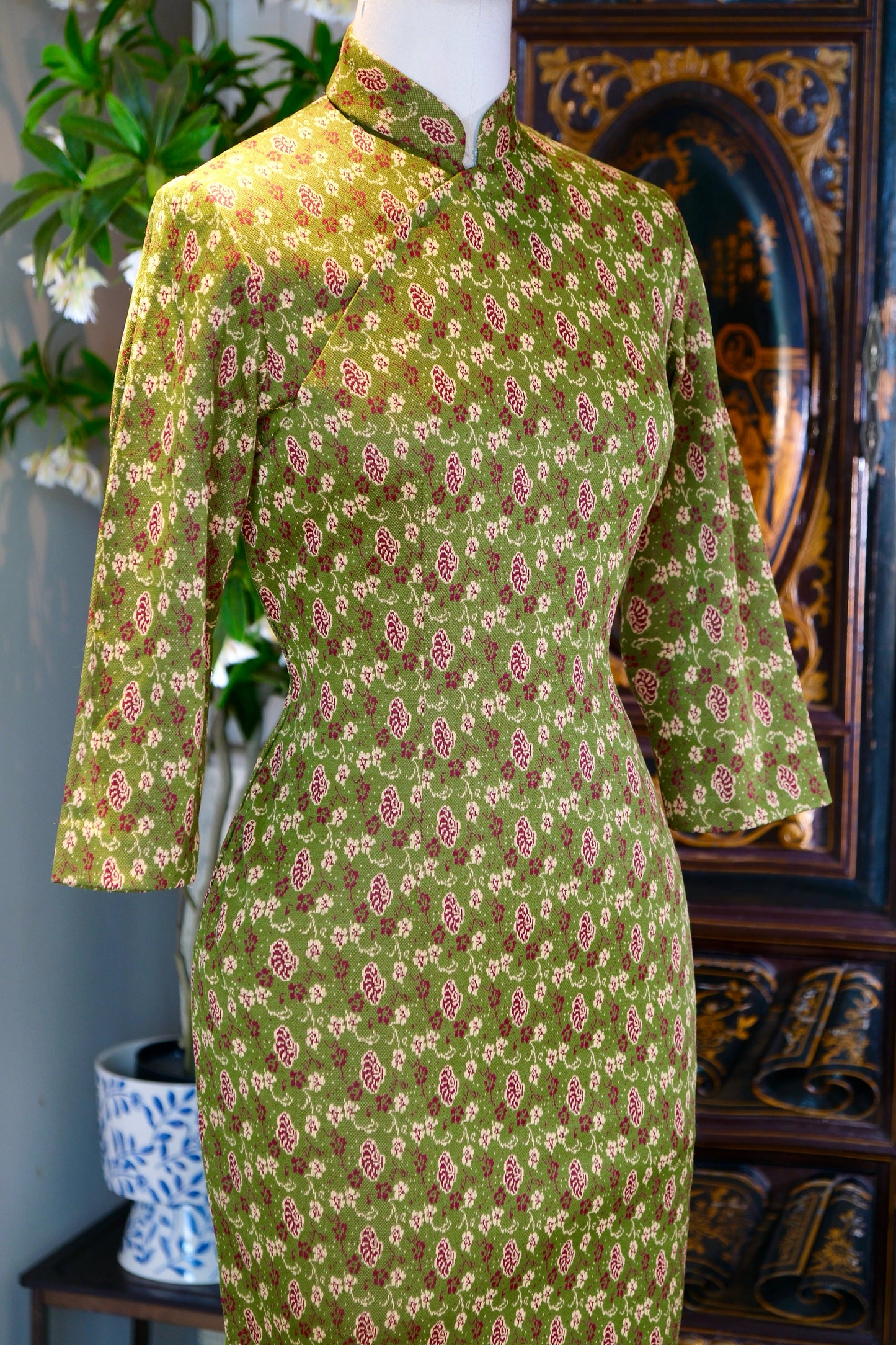
一、图案描述:南洋风情的织锦诗篇
这件旗袍的面料以橄榄绿为底,密布着红白相间的缠枝花卉纹样,仿佛将热带雨林的生机凝于方寸之间。主图案为对称排列的抽象花簇,红蕊白瓣,间以细碎藤蔓连接,形成“万紫千红总是春”的视觉韵律。这种纹样在六十年代台湾纺织业中被称为“南洋锦”,灵感源自东南亚传统蜡染工艺,通过针织技术实现了比丝绸更富弹性的肌理,既保留了东方纹样的典雅,又融入了殖民时期传入的西方植物学图谱的写实感。
二、古董衣的故事:时代浪潮中的女性剪影
六十年代的台湾,正处于战后经济复苏与文化重构的交汇点。这件旗袍诞生于台北大稻埕的针织工坊,彼时台湾纺织业以“外销导向”为政策核心,大量采用日本进口的针织机械,生产出兼具实用性与时尚感的成衣。旗袍的版型已脱离三十年代的海派宽袍大袖,转而贴合人体曲线,七分袖与及膝长度,既呼应了国际时尚界的“新风貌”(New Look)潮流,又保留了中式立领的传统符号。
据《台湾纺织工业史》记载,1965年台湾针织品出口额首次突破千万美元,此类旗袍多销往东南亚华侨社群,成为海外华人身份认同的载体。面料中的橄榄绿,在当时被称为“军绿变奏”,暗合了冷战时期台湾社会的特殊氛围——既需保持警惕,又渴望在压抑中绽放生机。
三、艺术风格与稀缺性:针织技术的诗性革命
从艺术风格而言,这件旗袍堪称“东西方美学的缝合体”。其纹样布局遵循中国传统“满地锦”的构图法则,却以针织的经纬交错替代了刺绣的立体感,形成“远观如绣,近看似织”的视觉错觉。针织面料的弹性,使旗袍无需像丝绸旗袍那样依赖归拔工艺即可贴合身形,这种“以技代艺”的创新,正是六十年代台湾服装工业“技术美学”的体现。
稀缺性方面,台湾针织旗袍的存世量远低于同时期的香港或上海制品。原因在于:其一,针织面料易老化,保存难度大;其二,六十年代台湾旗袍多作为日常穿着,损耗率高;其三,此类“南洋锦”纹样仅在1963-1967年间短暂流行,后因地缘政治变化导致原料断供而停产。据台北故宫纺织文物库统计,完整保存的六十年代台湾针织旗袍不足百件,且多藏于私人收藏家手中。
四、引经据典:衣以载道的文化密码
《周易·系辞下》有言:“黄帝、尧、舜垂衣裳而天下治”,服饰从来是文明的镜像。这件旗袍的立领,暗合《礼记·深衣》中“袂圆以应规,曲袷如矩以应方”的礼制思想;而其弹性面料,则呼应了六十年代台湾社会“在传统中求变”的集体心态。正如服装史学家扬之水在《中国古代服饰研究》中所言:“旗袍的演变,是一部穿在身上的现代史。”
今日重观这件旗袍,其价值不仅在于“古董”的时间标签,更在于它承载了台湾纺织工业的崛起记忆、南洋华侨的文化乡愁,以及针织技术对传统服饰语言的革新。它是橄榄绿上的南洋花语,是时代浪潮中永不褪色的女性剪影,更是我们触摸历史温度的一扇窗。
Measurements / Size Guide:
Bust / Waist / Hips: 94/78/100 cm
Total Length: 98 cm
Detailed Description:
The fabric of this Qipao features an olive green base, densely populated with interlocking red and white floral motifs, as if condensing the vitality of a tropical rainforest within a few square inches. The primary pattern consists of symmetrically arranged abstract flower clusters with red stamens and white petals, connected by delicate, sprawling vines, creating a visual rhythm of "a myriad of purples and a thousand reds always signify spring." In the 1960s Taiwanese textile industry, this pattern was known as "Nanyang Brocade" (South Seas Brocade). Inspired by traditional Southeast Asian Batik techniques, it achieved a more elastic texture than silk through knitting technology, preserving Oriental elegance while integrating the realism of Western botanical illustrations introduced during the colonial period.
Taiwan in the 1960s stood at the crossroads of post-war economic recovery and cultural reconstruction. This Qipao was born in the knitting workshops of Dadaocheng, Taipei. At that time, the Taiwanese textile industry centered on "export-oriented" policies, utilizing a large number of imported Japanese knitting machines to produce ready-to-wear garments that combined practicality with fashion. The silhouette had departed from the wide robes and large sleeves of the 1930s Shanghai style, shifting toward a form-fitting curve. The three-quarter sleeves and knee-length hem echoed the international "New Look" trend while retaining the traditional symbol of the Chinese mandarin collar.
According to the History of the Taiwan Textile Industry, Taiwan's knitwear exports first exceeded ten million USD in 1965. Such Qipaos were largely sold to overseas Chinese communities in Southeast Asia, becoming a carrier of identity for the Chinese diaspora. The olive green of the fabric, known at the time as a "military green variation," subtly reflected the unique atmosphere of Cold War-era Taiwan—a society that needed to remain vigilant yet yearned to bloom amidst suppression.
Artistically, this Qipao can be called a "sutured body of Eastern and Western aesthetics." Its pattern layout follows the traditional Chinese "All-over Brocade" (Mandi Jin) composition rule but replaces the three-dimensional feel of embroidery with the interlacing warp and weft of knitting, creating a visual illusion of "looking like embroidery from afar, but revealing its knit structure up close." The elasticity of the knitted fabric allowed the Qipao to fit the body without relying on the traditional "Gui-Ba" (stretching and shrinking) ironwork required for silk. This innovation of "replacing art with technology" is a manifestation of the "technical aesthetics" of the 1960s Taiwanese garment industry.
Regarding rarity, the surviving number of Taiwanese knitted Qipaos is far lower than that of contemporary Hong Kong or Shanghai pieces. The reasons are threefold: first, knitted fabrics age easily and are difficult to preserve; second, 1960s Taiwanese Qipaos were mostly worn as daily attire, leading to high wear and tear; third, this specific "Nanyang Brocade" pattern was only briefly popular between 1963 and 1967, after which production ceased due to raw material shortages caused by geopolitical changes. According to the textile archives of the Taipei Palace Museum, fewer than a hundred 1960s Taiwanese knitted Qipaos remain in complete condition, mostly held by private collectors.
The Book of Changes (I Ching) states: "The Yellow Emperor, Yao, and Shun allowed their robes to hang down, and the world was well-governed." Clothing has always been a mirror of civilization. The mandarin collar of this Qipao aligns with the ritualistic thought in the Book of Rites: "The sleeves are round to correspond with the compass; the curved collar is square to correspond with the carpenter's square." Meanwhile, its elastic fabric echoes the collective mindset of "seeking change within tradition" in 1960s Taiwanese society. As fashion historian Yang Zhishui noted in Research on Ancient Chinese Costume: "The evolution of the Qipao is a modern history worn on the body."
Revisiting this Qipao today, its value lies not only in the "vintage" time label but in its embodiment of the rise of Taiwan’s textile industry, the cultural nostalgia of Nanyang Chinese, and the innovation of traditional costume language through knitting technology. It is a floral language of the South Seas on olive green, a never-fading female silhouette in the tides of time, and a window through which we can touch the warmth of history.