深圳溯源
Couldn't load pickup availability
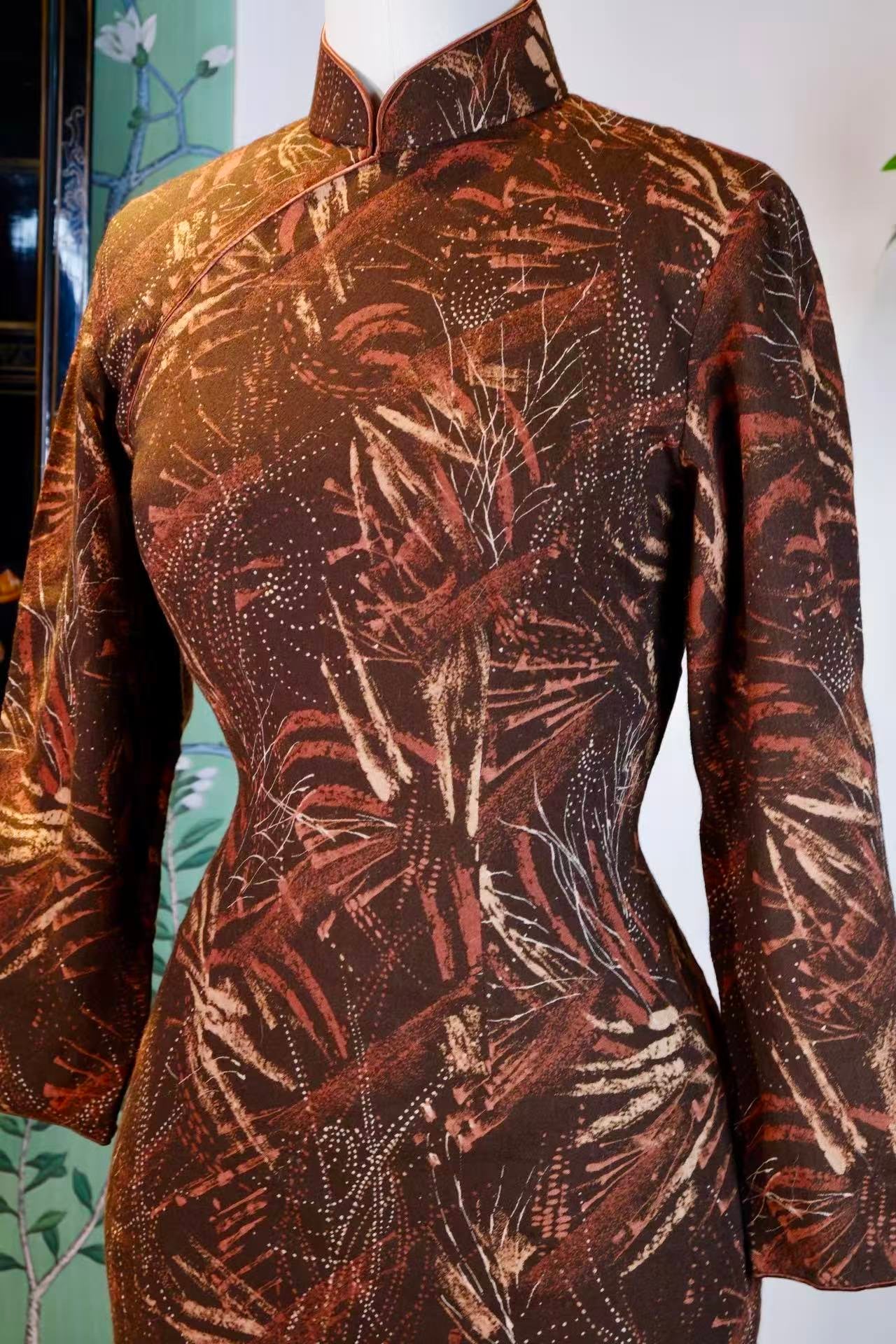
六十年代台湾喷绘抽象几何旗袍:墨色淋漓处,藏着半部离岛风云
一、图案考释:墨色淋漓的抽象诗学
这件旗袍的纹样堪称“东方抽象主义的先声”,以深褐为底色,
这种“似与不似之间”的抽象表达,与六十年代台湾现代诗派的“
二、古董衣叙事:离岛风云中的时尚切片
这件旗袍诞生于1960年代的台湾,
不同于传统手工印花的规整,喷绘以气压将染料雾化喷洒于布面,
三、艺术风格与稀缺性:抽象水墨的孤品价值
从艺术史的维度看,这件旗袍的抽象几何纹样,可视为“
其稀缺性更不容忽视:
结语:墨色深处,见时代魂魄
当指尖抚过这件旗袍的丝绸表面,
The motifs on this cheongsam can be hailed as a "harbinger of Oriental Abstractionism." Set against a deep umber base—reminiscent of Xuan paper saturated with the ink-stains of time—the airbrushed geometric lines and stippled elements are neither purely representational nor strictly Western Constructivism. Instead, they use the "white space" (liubai) and "flying white" (feibai) of traditional Chinese calligraphy as their skeletal frame, deconstructing the cun (texture stroke) methods of landscape painting into a modern geometric rhythm.
Those seemingly casual brownish-black strokes actually align with the "hemp-fiber strokes" (pima cun) found in the Manual of the Mustard Seed Garden, as if the ruggedness of Taihu rocks and the sinuous curves of withered branches have been frozen onto the fabric via airbrushing. Meanwhile, the scattered white stippled patterns act as a variation of Mi Fu’s "Mi dots" (midian cun), or perhaps the pearled tassels of Feitian (flying apsaras) from Dunhuang murals, leaping like sparks of light against the somber ground.
This abstract expression—residing in the liminal space between "likeness and unlikeness"—echoes the Surrealist currents of the 1960s Taiwanese Modernist Poetry school. Much like Zheng Chouyu’s famous line, "I pass through south of the Yangtze / That face waiting in the seasons, like the blooming and wilting of the lotus," the patterns drift between the concrete and the abstract. They preserve the restraint of Oriental aesthetics while utilizing the spontaneity of airbrushing to grant each garment a unique vitality. The matte luster of the fabric ripples through the ink-tones, as if the very moment of ink diffusing on paper has been captured in a still frame, allowing the viewer to glimpse the poetic essence of "ink so drenched the screen remains wet."
Born in 1960s Taiwan, this cheongsam emerged during a singular historical transition. At that time, a massive influx of textile artisans and qipao masters from the Jiangsu-Zhejiang-Shanghai region brought the "Haipai" (Shanghai-style) techniques to cities like Taipei and Kaohsiung. Simultaneously, international fashion trends—Parisian abstraction and New York Pop Art—flowed in via the U.S. military presence and the wave of overseas students, catalyzing a unique aesthetic of "Sino-Western fusion and the blending of old and new."
Unlike the rigid regularity of traditional hand-printing, airbrushing uses air pressure to atomize dye onto the fabric. This creates an ink-wash gradient effect and a geometric randomness that not only reduced production costs but also endowed the qipao with a "modern industrial" vitality. This technique was a "vanguard experiment" in the Taiwanese textile industry of the era, frequently seen in "Oriental Style" garments intended for European and American export markets. As a surviving antique, this piece is an invaluable material witness to that "Island Fashion History"—it carries the memory of the mainland immigrants’ ancestral landscapes (the ink-wash imagery) while reflecting Taiwan’s local exploration of modernity (the abstract geometric expression).
From the dimension of art history, the abstract geometric patterns of this qipao can be viewed as an early practice of "Oriental Abstract Art." In the 1960s Taiwanese art scene, represented by the "Ton-Fan Art Group" (Dongfang Huahui), artists were attempting to synthesize traditional Chinese brushwork with Western Abstract Expressionism. The airbrushed patterns of this qipao form a cross-media dialogue with those painterly explorations: the seemingly erratic brushstrokes are, in fact, a modern translation of "rhythmic vitality" (qiyun shendong) and a technical reconstruction of "treating white space as black" (ji bai dang hei). With silk as the medium, the "fluidity" of ink and the "order" of geometry reach a delicate equilibrium, elevating the piece beyond a utilitarian garment into a piece of wearable abstract ink-wash art.
Its rarity is equally undeniable. The nature of airbrush printing ensures that every finished product possesses subtle variations in pattern. After sixty years of time, the texture of the silk, the settling of the ink, and the traces of the craft have coalesced into an unrepeatable historical patina. Given that 1960s Taiwanese qipaos were mostly bespoke or produced in small batches, well-preserved airbrushed abstract pieces are exceptionally rare. It is not merely a cheongsam; it is a "materialized cultural memory," documenting an era of aesthetic transition, technical innovation, and historical winds.
When one's fingertips brush the silk surface of this qipao, it is as if the temperature of 1960s Taiwan can be felt: it is the nostalgia of the Jiangnan artisan, the modernist aspirations of the island’s youth, and the stubborn growth of Oriental aesthetics amidst the fractures of time. Its inky patterns serve as a wordless chronicle, recounting through abstract strokes the proposition of "how tradition marches toward modernity." Its very existence is the finest interpretation of "fashion as history"—amidst the drenched ink, we see not only the elegant silhouettes of half a century ago but also a nation’s persistence in beauty and its guardian-like devotion to culture.