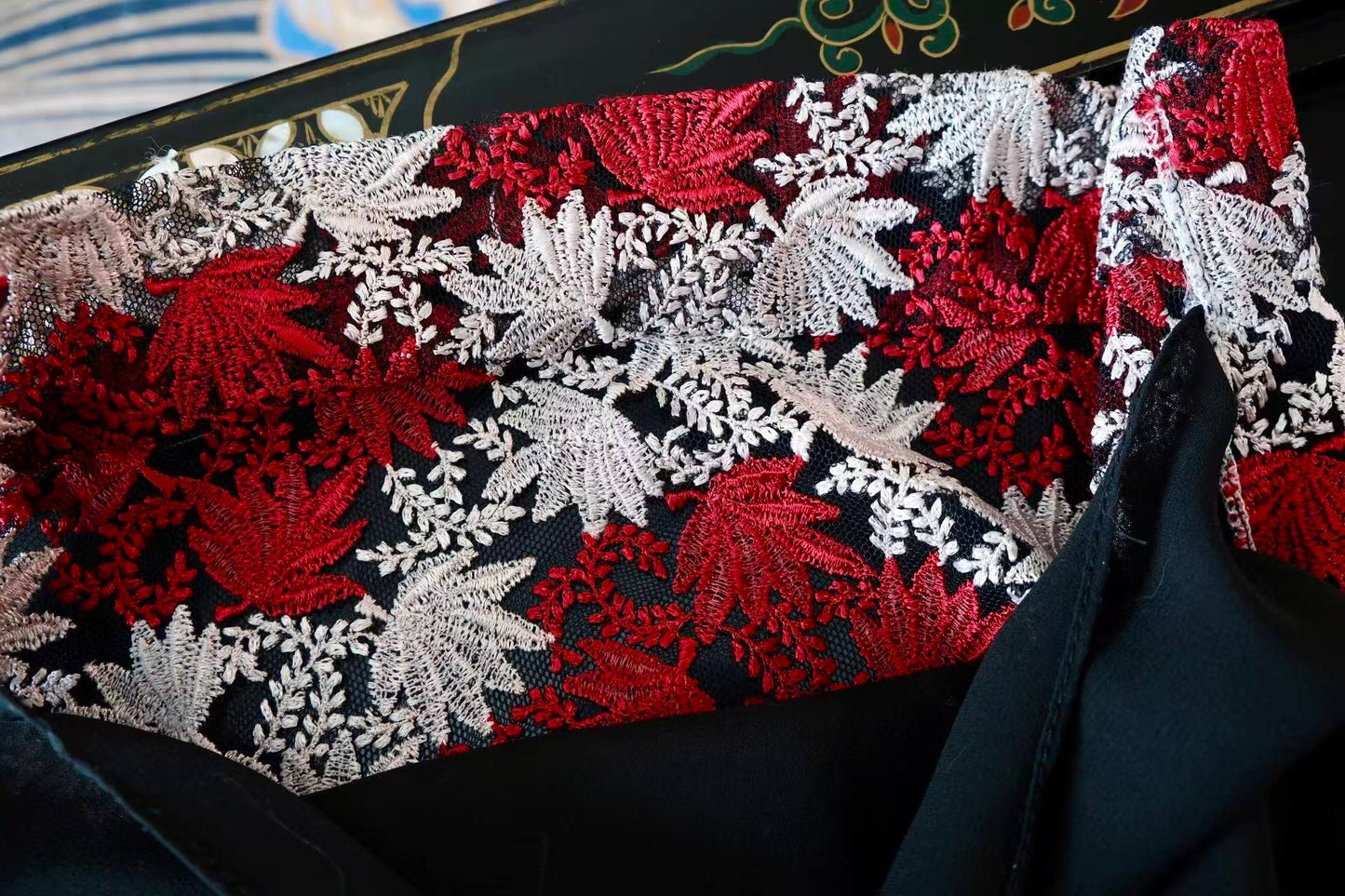
六十年代台湾机器绣花蕾丝旗袍:经纬间的枫雅诗笺
“一针一线皆风骨,半幅红绡寄锦书。”
这件尘封于上世纪六十年代的台湾产古董旗袍,以机器绣花蕾丝为骨,以枫叶纹样为魂,将东方婉约与时代匠心凝于方寸之间。其面料采用当时先进的机器蕾丝工艺,以黑纱为底,红白两色丝线交织出层叠枫叶,宛如《诗经》中“山有嘉卉,侯栗侯梅”的秋日盛景——赤枫如丹霞落人间,素枫似霜雪染枝头,疏密相间,错落成韵,恰合《文心雕龙》“摛文必在纬军国,负重必在任栋梁”之匠心独运。
“枫叶荻花秋瑟瑟,江州司马青衫湿。” 白居易笔下的枫叶,是羁旅之思,而此旗袍上的枫叶,却是时代风华的缩影。六十年代的台湾,传统工艺与现代技术碰撞,机器绣花蕾丝既保留了手工刺绣的细腻,又以工业时代的精准勾勒出枫叶的脉络:每片红枫如火焰燃烧,每片素枫似月光凝霜,经纬交错间,仿佛可见《考工记》所言“天有时,地有气,材有美,工有巧”的造物智慧。
“锦瑟无端五十弦,一弦一柱思华年。” 这件旗袍的稀缺性,不仅在于其年代久远,更在于其工艺的不可复制性。机器绣花蕾丝需以精密机械牵引丝线,在薄如蝉翼的黑纱上绣出立体枫叶,稍有偏差便前功尽弃。而红白双色丝线的渐变过渡,更需匠人对色彩与力度的极致把控,正如《天工开物》所载“凡丝缕之细,必以机杼运之”,每一针都是对“工巧”的极致追求。
“罗衣何飘飘,轻裾随风还。” 当旗袍轻垂于身,枫叶纹样随步履流转,恍若《洛神赋》中“翩若惊鸿,婉若游龙”的灵动。
这件旗袍,是时光的信物,是工艺的绝唱,更是东方美学的永恒诗篇。它不单是一件衣裳,更是一卷流动的史书,记录着六十年代台湾的工艺巅峰,诉说着枫叶纹样背后的东方哲思。“欲买桂花重载酒,终不似,少年游。” 惟有这件旗袍,能让我们在百年后,触摸到那个时代的温度与风华。
1960s Taiwanese Machine-Embroidered Lace Qipao: A Poetic Script of Maple Grace Within Warp and Weft
"Every stitch carries character; half a length of red silk conveys a letter from afar."
This antique Qipao from 1960s Taiwan, sealed by time, takes machine-embroidered lace as its bone and maple leaf motifs as its soul, condensing Oriental grace and era-defining ingenuity into every square inch. The fabric utilizes what was then advanced machine-lace technology, with a black gauze base where red and white silk threads interweave to create cascading maple leaves. It evokes the autumn splendor described in The Classic of Poetry: "On the mountain are fine plants—chestnuts and plums." The crimson maples fall like cinnabar clouds upon the earth, while the plain white leaves resemble frost-dyed branches—sparse yet rhythmic, echoing the masterful craftsmanship praised in The Literary Mind and the Carving of Dragons.
"Maple leaves and reed flowers rustle in autumn; the Qing-shan of the Sima of Jiangzhou is wet with tears." The maple leaves in Bai Juyi’s poetry signify the melancholy of a traveler, but the maples on this Qipao are a microcosm of an era's elegance. In 1960s Taiwan, traditional craft collided with modern technology. Machine-embroidered lace preserved the delicacy of hand embroidery while tracing the veins of the maple leaves with industrial precision. Each red leaf burns like fire, and each white leaf glimmers like moonlight on frost. Within the interlacing warp and weft, one can see the creative wisdom of Kao Gong Ji: "The seasons of Heaven, the energy of Earth, the beauty of materials, and the skill of the artisan."
"The patterned lute, for no reason, has fifty strings; each string, each bridge, brings thoughts of the flowering years." The scarcity of this Qipao lies not only in its age but in the irreproducibility of its craft. Machine embroidery on lace required precision machinery to guide silk threads across black gauze as thin as a cicada’s wing; the slightest deviation would ruin the entire piece. The gradient transition between red and white threads demanded an artisan’s ultimate control over color and tension—as recorded in Tiangong Kaiwu: "The fineness of silk threads must be guided by the loom." Every stitch is a pursuit of the pinnacle of "skillful craft."
"How the silken robes flutter; the light skirts return with the wind." When the Qipao drapes over the body and the maple patterns shift with each step, it captures the spirit of the Ode to the Nymph of the Luo River: "As light as a startled swan, as graceful as a swimming dragon."
This Qipao is a keepsake of time, a swan song of craftsmanship, and an eternal poem of Oriental aesthetics. It is not merely a garment but a flowing volume of history, recording the peak of 1960s Taiwanese craft and speaking of the Oriental philosophy behind the maple motif. "I wish to buy osmanthus flowers and carry wine again, but it will never be like the travels of youth." Only this Qipao allows us, a century later, to touch the warmth and elegance of that era.