深圳溯源
Couldn't load pickup availability
衣服尺寸:
胸围/腰围/臀围:98/90/104 厘米
衣长:107 厘米
细节描述:
一、图案解码:机绣工艺下的“旋纹密码”
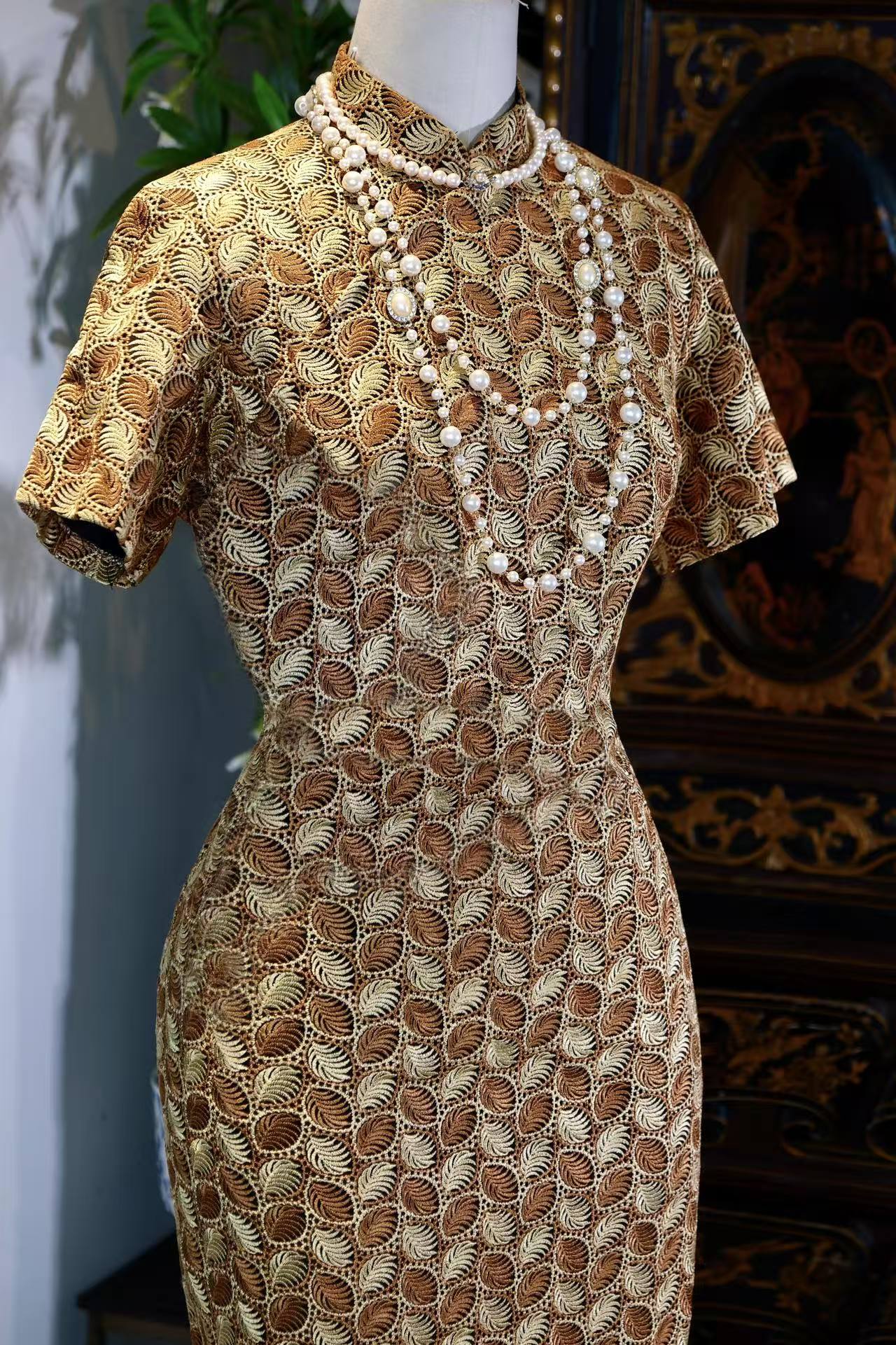
这件上世纪六十年代的台湾产古董旗袍,以金棕双色为主调,满铺的机绣纹样堪称视觉焦点。细观其纹,是由无数“旋涡状单元”紧密排列而成——每一单元似卷曲的叶片,又若抽象的浪花,棕色调沉稳如大地,在光线下明暗交错,仿若将“风拂叶动”的动态凝固于织物之上。
彼时台湾纺织业正处“传统工艺与现代机械融合”的转型期,机绣虽借机械之力,却未失手工温度:针脚细密如织,纹样单元大小均一,却又因金棕双色线的渐变过渡,避免了机械生产的呆板,反而呈现出“规整中见灵动”的艺术效果。这种“旋纹”设计,既暗合传统纹样中“卷草纹”的绵延意象,又融入六十年代现代主义对“抽象几何”的追求,是时代审美碰撞的鲜活注脚。
二、古董衣叙事:台海之间的服饰记忆
六十年代的台湾,旗袍仍是女性日常与社交场合的核心着装。彼时大陆旗袍工艺随迁徙者传入台湾,与本土纺织技术结合,催生出“台产旗袍”的独特风貌——这件旗袍便是例证:它诞生于台湾纺织厂(从机绣工艺的标准化与面料质感可推断),却承袭了海派旗袍的修身剪裁:立领贴合脖颈线条,短袖露出纤细腕骨,腰身收束自然,下摆微收至膝下,完美勾勒女性曲线,既保留传统旗袍的典雅,又因“短袖+中长款”的设计适配亚热带气候,尽显“在地化”巧思。
更难得的是其稀缺性:六十年代台湾机绣旗袍虽非孤品,但完整保存至今且纹样如此精巧者,实属凤毛麟角。彼时纺织面料多以棉、人造丝为主,经岁月侵蚀易褪色、脆化,而这件旗袍金棕色彩仍饱满,机绣纹样无明显断线,足见当年工艺的扎实,也暗合《台湾纺织史》中“六十年代台产旗袍为‘外销创汇’主力,工艺标准严苛”的记载。
三、艺术风格与稀缺性:传统与现代的“时光标本”
从艺术风格看,它是“传统纹样现代化”的典范:旋涡纹的抽象化处理,跳脱了传统旗袍“花鸟龙凤”的具象束缚,以几何韵律呼应六十年代全球“简约主义”潮流;金棕双色的沉稳搭配,既符合东方“贵而不俗”的审美,又因金属光泽暗合西方“奢华感”表达,堪称“东西方美学对话”的织物载体。
其稀缺性更藏于细节:机绣工艺虽提升了生产效率,但六十年代台湾纺织厂多以“小批量、多款式”生产,这类“满铺旋纹+金棕配色”的设计,大概率是为特定客户(如侨胞、外宾)定制的“高端款”,产量本就有限。加之半世纪时光冲刷,能留存至今且品相完好者,不仅是服饰,更是研究“六十年代台海服饰史、纺织工艺史”的活标本——正如《中国旗袍史》所言:“古董旗袍的价值,不在‘衣’,而在其承载的时代审美、工艺脉络与文化记忆。”
当指尖抚过金棕旋纹,仿佛触到了六十年代台湾街巷的风:穿这件旗袍的女子,或许曾踏着木屐走过迪化街的布行,或许曾在台北的咖啡馆里,以珍珠项链搭配它,成为时代风景里的一抹雅韵。如今,这件古董旗袍静立,却仍在诉说一个关于“传统与现代、地域与时代”的未尽故事。
Measurements / Size Guide:
Bust / Waist / Hips: 98/90/104 cm
Total Length: 107 cm
Detailed Description:
This 1960s Taiwanese antique cheongsam (qipao) features a dominant golden-brown palette, with its all-over machine-embroidered patterns serving as the visual anchor. Upon closer inspection, the design is composed of countless "swirl-shaped units" arranged in a dense, rhythmic order—each unit resembling a curled leaf or an abstract wave. The steady brown tones shift between light and shadow, as if the dynamic movement of "wind brushing through leaves" has been solidified onto the fabric.
During this period, Taiwan’s textile industry was in a transitional phase of "merging traditional craft with modern machinery." Although machine-driven, the embroidery retains a sense of artisanal warmth: the stitches are as fine as weaving, and the uniformity of the units avoids the rigidity of mass production through the subtle gradient of golden and brown threads. This "swirl" design echoes the continuous imagery of traditional "Scrolling Grass" (Juan Cao Wen) while embracing the 1960s modernist pursuit of "geometric abstraction"—a vivid footnote to the collision of era-specific aesthetics.
In the 1960s, the qipao remained the core attire for Taiwanese women in both daily and social settings. As craftsmanship from mainland China migrated to the island, it merged with local textile technology to create the unique "Taiwan-made Qipao" style. This garment is a prime example: born from a Taiwanese mill (evident from the standardized embroidery and fabric texture), yet inheriting the slim-fit tailoring of the "Shanghai style." The standing collar fits the neckline perfectly, short sleeves expose slender wrists, and the waist is naturally cinched. The hem, tapering slightly below the knee, preserves traditional dignity while the "short-sleeved, mid-length" design adapts to the subtropical climate—a stroke of "localized" ingenuity.
Its scarcity is particularly noteworthy. While machine-embroidered qipaos were not unique at the time, specimens that remain perfectly intact with such intricate patterns are "phoenix feathers." Fabrics then were primarily cotton or rayon, prone to fading and embrittlement over decades. Yet, the golden-brown colors here remain vibrant, and the embroidery shows no broken threads—testament to the solid craftsmanship of the era and aligning with records in the Textile History of Taiwan, which note that 1960s exports maintained rigorous quality standards.
From an artistic perspective, this is a model of "Modernized Traditional Motifs." The abstract treatment of the swirls breaks free from the literal constraints of "flowers, birds, dragons, and phoenixes," echoing the global "Minimalism" of the 1960s through geometric rhythm. The steady golden-brown pairing fulfills the Eastern aesthetic of "luxury without vulgarity," while the metallic luster aligns with Western expressions of "opulence"—a textile vessel for the dialogue between Eastern and Western aesthetics.
The rarity is hidden in the details. While machine embroidery improved efficiency, Taiwanese mills in the 60s often produced in "small batches and diverse styles." This specific "all-over swirl" design was likely a high-end model customized for specific clients (such as overseas Chinese or foreign guests). After half a century, it serves as a living specimen for studying the history of dress and textile technology in Taiwan—proving that the value of an antique qipao lies not in the "cloth," but in the aesthetic spirit and cultural memory it carries.
As fingertips brush over the golden-brown swirls, one can almost feel the breeze from a 1960s Taiwanese alley. The woman who wore this might have stepped through the fabric stalls of Dihua Street in her clogs, or paired it with a pearl necklace in a Taipei café, becoming a silhouette of grace in the scenery of her time. Today, this antique qipao stands silent, yet it continues to tell an unfinished story of tradition, modernity, and the resonance between region and era.