深圳溯源
Couldn't load pickup availability
衣服尺寸:
胸围/腰围/臀围:98/88/102 厘米
衣长:112 厘米
细节描述:
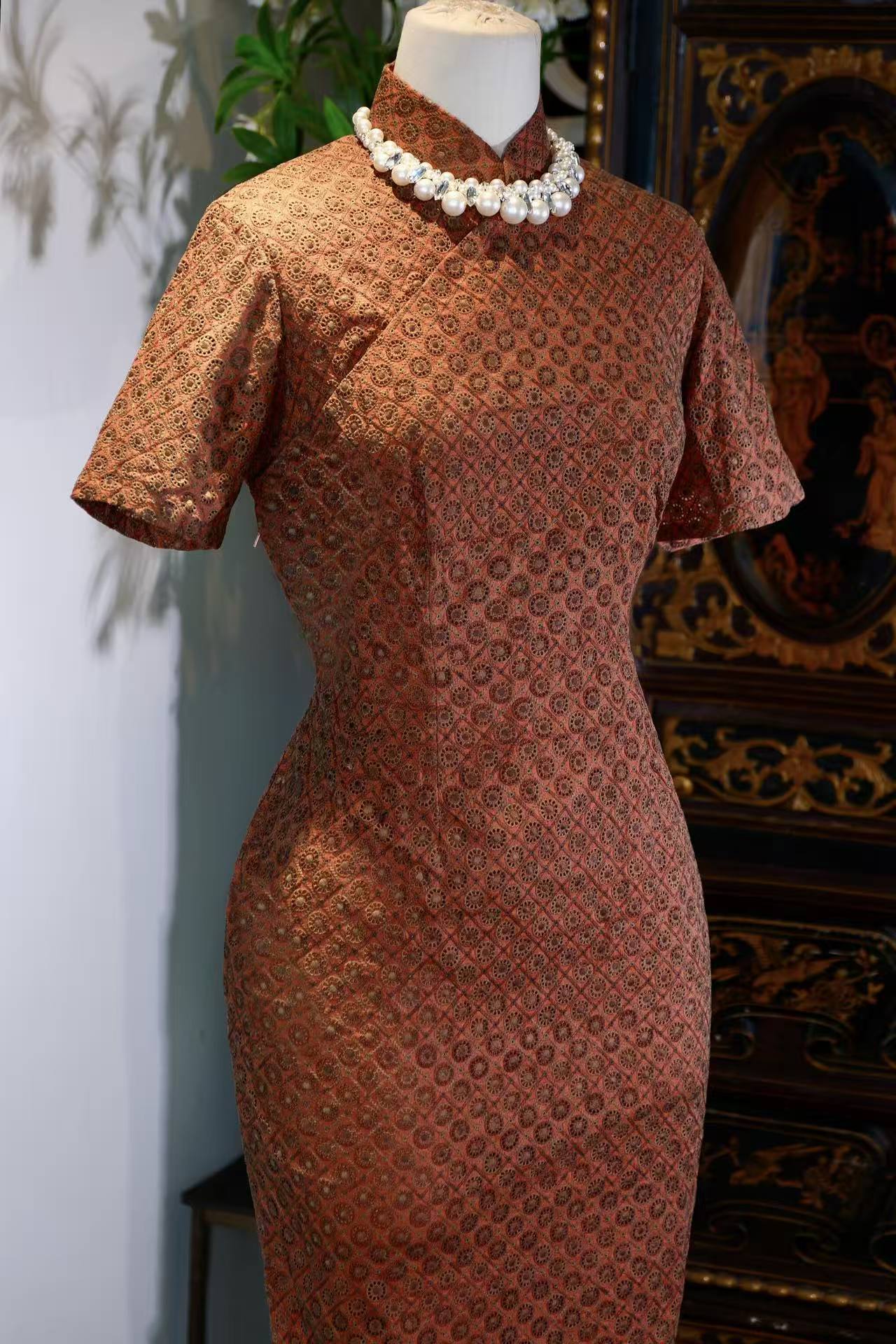
当指尖触到这件上世纪六十年代台湾产机绣蕾丝旗袍的刹那,仿佛触到了半世纪前的时光褶皱。这抹沉静的棕红,是岁月沉淀的温柔底色,其上机绣蕾丝织就的纹样,恰似古籍中走出的“菱花织锦”——细密的菱形网格间,团花纹样如星子散落,每一朵都藏着旧时光的精致与讲究。
一、纹样里的东方美学密码
旗袍上的图案,是传统与时代的精妙碰撞。菱形网格为骨,团花为魂,暗合《考工记》中“天有时,地有气,材有美,工有巧”的造物哲学。团花并非简单的重复,而是以“中心对称”的布局,在菱形格中演绎“四时有序”的东方韵律——或如盛开的牡丹,隐喻富贵安康;或似绽放的菊花,暗合“采菊东篱”的文人雅趣。机绣工艺虽非手工,却在六十年代的台湾,以工业时代的精准,复刻了传统刺绣的细腻,让每一针都带着“密而不乱,繁而有韵”的东方美学基因。
二、一件旗袍的迁徙史诗
这件旗袍的故事,要从六十年代的台湾说起。彼时,台湾旗袍在传承海派旗袍“修身、立领”精髓的同时,融入了海岛特有的温润与开放。机绣蕾丝的出现,是时代的选择:一方面,蕾丝作为西方舶来品,在旗袍上完成了“本土化”的蜕变,以东方纹样消解了西方的张扬;另一方面,机绣技术的普及,让旗袍从“贵妇专属”走向“闺阁日常”,却也因台湾当时纺织工业的初兴,留存下“半手工半机械”的独特质感——既有工业时代的效率,又未失手工时代的温度。
它或许曾属于一位书香门第的小姐,在台北的夏夜,伴着蝉鸣与茉莉香,穿着它赴一场友人的茶会;又或许曾是一位远嫁台湾的大陆女子,将旗袍作为嫁妆,把对故土的思念,缝进每一寸蕾丝的经纬里。岁月流转,它从台湾的衣橱,漂洋过海,最终落定在此,成为“时光的信使”,诉说着两岸旗袍文化的同源与流变。
三、稀缺性:不可复制的时代孤品
在古董旗袍的收藏谱系中,六十年代台湾产机绣蕾丝旗袍,是“稀缺”的代名词。彼时台湾旗袍产业虽盛,却因原材料(如进口蕾丝、特定染料)的有限,以及“过渡期”工艺的特殊性(机绣与手工的结合),留存至今的完整品极少。更难得的是,这件旗袍的版型,完美复刻了六十年代台湾旗袍的“改良特征”:立领高度适中,既保留东方含蓄,又方便日常活动;腰线略收,裙摆微开,恰合当时女性“温婉中见独立”的气质。
引《诗经》“有美一人,婉如清扬”来形容,这件旗袍的美,恰在于“清扬”——不张扬,不媚俗,以沉静的棕红、细腻的蕾丝、经典的版型,诠释着东方女性“内敛而优雅”的永恒魅力。它是时光的孤品,是文化的活化石,更是不可复制的“东方雅韵”。
若你愿将它收入衣橱,便是与半世纪前的时光对话,与一位素未谋面的佳人“隔空相拥”。它会在你的身上,续写新的故事,让六十年代的台湾风情,在当代的晨光里,再次绽放。
Measurements / Size Guide:
Bust / Waist / Hips: 98/88/102 cm
Total Length: 112 cm
Detailed Description:
The moment your fingertips brush against this 1960s Taiwanese machine-embroidered lace cheongsam (qipao), you feel the ripples of time from half a century ago. This tranquil brownish-red serves as a gentle base, mellowed by years of history; upon it, the machine-embroidered lace patterns resemble the "Rhombic Brocade" (Linghua Zhijin) described in ancient texts. Within the intricate diamond-shaped mesh, medallion motifs are scattered like stars, each concealing the refinement and deliberate care of days gone by.
The patterns on this qipao represent a masterful collision of tradition and era. The rhombic grid forms the skeleton, while the medallion blossoms provide the soul, aligning with the creation philosophy in the Artificers' Record (Kao Gong Ji): "Heaven has its seasons, Earth its vitality, materials their beauty, and craftsmanship its ingenuity." The medallions are not simple repetitions but employ a "centrally symmetrical" layout, interpreting the "order of the four seasons" within each rhombic cell. Some resemble peonies in full bloom, symbolizing prosperity; others are like chrysanthemums, echoing the literati’s reclusive elegance. Though machine-embroidered, the 1960s Taiwanese craftsmanship used the precision of the industrial age to replicate the delicacy of traditional needlework, ensuring every stitch carries the Eastern genetic code of "dense yet orderly, complex yet rhythmic."
The story of this qipao begins in 1960s Taiwan. At that time, Taiwanese qipaos inherited the essence of the "Shanghai style"—the slim fit and standing collar—while absorbing the island’s unique warmth and openness. The emergence of machine-embroidered lace was a choice of the era: lace, a Western import, underwent a "localization" metamorphosis, using Eastern motifs to dissolve Western flamboyance. Simultaneously, the popularization of machine embroidery allowed the qipao to move from the "exclusive domain of noblewomen" into "everyday boudoir attire." Yet, due to the nascent state of Taiwan’s textile industry, it retained a unique "semi-manual, semi-mechanical" texture—possessing industrial efficiency without losing the warmth of the artisanal age.
It might have belonged to a young lady from a scholarly family, wearing it to a tea party amidst the cicadas and jasmine scents of a Taipei summer night; or perhaps it was part of the dowry for a woman who moved from the Mainland to Taiwan, stitching her longing for her ancestral home into the very warp and weft of the lace. As time flowed, it drifted from a Taiwanese wardrobe across the seas, finally settling here as a "messenger of time," recounting the shared origins and divergent evolutions of qipao culture across the Strait.
In the lineage of antique qipao collecting, 1960s Taiwanese machine-embroidered lace is synonymous with "scarcity." Although the industry flourished then, complete specimens remain rare due to the limited availability of raw materials (such as imported lace and specific dyes) and the ephemeral nature of "transitional" craftsmanship. Even rarer is the silhouette of this piece, which perfectly replicates the "reformed characteristics" of the era: the standing collar is measured for moderate height, preserving Eastern modesty while allowing for daily movement; the waist is subtly cinched, and the hem flares slightly, matching the "gentle yet independent" temperament of women of that time.
To quote the Classic of Poetry: "There is a beautiful lady, graceful and free." The beauty of this qipao lies exactly in that "freedom"—neither ostentatious nor vulgar. With its quiet brownish-red, delicate lace, and classic cut, it interprets the eternal charm of the Eastern woman: "restrained yet elegant." It is a unique piece of time, a living fossil of culture, and an irreplaceable "Eastern Grace."
To add this to your wardrobe is to engage in a dialogue with time from half a century ago and to share a "distant embrace" with a lady you have never met. Upon you, it will continue to write new stories, letting the 1960s Taiwanese flair bloom once more in the morning light of today.