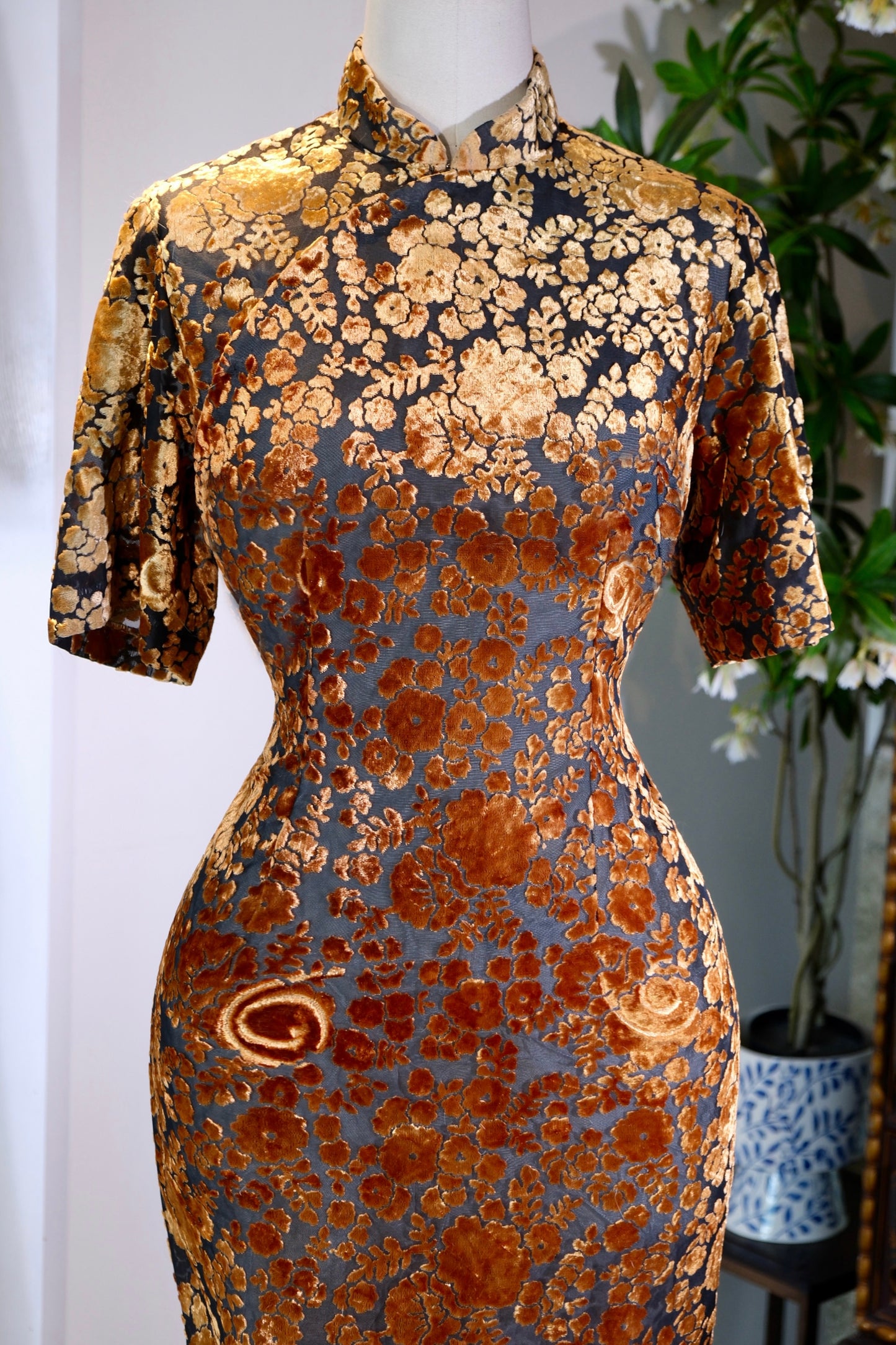
六十年代台湾烧花丝绒旗袍:金丝绣就的旧时月色
衣服尺寸:
胸围/腰围/臀围:100/92/106 厘米
衣长:108 厘米
细节描述:
这件六十年代台湾烧花丝绒旗袍,是时光在经纬间凝固的琥珀。其面料采用台湾特有的“烧花”工艺——以丝绒为底,经化学蚀刻后,暗纹处绒毛细密如苔,花纹处经纬通透若纱,形成“金丝浮于墨池”的视觉效果。细观其纹样,并非明清织锦的程式化缠枝,而是以写意笔法绣出的牡丹与月季:花瓣以金线盘绕出浮雕感,叶脉用银灰丝线勾出飞白,暗合了当时台湾纺织业“西学为体,中学为用”的创新——既保留传统“堆绫”工艺的立体感,又融入了西方 Art Deco 的几何韵律。
据《台湾纺织史稿》载,1950-1960年代台湾丝绒业曾因日本技术输入迎来黄金期,此类“烧花”面料多出口欧美,留存本土者凤毛麟角。这件旗袍的剪裁更显匠心:立领仅高4.5厘米,袖口微喇呈“荷叶边”雏形,腰身处收省线多达六道,完美贴合东方女性“S”型曲线,却又不似海派旗袍的张扬,反而透着台北贵妇特有的含蓄——正如作家白先勇笔下《台北人》里的贵妇,“穿着金线旗袍,连叹息都带着丝绒的闷响”。
稀缺性更在于其“不可复制性”:烧花工艺的蚀刻液配方早已失传,现存同款面料多因年代久远而脆化,唯有这件因曾被主人珍藏于樟木箱,至今仍保留着“绒毛细密如新,金线光泽如旧”的状态。它不仅是衣物,更是六十年代台湾纺织工业的活化石,是那个“旧时王谢堂前燕,飞入寻常百姓家”的时代里,最后一抹用金丝银线织就的旧时月色。
1960s Taiwanese Devoré Velvet Cheongsam: Old Moonbeams Woven in Gold
Measurements / Size Guide:
Bust / Waist / Hips: 100/92/106 cm
Total Length: 108 cm
Detailed Description:
This 1960s Taiwanese Devoré velvet cheongsam (qipao) is a piece of amber where time has solidified between the warp and weft. Its fabric employs Taiwan’s unique "Devoré" (burn-out) technique—using velvet as a base, chemical etching leaves the recessed areas as dense and fine as moss, while the patterns become as translucent as gauze. This creates a striking visual effect of "gold silk floating upon an ink pond." A closer inspection of the motifs reveals they are not the stylized intertwining branches of Ming and Qing brocades, but peonies and Chinese roses rendered with freehand brushwork. The petals are coiled with gold thread to create a relief-like depth, while leaf veins are outlined in silver-gray silk with a "flying white" calligraphy effect. This perfectly aligns with the innovation of the Taiwanese textile industry at the time: "Western application with Chinese essence"—retaining the three-dimensionality of traditional Dui Ling (piled silk) craft while integrating the geometric rhythm of Western Art Deco.
According to the Draft History of the Taiwanese Textile Industry, the velvet sector in Taiwan entered a golden age in the 1950s and 60s due to Japanese technical input. Such Devoré fabrics were primarily exported to Europe and the US, with very few remaining locally. The tailoring of this piece further reveals its ingenuity: the standing collar is exactly 4.5 cm high, the cuffs flare slightly into a proto-lotus edge, and there are as many as six waist darts, perfectly contouring the "S" curve of the Eastern female form. Yet, unlike the flamboyant Shanghainese style, it exudes the unique reserve of a Taipei socialite—resembling the noblewomen in Pai Hsien-yung’s Taipei People, who "wore gold-threaded cheongsams, where even a sigh carried the muffled resonance of velvet."
Its scarcity lies in its "unrepeatability": the chemical etching formulas for this specific Devoré craft have long been lost, and most surviving fabrics of this type have become brittle with age. This piece alone, having been treasured in a camphor wood chest, remains in a state where "the velvet is as dense as new, and the gold thread as lustrous as old." It is more than a garment; it is a living fossil of the 1960s Taiwanese textile industry—the final glimmer of old moonbeams woven in gold and silver from an era where "the swallows from the halls of the old nobility have flown into the homes of ordinary folk."