深圳溯源
Couldn't load pickup availability
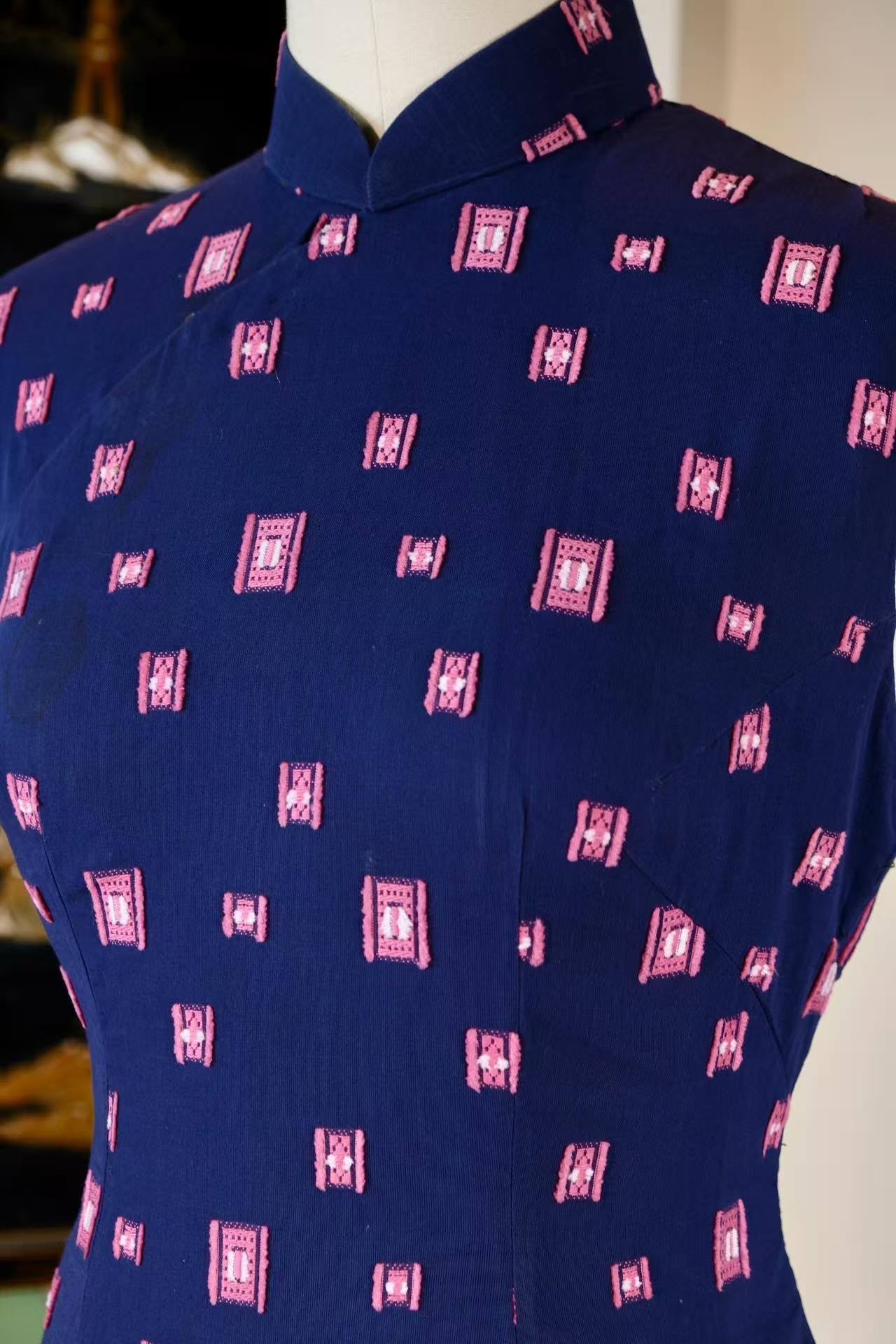
六十年代台湾机绣棉旗袍:蓝粉间的东方美学叙事
在时光的褶皱里,总有一件衣裳能唤醒一个时代的记忆。
旗袍上的粉色纹样,乍看是抽象的矩形排列,实则暗藏玄机。
尤为珍贵的是,这些粉色纹样并非印刷而成,
六十年代的台湾,正处于纺织业的黄金时代。彼时,
正如服饰史学家卢寿荣在《中国旗袍考》中所言:“
当靛蓝棉布轻抚肌肤,粉色图纹在胸前跳动,
在快时尚横行的今天,这样的古董旗袍愈发显得珍贵。它提醒我们:
Here is the translation of your evocative analysis of the 1960s Taiwanese machine-embroidered cotton cheongsam into English.
Within the folds of time, there is always a garment capable of awakening the memories of an era. This 1960s vintage cheongsam, housed in Taipei, features a deep indigo base adorned with pink geometric patterns. Like fireworks blooming in the night sky, it condenses the glory of Taiwan’s post-war textile industry and the genetic code of Oriental aesthetics into a single piece of cotton fabric.
The pink patterns on the cheongsam appear at first glance to be an abstract rectangular arrangement, but they actually hide a profound ingenuity. The repetitive alignment of rectangular frames borrows from the "Hui-pattern" (回纹) found on ancient bronzeware, symbolizing the continuous and unending vitality of life. This design—deconstructing and reorganizing traditional symbols—was precisely where the innovation of Taiwan's textile industry lay in the 1960s. With the aid of machine embroidery technology, artisans used cotton thread as a brush to simplify the complex lines of classical motifs into geometric blocks. This retained the cultural core of "every image having a meaning" while aligning with the "less is more" aesthetic trend of post-war modernist design.
Particularly precious is the fact that these pink patterns are not printed; they are embroidered stitch by stitch using vintage flat-embroidery machines. A close inspection of the stitching reveals slightly raised thread ends, creating a subtle three-dimensional texture. This is the fundamental difference between early machine embroidery and later computerized embroidery, and it serves as a vital criterion for dating vintage cheongsams.
The 1960s marked the golden age of Taiwan's textile industry. At that time, Taiwanese manufacturers introduced Japanese Brother embroidery machines, becoming global pioneers in the industrial production of cheongsams. The pure cotton fabric of this dress is a masterpiece of local Taiwanese mills—a blend of Alishan cotton and imported long-staple cotton with a thread count of 120 per inch. This ensures both the crispness of the fabric and a silk-like drape.
As fashion historian Lu Shourong stated in A Study of Chinese Cheongsam: "Every transformation of the cheongsam is a redefinition of the relationship between the body and space by the Chinese people." The slim-fit silhouette of this cheongsam breaks through the traditional "body-covering" function, instead emphasizing the beauty of female curves. This is not only a manifestation of the awakening of female consciousness post-war but also a microscopic footnote to Taiwan's transition from an agrarian civilization to an industrial one.
When the indigo cotton caresses the skin and the pink patterns dance across the chest, we can almost hear the hum of sewing machines on the streets of 1960s Taipei and see the focused expressions of female workers before their embroidery machines. This cheongsam is more than just clothing; it is a "fluid cultural relic." It witnessed the rise of Taiwan's textile industry, recorded the modern transformation of Oriental aesthetics, and carried an entire generation of women’s pursuit of beauty.
In today’s world of rampant fast fashion, such vintage cheongsams become increasingly precious. They remind us that true fashion is never a fleeting trend, but a cultural gene that continues to touch the heart through time. As the Book of Rites (Li Ji) says: "Clothing is the manifestation of virtue." This blue-and-pink cheongsam is the best footnote to the spirit of 1960s Taiwan—fervor within subtlety, innovation within tradition, revealing the eternal charm of Oriental aesthetics within its every inch.