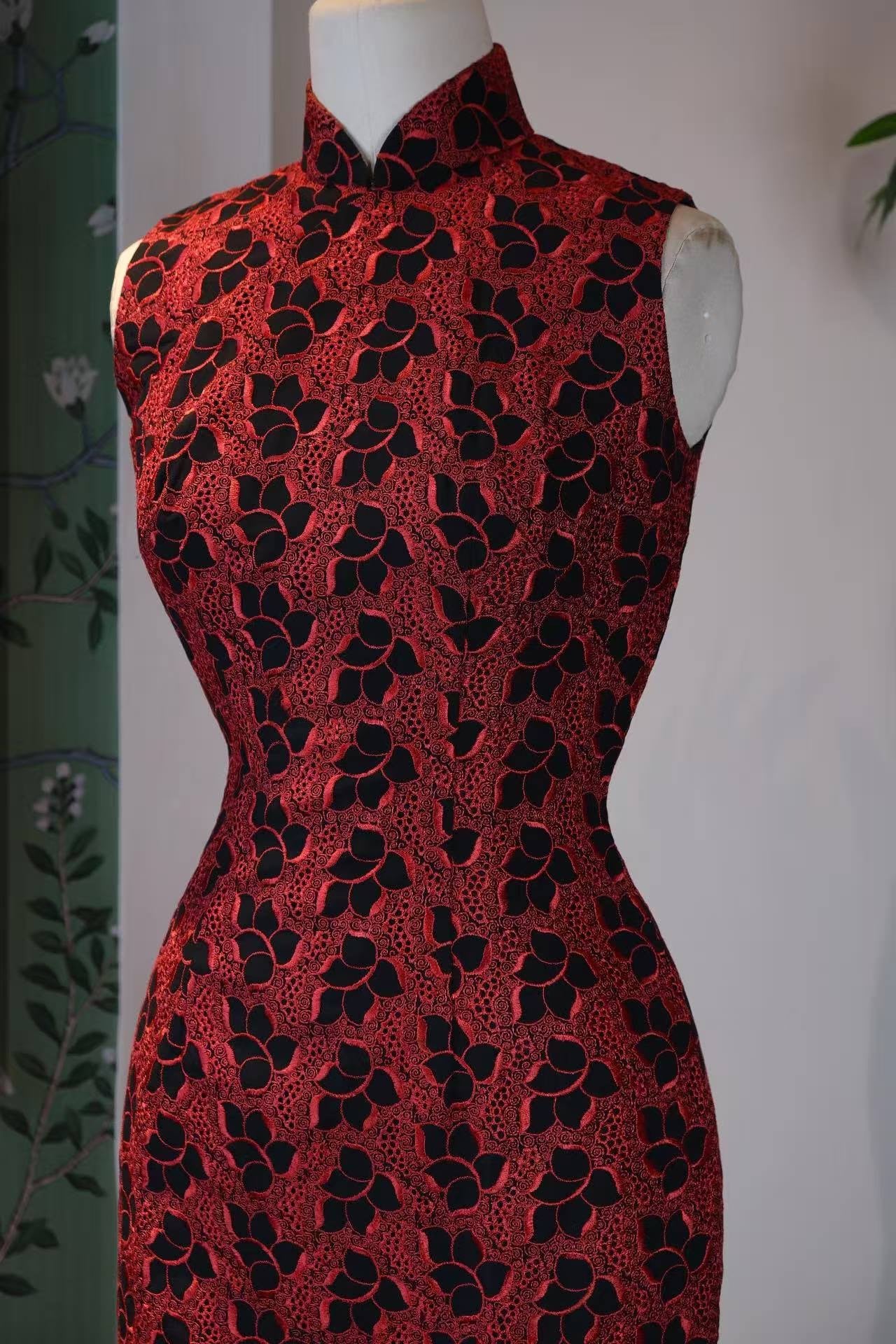
六十年代台製机器绣花蕾丝古董旗袍
赤焰凝脂,墨莲浮香:上世纪六十年代台湾机器刺绣蕾丝古董旗袍,以工业时代的精密绣艺,复刻着千年织物的华章。
一、图案考据:莲叶田田,暗藏乾坤
面料之上,赤红色刺绣蕾丝与墨色底布形成“朱墨相生”的视觉张力。绣线勾勒的莲瓣纹并非传统写实,而是以几何化线条重构——每组花型由五片弧形花瓣组成放射状花簇,恰似《楚辞》“制芰荷以为衣兮,集芙蓉以为裳”的现代变奏;花簇间隙点缀着螺旋纹与点线,暗合商周青铜器“涡纹”的狞厉之美,在柔媚中注入刚劲。
二、工艺溯源:台湾纺织业的黄金密码
此袍诞生于1960年代台湾纺织业腾飞之际——彼时台湾承接全球蕾丝代工产业,以瑞士筒袜机(Tubular Lace Machine)开创“立体提花蕾丝”工艺。每寸布料需经12道工序,绣线密度达80针/英寸,较同期上海“露蕾丝”更显紧致,其工艺复杂度堪比法国里昂 silk lace,却是更接地气的“台湾制造”传奇。
三、文化隐喻:东方与西方的织物辩证
机器刺绣蕾丝的机械化生产曾被视为“手工艺术的敌人”,但此袍以精密绣线编织出莲纹的东方意境,恰如本雅明所说“机械复制时代的艺术作品”仍可承载灵韵。当西方蕾丝工艺遇上东方旗袍形制,当工业时代的齿轮咬合古典的莲纹,这件旗袍成为冷战时期台湾文化身份的隐喻:在传统与现代、本土与全球的张力中,织就独一无二的文化经纬。
赤红如焰,莲纹似画。这件旗袍不仅是六十年代台湾纺织工业的活化石,更是东方美学在工业时代的诗意重生。穿它,便是将一段被遗忘的纺织史诗,穿在身上,走在当下。
1960s Taiwanese Machine-Embroidered Lace Antique Qipao
"Crimson flames against smooth tallow, dark lotus drifting with fragrance." This 1960s antique Qipao from Taiwan utilizes the precision embroidery of the industrial age to replicate the magnificent chapters of millennial textiles.
I. Pattern Research: Lotus Leaves and Hidden Universes
Upon the fabric, the scarlet embroidered lace and ink-black base cloth create a visual tension of "interdependent vermilion and ink." The lotus petal motifs outlined by the embroidery threads are not traditionally realistic but reconstructed with geometric lines. Each floral cluster consists of five arched petals forming a radial bloom, resembling a modern variation of the line from The Songs of Chu: "I fashion lotus leaves into my raiment and gather hibiscus to make my skirts." Between the floral clusters, spiral patterns and dotted lines are interspersed, echoing the fierce beauty of "vortex motifs" on Shang and Zhou bronzewares, injecting strength into the garment's elegance.
II. Craft Provenance: The Golden Cipher of Taiwan’s Textile Industry
This robe was born during the soaring rise of Taiwan’s textile industry in the 1960s. At that time, Taiwan took over the global lace manufacturing industry, pioneering "three-dimensional jacquard lace" using Swiss tubular lace machines. Every inch of fabric underwent twelve processes, with a thread density reaching 80 stitches per inch. Compared to contemporary Shanghai "openwork lace," this craft is more compact; its complexity rivals that of silk lace from Lyon, France, yet it remains a more grounded legend of "Made in Taiwan."
III. Cultural Metaphor: A Dialectic of East and West
While the mechanized production of embroidered lace was once viewed as the "enemy of handmade art," this Qipao weaves the Oriental spirit of the lotus with precision threads. As Walter Benjamin suggested, the "artwork in the age of mechanical reproduction" can still carry its unique aura. When Western lace craft meets the form of the Oriental Qipao, and the gears of the industrial age engage with classical lotus patterns, this garment becomes a metaphor for Taiwan's cultural identity during the Cold War era: weaving a unique cultural warp and weft amidst the tension between tradition and modernity, local and global.
Crimson as fire, lotus patterns like a painting. This Qipao is not only a living fossil of Taiwan’s 1960s textile industry but also a poetic rebirth of Oriental aesthetics in the industrial age. To wear it is to clothe oneself in a forgotten textile epic while walking in the present.