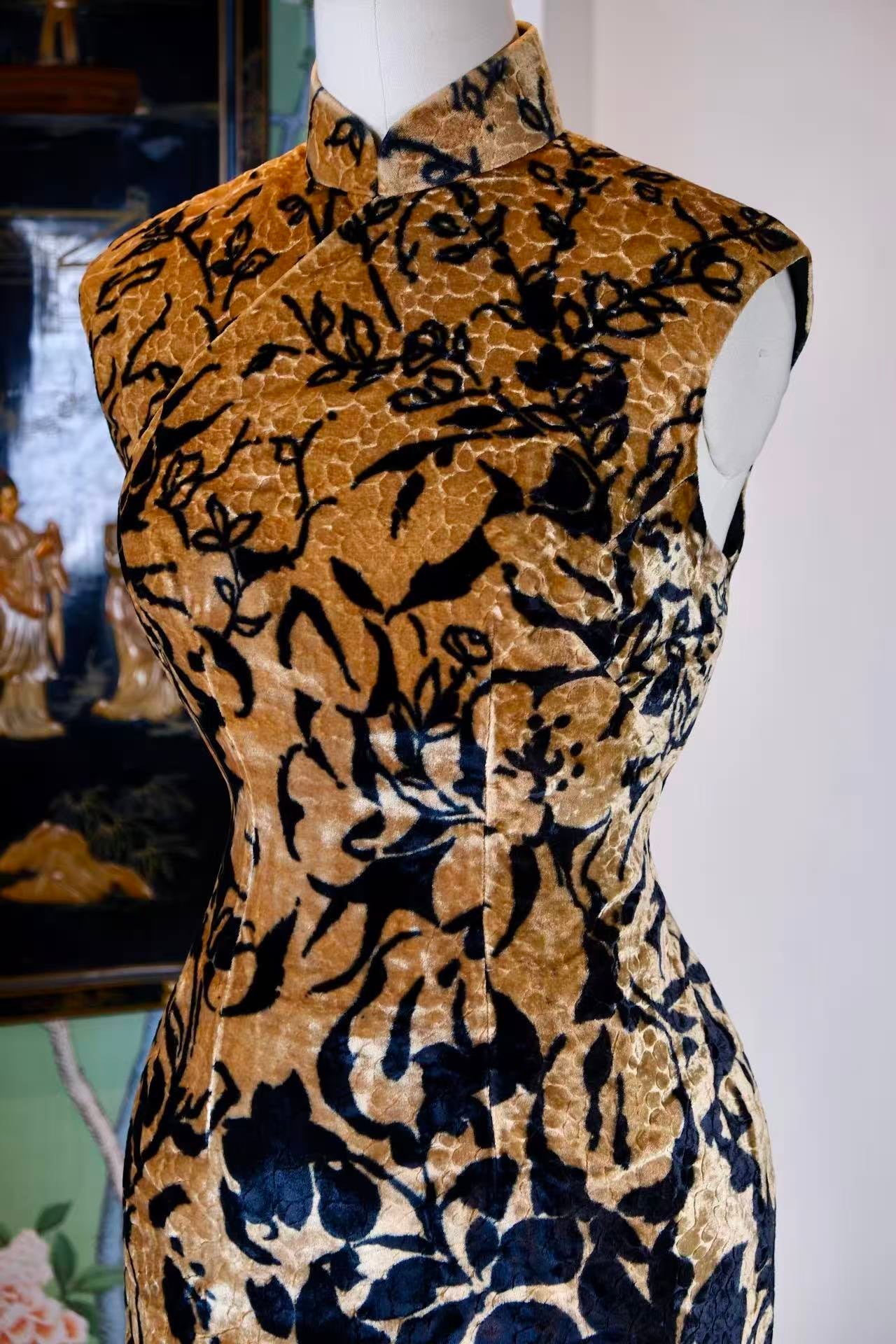
六十年代大理石纹丝绒印花香港旗袍:丝绒上的水墨乾坤
丝绒为帛,藏蓝作墨,棕黄为笺。当指尖抚过这件香港工坊的遗珍,凹凸肌理间似有半个世纪的温存流转——它以“大理石纹”为骨,却非冷硬石材,而是丝绒经纬织就的暗纹锦缎,如宣纸上晕染开的松烟墨,沉静而温润。
上半阙,棕黄底色蔓生疏枝,藏蓝墨点勾勒出折枝写意,如八大山人朱耷笔下的枯木怪石,寥寥数笔却气韵生动;下半阙,藏蓝浓墨泼洒成团,棕黄丝绒在深色间隙中透出微光,恍若石涛《搜尽奇峰图》里的层峦叠嶂,虚实相生间藏着“墨分五色”的层次美学。
领缘斜襟,收腰抚臀,六十年代香港旗袍的经典廓形在此凝练——既承袭了海派旗袍的“收省”技艺,让丝绒紧贴身形如第二层肌肤;又融入港式改良的利落线条,行走间裙摆微漾,恰似《红楼梦》中“行动处似弱柳扶风”,却添了几分东方都会女性的飒爽风骨。
大理石纹丝绒面料,乃六十年代香港纺织业的昙花一现。彼时香港作为远东纺织重镇,将西方丝绒织造工艺与东方审美融合,这种特殊纹理需在绒面压花后手工印花,每一寸肌理皆是匠人指尖的“火石痕迹”——如今存世者寥寥,博物馆藏品中亦难得一见。
香港作为中西文化交汇的“南天门”,这件旗袍正是那个特殊时代的缩影:丝绒的华丽呼应着殖民地的摩登风尚,印花的写意却坚守着华夏文脉的根系。它曾属于某位穿梭于兰心戏院与弥敦道的名媛,裙袂轻扬间,见证过霓虹灯初上的香江夜色,也藏着老派上海人南迁后的乡愁。
存世稀若晨星,工艺绝版半个世纪。每一道丝绒褶皱都是时间的勋章,每一处印花晕染皆为孤品印记。它不仅是衣裳,更是一卷可穿戴的“东方水墨手稿”,是六十年代香港作为“东方巴黎”的时尚证词。
“衣香鬓影,不过百年。”当现代快时尚流水线上的衣物如昙花凋零,这件历经六十载岁月沉淀的大理石纹丝绒旗袍,却在时光里愈发醇厚。它不是博物馆的静物标本,而是可被体温唤醒的活历史——穿上它,便是将石涛的笔墨、香港的霓虹、丝绒的温存,一并纳入怀中,成为行走的“东方美学代言人”。
1960s Hong Kong Marbled Printed Velvet Qipao: A Universe of Ink on Silk
"Velvet as the parchment, navy blue as the ink, and amber-yellow as the letter."
As fingertips brush over this relic from a Hong Kong atelier, a half-century of warmth flows through the embossed texture. Its "marble-veined" structure is not of cold stone, but a dark-patterned brocade woven from velvet threads—resembling pine-smoke ink bleeding across Xuan paper, serene and lustrous.
The upper portion features an amber-yellow base where sparse branches grow; navy ink dots outline a freehand floral sketch, reminiscent of the "Withered Wood and Strange Rocks" by Bada Shanren—a few strokes conveying vivid spiritual resonance. The lower portion sees a splash of heavy navy ink, with amber velvet gleaming through the dark crevices, evoking the towering peaks of Shi Tao’s Searching for the Supernatural Peaks. Between the solid and the void lies the layered aesthetic of "the five shades of ink."
The diagonal closure and cinched waist condense the classic 1960s Hong Kong silhouette—inheriting the "dart-tucking" (Shousheng) skill of the Shanghai school to make the velvet fit like a second skin, while integrating the sharp lines of Hong Kong's modernization. Every movement sets the hem rippling, capturing the Dream of the Red Chamber imagery: "Moving like a delicate willow swaying in the wind," yet infused with the spirited backbone of an Oriental urban woman.
Marbled velvet was a fleeting brilliance in the 1960s Hong Kong textile industry. As a Far East textile hub, Hong Kong fused Western velvet weaving with Oriental aesthetics. This specific texture required manual printing after the pile was embossed—every inch of grain is a "firestone trace" from a craftsman’s touch. Such pieces are now as rare as morning stars, seldom seen even in museum collections.
As the "Southern Gate" where East meets West, this Qipao is an epitome of that unique era: the opulence of velvet echoes colonial modernity, while the freehand prints guard the roots of Chinese cultural lineage. It once belonged to a socialite navigating between the Lyceum Theatre and Nathan Road; within its swaying skirts, it witnessed the neon lights of old Hong Kong and harbored the nostalgia of the Shanghainese diaspora.
Its existence is rare; its craftsmanship has been out of print for half a century. Every velvet fold is a medal of time; every ink bleed is a unique mark. This is not just clothing, but a wearable "Oriental Ink Manuscript"—a fashion testament to 1960s Hong Kong as the "Paris of the East."
"Fragrance of clothes and shadows of hair last but a hundred years." While modern fast-fashion fades like a night-blooming cereus, this marbled velvet Qipao grows richer with age. It is not a static museum specimen, but living history awakened by body heat. To wear it is to embrace Shi Tao’s brushwork, Hong Kong’s neon, and the warmth of velvet—becoming a walking ambassador of Oriental aesthetics.