深圳溯源
Couldn't load pickup availability
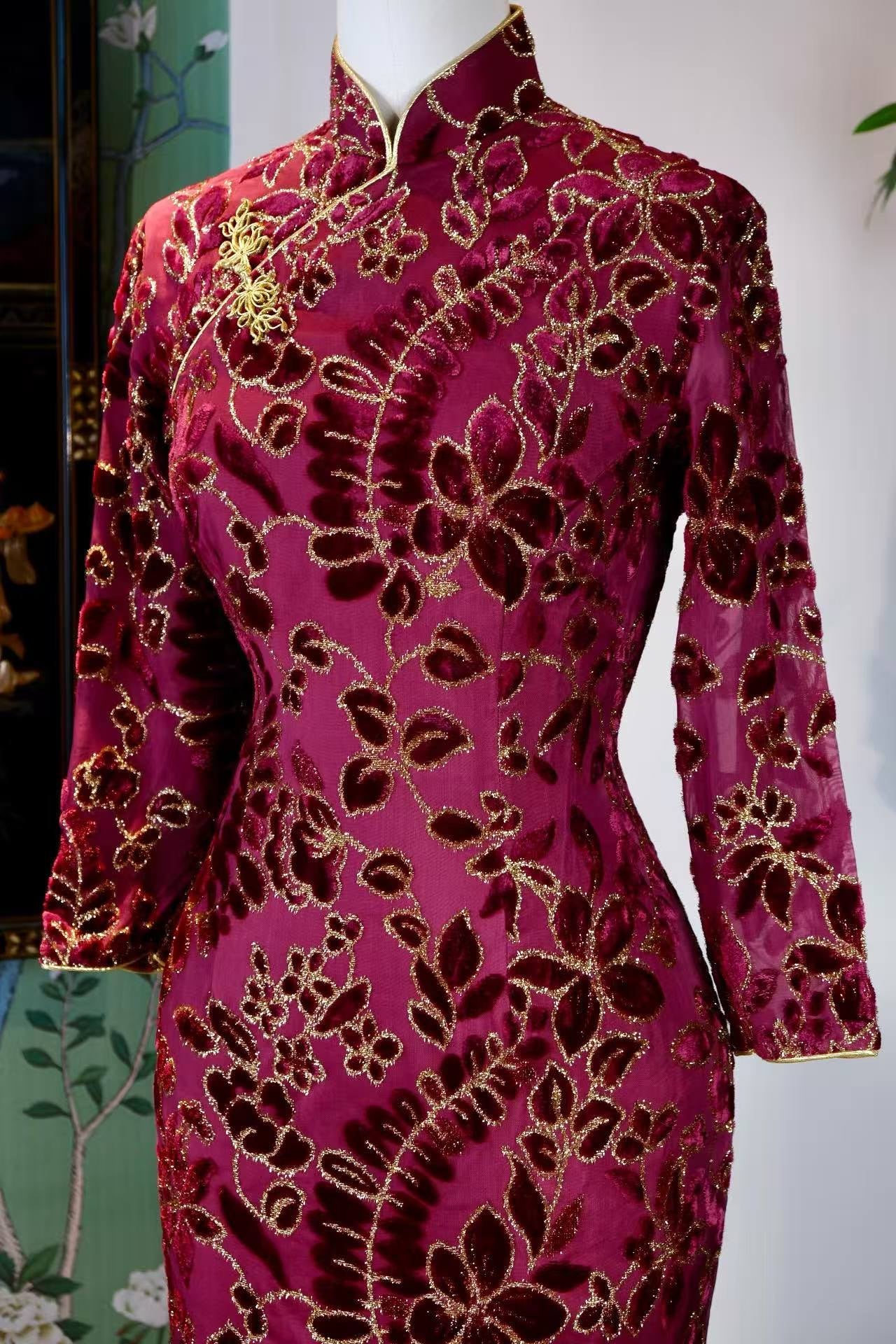
六十年代意大利织金烧花丝绒旗袍:丝绒上的东方诗笺
这件诞生于上世纪六十年代的香港古董旗袍,
旗袍上的图案以“缠枝花卉”为主题,取材自中国传统吉祥纹样“
其艺术风格承袭海派旗袍的“雅致”与“摩登”:高领如“
今日观之,这件旗袍不仅是“旧时光的遗珍”,更是“
This 1960s antique Qipao, crafted in Hong Kong, features imported Italian gold-jacquard burn-out velvet. It fuses Western weaving techniques with the soul of Oriental aesthetics into a single crimson robe, standing as a "wearable historical scroll." Its scarcity lies not only in the rarity of the fabric—Italian velvet of that era was famed for being "thin as a cicada's wing and soft as a cloud"—but also in the masterful burn-out (Devoré) technique. This process uses chemical agents to etch the velvet surface, removing the pile to reveal the base fabric before outlining the patterns with gold threads to create a "relief-like" three-dimensional effect. Such a technique required artisans to precisely control chemical concentrations and timing; the slightest error would ruin the entire piece, making surviving specimens exceedingly rare.
The motif centers on "Intertwining Florals," a variation of the traditional Chinese auspicious "Intertwining Lotus" pattern, yet reconstructed with Western realistic brushwork. The blossoms are as full as blooming peonies, their petal edges densely embroidered with gold threads, shimmering like a "garment of golden wires." The foliage, rendered through the burn-out process, presents varying shades of crimson, resembling "leaves stained by flowing clouds." The winding vines, akin to "swimming dragons and dancing phoenixes," subtly echo the life-affirming spirit of The Classic of Poetry. More exquisitely, the golden stamen and stems evoke the imagery of Tang Dynasty poet Wen Tingyun’s line: "Golden pistils blooming on red silk," condensing the "soul of the flower" upon the velvet and imbuing the static pattern with the dynamic beauty of "flowers swaying in the wind."
The artistic style inherits the "elegance" and "modernity" of the Shanghai school: the high collar is as "slender as a crane’s neck," and the cinched waist emphasizes the soft beauty of the Oriental "willow waist." The three-quarter sleeves are finished with gold-thread piping, resembling "lightly fluttering cloud-sleeves." Simultaneously, the drape of Italian velvet and the translucency of the burn-out process bestow the grandeur of a Western evening gown. As Eileen Chang noted in Chronicle of Changing Clothes: "The slender waist of the Qipao is the perfect fusion of Oriental restraint and Western flamboyance." This "Sino-Western" aesthetic is the unique hallmark of 1960s Hong Kong as a cultural crossroads.
Viewed today, this Qipao is more than a "relic of old times"; it is a "symbiosis of craftsmanship and poetry." The scarcity of Italian velvet, the endangered nature of the burn-out craft, and the ingenuity of Hong Kong tailors collectively forge its "one-of-a-kind" value. Meanwhile, the auspicious symbolism of the intertwining flowers and the noble aura of the gold embroidery make it a "living fossil of Oriental aesthetics." Brushing your fingertips over the gold patterns on the velvet, one can almost hear the clanging of 1960s Hong Kong trams and see a woman holding a velvet handbag, walking down the neon-lit Nathan Road—a segment of an era's splendor, frozen within this "wearable poetic script."