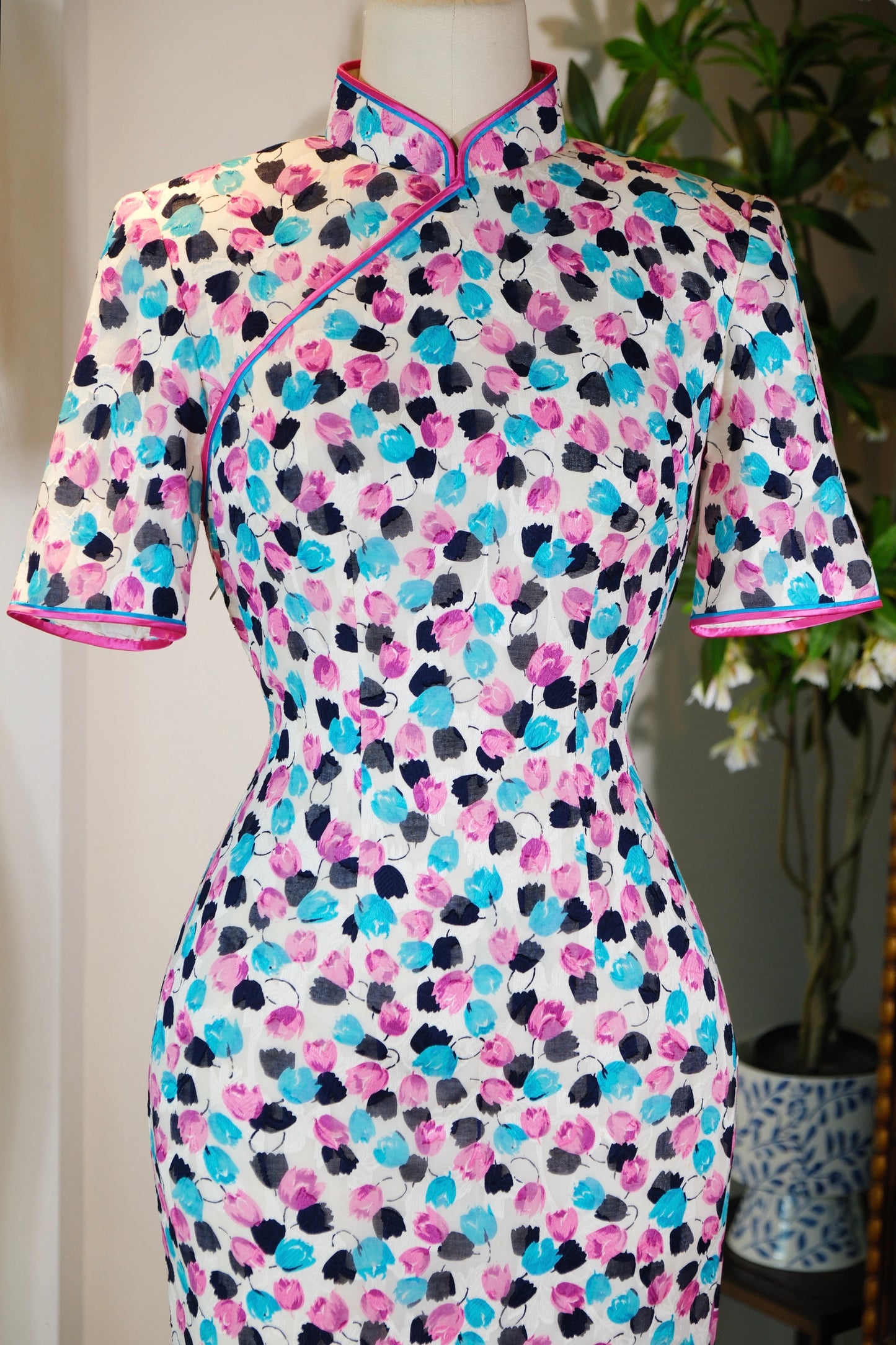
六十年代港产树叶暗纹郁金香印花古董旗袍
衣服尺寸:
胸围/腰围/臀围:92/74/96 厘米
衣长:115 厘米
细节描述:
这件诞生于六十年代香港的旗袍,恰似一首穿在身上的“时光叙事诗”。素白缎面为底,树叶暗纹如细密的脉络隐于经纬之间,似江南园林里被岁月晕染的苔痕,在光影流转中泛着低调的奢华;而粉蓝、玫红、黛青的郁金香印花,则如打翻的调色盘,以写意笔触泼洒出热烈的生命力,暗纹的静与印花的动,在衣身交织成一场跨越时空的对话。
六十年代的香港,是东方传统与西方现代碰撞的“文化实验室”。旗袍作为东方女性的“身份符号”,在这一时期完成了从“传统礼服”到“日常时装”的转型。这件旗袍的剪裁,既保留着立领、斜襟、收腰的经典形制,又融入了西式立体裁剪的贴合感,腰线的收束恰如《诗经》中“窈窕淑女”的曲线,而郁金香的西洋意象,则是港式旗袍“海纳百川”的明证——正如张爱玲在《更衣记》中所言:“旗袍的演变,是中国女性从‘深闺’走向‘街头’的缩影。”
古董衣的珍贵,在于它承载的“未被书写的日常”。或许它曾属于一位在港岛中环上班的“新女性”,清晨穿着它挤叮叮车,傍晚则换上高跟鞋赴一场舞会;或许它曾是一位南洋华侨妻子的嫁衣,在六十年代的维多利亚港,见证过一段跨越山海的爱情。树叶暗纹的提花工艺,如今已鲜有匠人能复刻,这种“隐于细节的奢华”,恰是六十年代香港旗袍的精髓——不张扬,却处处藏着匠心。
它像一件“会呼吸的文物”,每一片树叶暗纹都在诉说:真正的经典,从不是博物馆里的陈列品,而是能融入当代生活的“活态遗产”。当现代女性穿上它,仿佛能触摸到六十年代香港的风——那风里有叮叮车的铃响,有太平山顶的晚风,更有一代女性在传统与现代间寻找自我的勇气。
1960s Hong Kong-Made Antique Qipao: Leaf Undercurrent & Tulip Print
Measurements / Size Guide:
Bust / Waist / Hips: 92/74/96 cm
Total Length: 115 cm
Detailed Description:
This Qipao, born in 1960s Hong Kong, is like a "narrative poem of time" worn on the body. With a plain white satin base, the leaf-patterned undercurrents hide like delicate veins within the warp and weft, resembling the moss traces stained by time in a Jiangnan garden. They exude an understated luxury amidst the shifting light and shadows. Meanwhile, the tulip prints in powder blue, rose red, and dark cyan are like an overturned palette, splashing a fervent vitality with freehand brushstrokes. The stillness of the hidden patterns and the dynamism of the prints intertwine on the garment, creating a dialogue that spans time and space.
Hong Kong in the 1960s was a "cultural laboratory" where Eastern tradition collided with Western modernity. As an "identity symbol" for Oriental women, the Qipao completed its transformation from "traditional formal wear" to "everyday fashion" during this period. The tailoring of this piece preserves the classic forms of the high collar, diagonal closure, and cinched waist, while integrating the fit of Western three-dimensional cutting. The constriction of the waistline mirrors the curves of the "graceful lady" described in the Classic of Poetry. The Western imagery of the tulip is clear evidence of the "all-embracing" nature of Hong Kong-style Qipaos—as Eileen Chang noted in A Record of Changing Clothes: "The evolution of the Qipao is a microcosm of Chinese women moving from the 'inner chambers' to the 'streets'."
The preciousness of antique clothing lies in the "unwritten daily life" it carries. Perhaps it once belonged to a "New Woman" working in Central, Hong Kong, who wore it to squeeze onto a Ding Ding tram in the morning and changed into high heels for a ball in the evening. Or perhaps it was the wedding gown of a Southeast Asian overseas Chinese wife, witnessing a love that crossed mountains and seas at Victoria Harbour in the 1960s. The jacquard craftsmanship of the leaf undercurrents is rarely replicated by artisans today; this "luxury hidden in the details" is precisely the essence of 1960s Hong Kong Qipaos—unpretentious, yet embedded with ingenuity everywhere.
It is like a "breathing cultural relic." Every leaf pattern tells us: true classics are never mere exhibits in a museum, but "living heritage" that can integrate into contemporary life. When a modern woman puts it on, she can almost touch the wind of 1960s Hong Kong—a wind carrying the ring of the Ding Ding tram, the evening breeze from Victoria Peak, and the courage of a generation of women finding themselves between tradition and modernity.