深圳溯源
Couldn't load pickup availability
衣服尺寸:
胸围/腰围/臀围:92/80/100 厘米
衣长:107 厘米
细节描述:
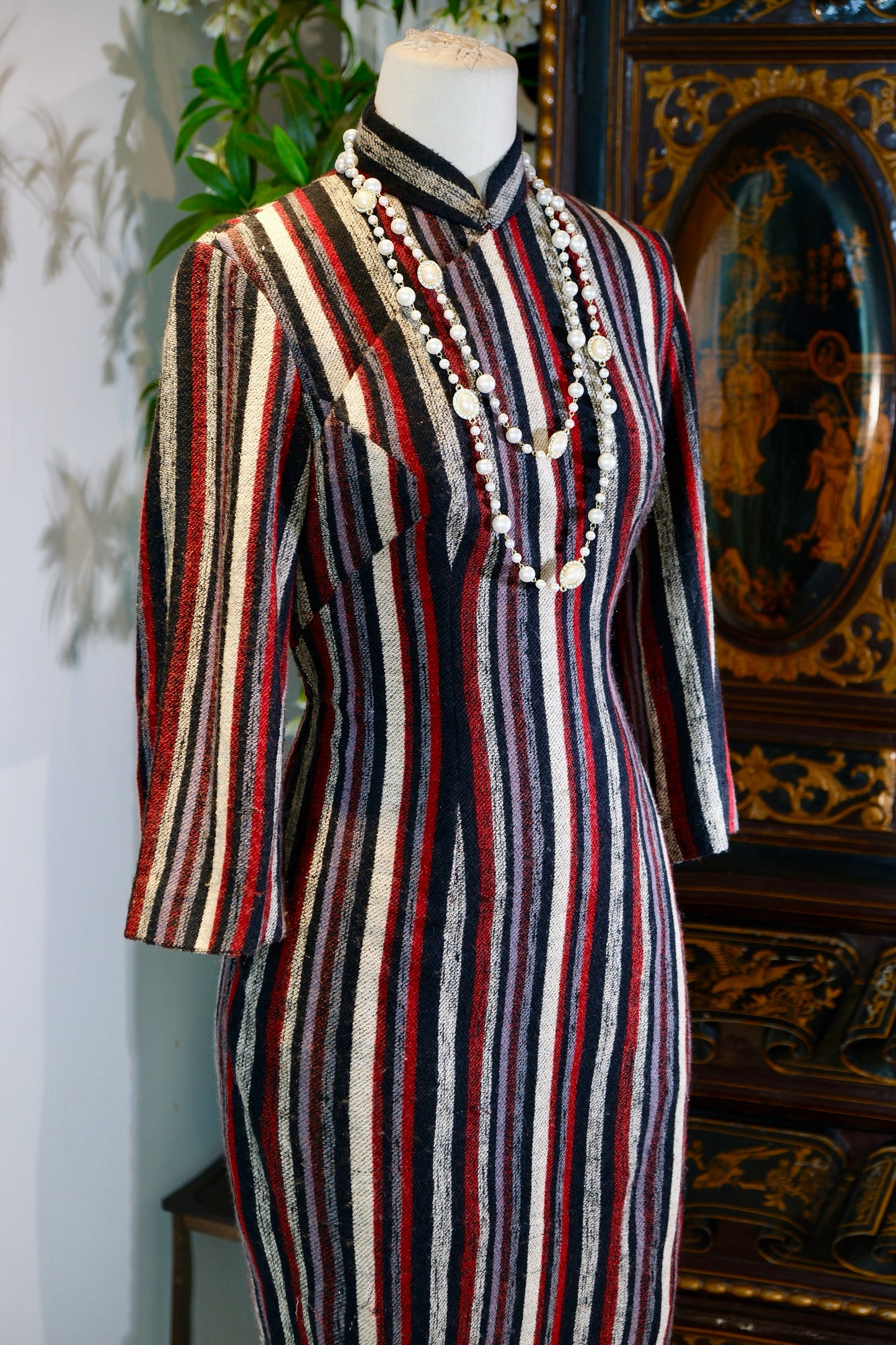
当目光触及这件六十年代香港产条纹毛呢旗袍时,仿佛推开了一扇通往旧时光的雕花窗。那些在经纬间流淌的竖条纹,是岁月精心编排的视觉韵律——藏青的深邃如维多利亚港的夜雾,赭红的热烈似石库门弄堂里的暖阳,米白的素净若香江畔的晨霭,更有几缕银灰的暗纹,在光线下若隐若现,宛如老电影胶片上的颗粒感,将那个时代的摩登与怀旧悄然缝合。
一、图案:流动的几何诗学
旗袍的条纹并非简单的色彩堆砌,而是深谙“计白当黑”的东方美学。宽窄不一的竖条纹以黄金比例交错,藏青与赭红的碰撞暗合“朱墨相映”的传统色谱,米白条纹则如宣纸留白,为视觉提供呼吸的间隙。毛呢材质的肌理感更赋予条纹独特的生命力:粗粝的纤维间,色彩边缘带着手工织造特有的晕染效果,远观如流动的江河,近看则似老上海月份牌上的笔触,既有工业时代的秩序感,又保留了手工艺的温润。
二、故事:香江裁缝的黄金时代
这件旗袍诞生于香港制衣业的鼎盛期。六十年代的香港,作为东西方文化交汇的熔炉,孕育出一批深谙海派旗袍精髓又吸纳西方立体剪裁的裁缝。据《香港时装史》记载,彼时中环的裁缝铺常以“一衣一版”为傲,这件旗袍的收腰曲线便暗藏玄机:通过18道归拔工艺,将毛呢的挺括与女性的柔美完美融合,侧缝的隐形省道如书法中的“飞白”,在不动声色间勾勒出玲珑体态。
彼时的香港名媛,常着此类毛呢旗袍出席赛马会或慈善晚宴。可以想象,某位身着此衣的女子,或许曾在半岛酒店的露台凭栏远眺,珍珠项链随海风轻晃,条纹在暮色中流转,成为香江夜色里一道流动的风景线。
三、艺术风格:海派遗韵与摩登新声
从艺术史视角看,这件旗袍是海派旗袍“改良运动”的海外延续。它摒弃了传统旗袍的繁复刺绣,转而以条纹的纯粹性呼应包豪斯“少即是多”的现代主义理念,却又在立领、斜襟等细节处坚守东方基因。七分袖的设计则暗合六十年代全球女性解放的浪潮,既保留了旗袍的含蓄,又增添了行动的便利。
其稀缺性更在于材质的时代印记。六十年代的毛呢面料多采用羊毛与化纤混纺,这种材质在当时被视为“进步”的象征,却因年代久远而愈发珍贵。如今,这种带有粗粝质感、色彩饱和度恰到好处的老毛呢,早已在现代纺织工业中难觅踪迹,每一件留存至今的毛呢旗袍,都是不可复制的“时光标本”。
四、稀缺性:时光淬炼的孤品
据香港服饰博物馆统计,六十年代港产毛呢旗袍的存世量不足千件,而如这件般条纹规整、保存完好的更是凤毛麟角。它的珍贵不仅在于材质与工艺,更在于它承载的集体记忆:那是香港从转口港向国际都市转型的激情岁月,是东方女性在传统与现代间寻找平衡的生动注脚。
当指尖抚过这些历经半世纪依然清晰的条纹,仿佛能触摸到那个时代的脉搏——既有对旧时光的眷恋,又有对新世界的向往。这件旗袍,早已超越了衣物的范畴,成为一部穿在身上的文化史,一曲用经纬编织的时光恋歌。
Measurements / Size Guide:
Bust / Waist / Hips: 92/80/100 cm
Total Length: 107 cm
Detailed Description:
Touching this 1960s Hong Kong-made striped woolen cheongsam (qipao) is like opening a carved window into the past. The vertical stripes flowing through the warp and weft are visual rhythms orchestrated by time: the depth of navy blue like the night mist over Victoria Harbour; the warmth of ochre red like sunlight in a Shikumen alley; the purity of cream white like the morning haze along the Fragrant Harbor. A few streaks of silver-grey shimmer under the light like the grain on old film, quietly stitching together the era's modernity and nostalgia.
The stripes are not merely a stack of colors; they understand the Eastern aesthetic of "counting white as black." Vertical lines of varying widths intersect in golden ratios, where navy and ochre collide in a traditional palette of "vermilion and ink," while white stripes provide visual "breathing space" like the margins of rice paper. The texture of the woolen tweed gives the stripes a unique vitality: amidst the coarse fibers, the color edges possess a blurred effect characteristic of manual weaving—resembling flowing rivers from afar and the brushstrokes of vintage Shanghai calendar posters up close.
This qipao was born during the peak of Hong Kong’s garment industry. In the 1960s, Hong Kong served as a melting pot where Eastern and Western cultures converged, nurturing tailors who mastered the essence of "Shanghai Style" while absorbing Western three-dimensional cutting. According to the Fashion History of Hong Kong, tailors in Central took pride in "one pattern per garment." The curve of this waist hides profound ingenuity: through 18 rounds of "Gui-Ba" (stretching and shrinking), the crispness of wool is perfectly merged with feminine softness, using invisible darts to contour the silhouette with the subtlety of "flying white" in calligraphy.
One can imagine a Hong Kong socialite wearing this to the races or a charity gala, leaning against the terrace of the Peninsula Hotel, her pearl necklace swaying in the sea breeze as the stripes shimmer in the twilight—a flowing landscape in the Hong Kong night.
From an art history perspective, this garment is the overseas continuation of the "Haipai Reformation." It discards traditional embroidery in favor of the purity of stripes, echoing the Bauhaus "Less is More" philosophy while remaining steadfast in its Eastern DNA through the standing collar and diagonal bodice. The three-quarter sleeve design aligns with the global wave of female liberation in the 60s, preserving modesty while adding practical convenience.
Its scarcity lies in the "material mark" of the era. Woolen fabrics of the 60s were often blends of wool and early synthetic fibers—a symbol of "progress" then, yet increasingly precious now. This specific texture and color saturation have vanished from modern industrial spinning; every surviving piece is an irreproducible "specimen of time."
According to the Hong Kong Costume Museum, fewer than a thousand 1960s Hong Kong-made woolen qipaos remain in existence, and those with such pristine stripes are rare. Its value lies not just in craft, but in collective memory: the passionate years of Hong Kong’s transformation into an international metropolis, and a vivid footnote to the Eastern woman’s search for balance between tradition and modernity.
When fingertips brush over these stripes, one can almost feel the pulse of that era—a longing for the old world and a yearning for the new. This qipao has transcended clothing; it is a wearable cultural history, a love song of time woven through warp and weft.