深圳溯源
Couldn't load pickup availability
衣服尺寸:
胸围/腰围/臀围:100/92/108 厘米
衣长:118 厘米
细节描述:
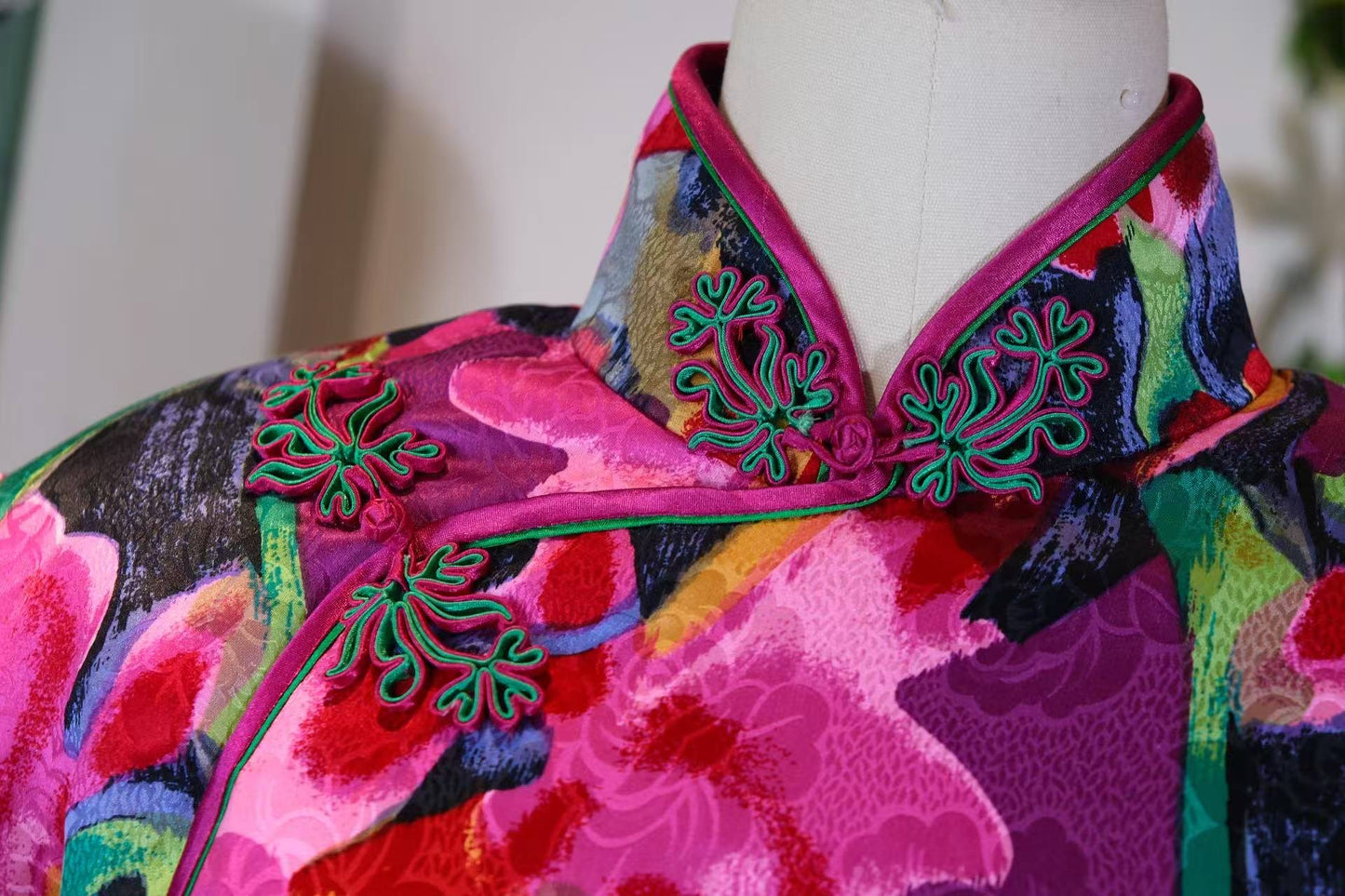
一、织物肌理:暗纹里的玫瑰密码
这件诞生于上世纪六十年代的香港古董旗袍,以提花缎为底,
二、抽象色块:东方写意与西方现代的碰撞
最令人惊叹的,是旗袍上大胆的抽象色块设计。玫红、翠绿、靛蓝、
三、工艺细节:盘扣里的时光密码
领口的盘扣是整件旗袍的“点睛之笔”:
四、时代故事:香港纺织业的黄金岁月
上世纪五十年代至七十年代,是香港纺织业的“黄金时代”。彼时,
五、稀缺性:时光淬炼的传世之美
历经六十余载岁月,这件旗袍的提花缎面料依然光洁如新,
结语:这件六十年代的玫瑰暗纹提花缎旗袍,是“
Measurements / Size Guide:
Bust / Waist / Hips: 100/92/108 cm
Total Length: 118 cm
Detailed Description:
Born in 1960s Hong Kong, this antique qipao uses jacquard satin as its canvas, weaving secret rose motifs into every inch of the warp and weft. As light skims the satin surface, the faint outlines of roses emerge like flower shadows under the moon, echoing the restrained beauty of the Book of Songs: "The peach tree is young and elegant; brilliant are its flowers." Without the need for heavy embroidery, the romantic essence of the rose blooms quietly through the textural variations of the silk. This "hidden jacquard" technique represented the pinnacle of the Hong Kong textile industry at the time, requiring manual calibration of thousands of warp threads to transform rose stems and petals into a private linguistic code—truly a "miniature relief worn on the body."
The most breathtaking feature is the bold, abstract color-block design. Shades of rose red, emerald green, indigo blue, and bright yellow interweave with brushstrokes reminiscent of splashed ink. Though seemingly spontaneous, the arrangement follows a rigorous logic: the edges of the color blocks diffuse like ink washes, possessing both the meticulousness of Song Dynasty court paintings and the tension of Western Abstract Expressionism. This fusion of "Oriental freehand + Western Modernism" is the unique hallmark of 1960s Hong Kong—the "Pearl of the Orient." Designers of that era, nurtured by traditional Suzhou and Cantonese embroidery while exposed to the artistic waves of Picasso and Matisse, deconstructed the concrete form of the rose into chromatic symbols. As Eileen Chang noted in Chronicle of Changing Clothes: "Clothes are a pocket drama one carries with them." The abstract blocks on this qipao are a "dramatic monologue" of the cultural collisions in 1960s Hong Kong.
The frog fasteners (Pankou) at the collar are the finishing touch: rose red and emerald green silk threads are coiled into floral shapes, each stitch hiding the artisan's dedication. The color selection cleverly echoes the main palette of the abstract blocks, ensuring a cohesive design language throughout. It is worth noting that 1960s Hong Kong qipaos still upheld the tradition of "bespoke tailoring." The proportions of the cinched waist and side slits are precisely calibrated to fit the curves of the Oriental woman—elegant yet dignified. Much like the description of Wang Xifeng's attire in Dream of the Red Chamber: "Radiant with colorful embroidery, like a goddess or a celestial being," this qipao is the ultimate footnote to Oriental feminine beauty.
The period from the 1950s to the 1970s was the "Golden Age" of Hong Kong’s textile industry. Leveraging its geographical advantage, Hong Kong became a global hub for textile trade and birthed the unique "Hong Kong-style Qipao": it retained the slim tailoring of the Shanghai style, integrated the vibrant colors of Lingnan culture, and absorbed innovative elements of Western fashion. This 1960s qipao is a "living fossil" of this era. Its abstract design predated the rise of Western Pop Art by nearly a decade, demonstrating the foresight of Hong Kong designers. Meanwhile, the jacquard craftsmanship remained loyal to the essence of Oriental fabrics. It is a piece of the glorious history of "Made in Hong Kong"—in an era before computer-aided design, designers sketched color blocks by hand, and craftsmen wove patterns with their own fingers.
After more than sixty years, the jacquard satin remains as smooth as new, the abstract colors show no signs of fading, and the silk threads of the fasteners remain firm. This is a testament to the rigorous standards for dyes and threads held by the 1960s Hong Kong textile industry. Today, finding a perfectly preserved 1960s abstract qipao is like "searching for a needle in the ocean." It is a pioneer of the fusion between Oriental aesthetics and modern design. Every edge of the color blocks and every hidden rose petal tells a story of "timeless beauty refined by the decades."
Conclusion: This 1960s rose-pattern jacquard satin qipao is a "miniature epic of Oriental aesthetics." It uses fabric as its paper and color as its ink to document the golden years of Hong Kong; it uses craftsmanship as its pen and time as its witness to engrave the elegant soul of the Oriental woman. Much like the romantic imagery of "Clouds remind me of her clothes, and flowers of her face," it allows every woman who wears it to meet her most beautiful self in the long river of time.