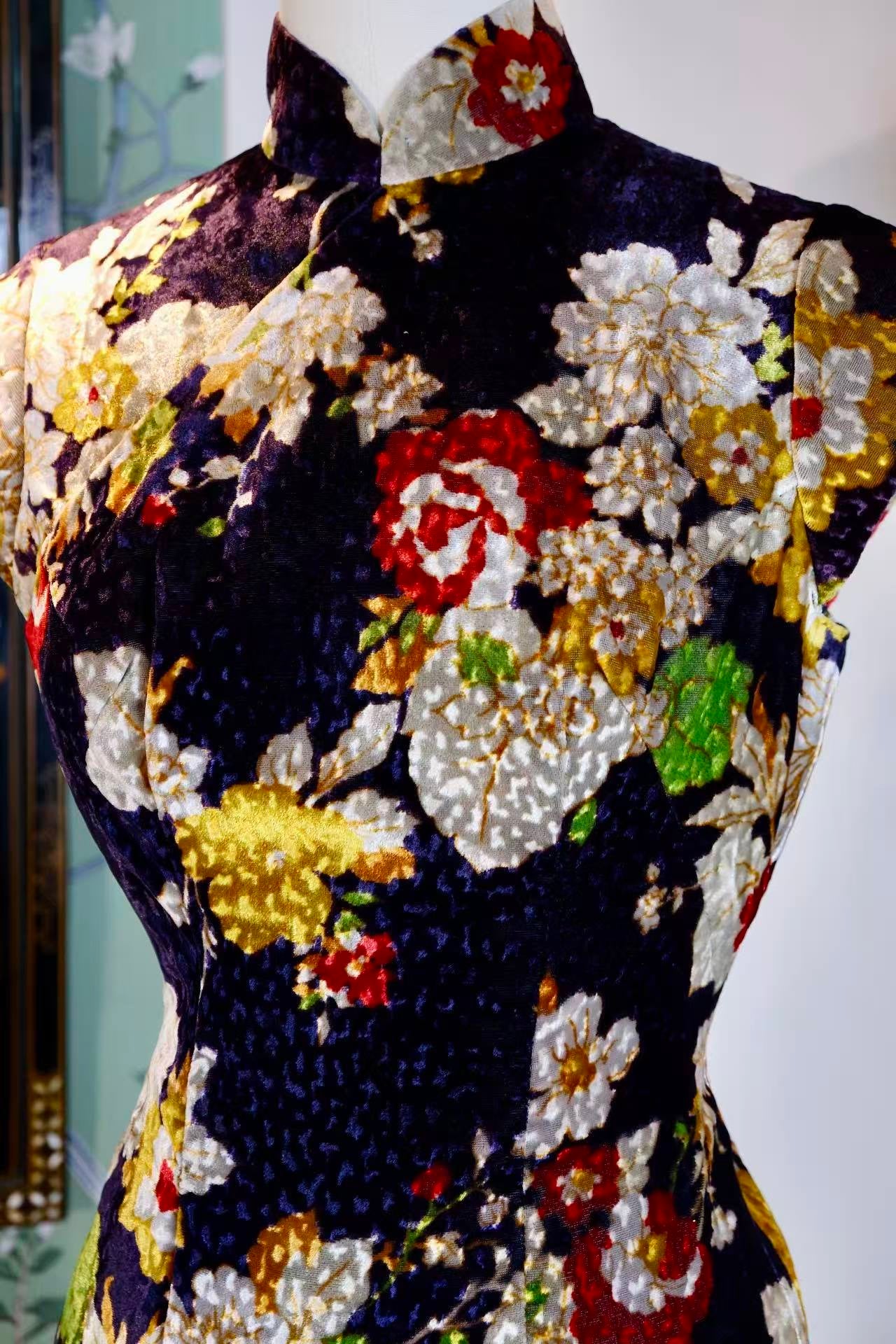
六十年代香港压花丝绒古董旗袍:繁华落尽见真淳
这件诞生于上世纪六十年代的香港压花丝绒旗袍,恰似一部凝固的时光诗篇,将那个中西文化碰撞交融的黄金年代,化作衣襟上的永恒风华。深蓝如夜的丝绒底色上,红、白、金、绿的花卉图案以压花工艺层层叠叠绽放,仿佛将盛唐的雍容与民国的雅致熔铸一炉,在光影流转间诉说着“昔日繁华,今朝珍藏”的传奇。
旗袍上的图案堪称一场视觉的盛宴:大朵的白牡丹雍容华贵,花瓣边缘以金线勾勒,恰似《长恨歌》中“云鬓花颜金步摇”的贵妃风姿;红梅点点,如“疏影横斜水清浅”的文人雅趣;金菊绽放,暗合“满城尽带黄金甲”的磅礴气韵。这些花卉并非随意堆砌,而是以中国传统“折枝花卉”的构图法巧妙分布,枝叶缠绕间暗藏“连绵不断”的吉祥寓意,每一处压花纹理都如浮雕般立体,触摸时仿佛能感受到当年工匠在织机前的专注呼吸。
从艺术风格来看,这件旗袍完美诠释了六十年代香港旗袍的“海派”精髓——它既保留了传统旗袍的立领、斜襟、开衩等经典元素,又大胆融入西方面料工艺的创新。压花丝绒这种材质,本是欧洲贵族礼服的专属,却被香港裁缝巧妙嫁接于东方旗袍之上,创造出“中体西用”的独特美学。正如张爱玲在《更衣记》中所言:“中国的服装,到了香港,便像被施了魔法,既守着旧时的规矩,又生出新的花样。”这件旗袍正是这种“魔法”的具象化:深蓝底色象征着东方的沉静内敛,而绚烂的花卉图案则如维多利亚港的霓虹,在保守与张扬间找到了微妙的平衡。
其稀缺性更在于时代背景的特殊性。六十年代的香港,正处于从转口贸易港向轻工业中心转型的关键期,旗袍制作也从传统的“量身定制”逐渐转向“成衣化”,但这件旗袍仍保留着手工压花、单件剪裁的匠心,堪称“最后的定制时代”的见证。当时的压花丝绒面料多依赖进口,工艺复杂且成本高昂,能够完整保存至今、品相如新的作品,更是凤毛麟角。它不仅是服饰史上的活化石,更是一段“东方之珠”崛起岁月的物质载体——那些在面料上起伏的花卉纹路,恰似当年香港人对美好生活的热切向往,在岁月的长河中永不褪色。
今日凝视这件旗袍,仿佛能看见六十年代的香港街头:穿着改良旗袍的女子提着竹编手袋,从叮叮车旁款款走过,丝绒面料在阳光下泛着温润的光泽,压花图案随步伐轻轻摇曳,将东方女性的婉约与都市摩登的活力完美融合。它早已超越了一件衣物的范畴,成为连接过去与现在、东方与西方的文化符号,在繁华落尽后,以最本真的姿态,向世人展示着那个年代独有的艺术魅力与时代精神。
1960s Hong Kong Embossed Velvet Antique Qipao: True Purity After the Height of Splendor
This 1960s embossed velvet Qipao from Hong Kong is like a solidified poem of time. It condenses the golden era—a period defined by the collision and fusion of Eastern and Western cultures—into an eternal elegance upon its lapels. Against a velvet base as deep blue as the night, floral patterns in red, white, gold, and green bloom in layers through the embossing process. It seems to meld the majesty of the Great Tang with the refinement of the Republican era, narrating a legend of "yesterday's splendor, today's treasure" amidst the shifting light and shadow.
I. Iconography: A Visual Feast of Relief
The patterns on the Qipao are a visual banquet: large white peonies exude opulence, their petal edges outlined in gold, reminiscent of the "golden hairpins and flowery faces" described in The Song of Everlasting Regret. Red plum blossoms offer the scholarly charm of "sparse shadows slanting across shallow water," while golden chrysanthemums bloom with the majestic momentum of "the whole city clad in golden armor." These flowers are not randomly placed but are artfully distributed using the traditional Chinese "broken-branch" (Zhezhi) composition. The intertwining stems hide auspicious meanings of "unbroken continuity," and every embossed texture is as three-dimensional as a relief sculpture—touching it feels like feeling the focused breath of the artisan before the loom.
II. Aesthetic Spirit: The "Shanghai Style" in Hong Kong
From an artistic perspective, this piece perfectly interprets the essence of the "Shanghai Style" (Haipai) in 1960s Hong Kong. It preserves classic elements—standing collar, diagonal bodice, and side slits—while boldly integrating innovations in Western fabric technology. Embossed velvet, originally exclusive to European aristocratic gowns, was ingeniously grafted onto the Oriental Qipao by Hong Kong tailors, creating a unique aesthetic of "Chinese essence with Western utility." As Eileen Chang wrote in Chronicle of Changing Clothes: "Chinese clothing, upon reaching Hong Kong, seemed to be touched by magic; it kept the old rules while sprouting new patterns." This Qipao is that magic materialized: the deep blue base symbolizes Oriental calm and restraint, while the brilliant floral patterns mirror the neon lights of Victoria Harbour, finding a delicate balance between conservative tradition and flamboyant modernism.
III. Historical Scarcity: Witness to the "Last Bespoke Era"
Its scarcity is rooted in its unique historical context. In the 1960s, Hong Kong was transitioning from an entrepôt to a light industrial center. Qipao production began moving from "bespoke" to "ready-to-wear," yet this piece retains the soul of hand-embossing and single-unit tailoring, witnessing the "Last Bespoke Era." The embossed velvet fabrics of the time were largely dependent on imports, featuring complex processes and high costs. Finding a piece that has been perfectly preserved with its original luster is exceedingly rare. It is a living fossil of fashion history and a material carrier of the "Oriental Pearl's" rising years—the undulating floral veins on the fabric mirror the ardent aspirations of Hong Kong people for a better life.
Conclusion Gazing at this Qipao today is like seeing the streets of 1960s Hong Kong: a woman in an improved Qipao, carrying a bamboo handbag, strolling past a "Ding Ding" tram. The velvet glows softly in the sun, and the embossed patterns sway gently with her steps, perfectly blending Oriental grace with urban vitality. It has long transcended the realm of clothing to become a cultural symbol connecting past and present, East and West—displaying, after the splendor has settled, the unique artistic charm and spirit of its time.