六十年代·香江墨韵旗袍记
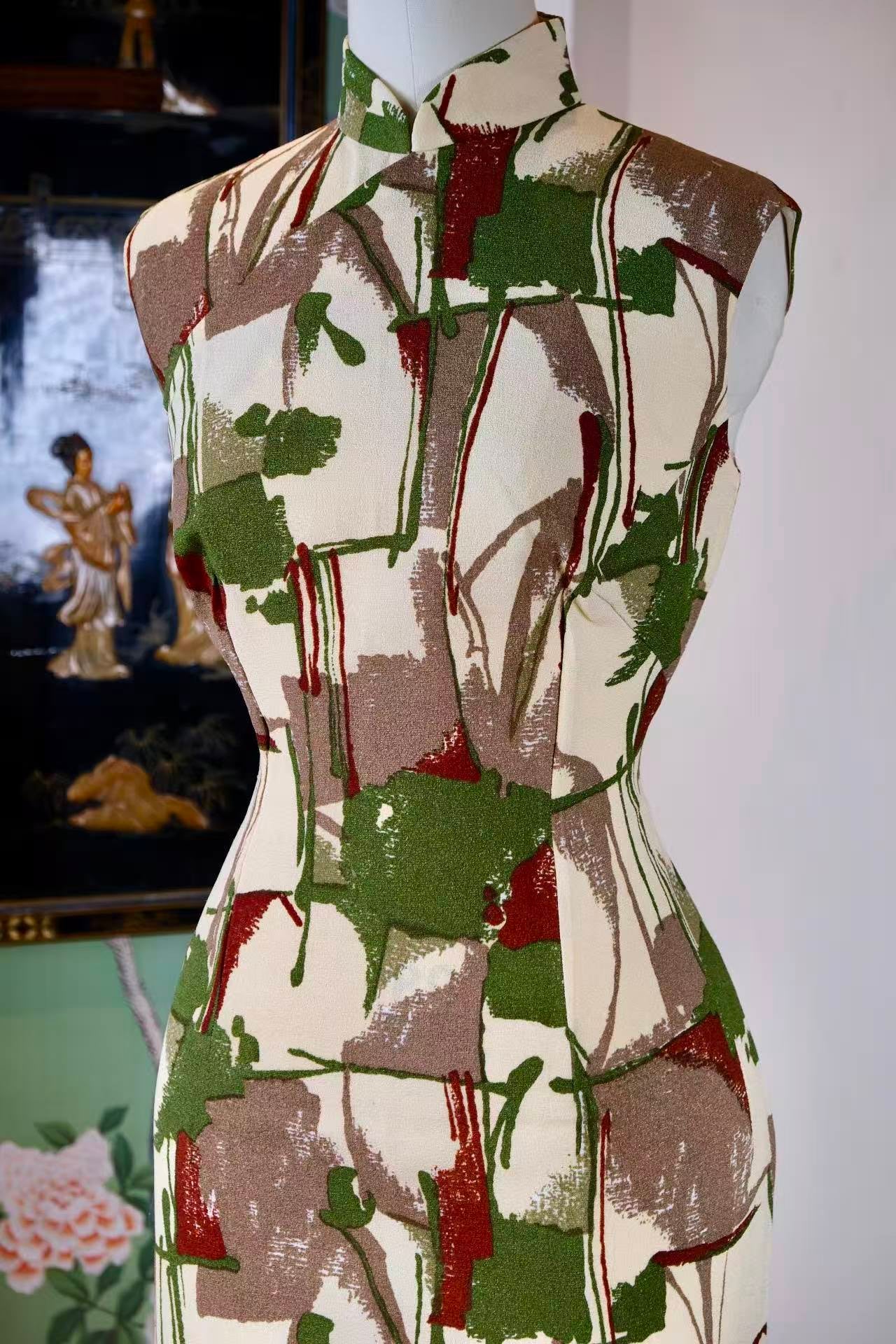
当波普艺术在西方掀起色彩革命,东方的香江裁缝却以针线为笔,在绉纱上泼洒出一幅“墨渖淋漓”的写意山水。这件香港产古董旗袍,以米白为纸,褐赭为骨,翠绿与酡红为魂,将传统折枝花卉解构为抽象色块——或如荷叶田田,或似兰叶萋萋,更以飞白笔触摹写藤蔓缠绕,恍若徐渭《墨葡萄图》的纵逸,又带几分克萊福特·斯蒂爾(Clyfford Still)色域绘画的锋芒。
面料肌理尤见匠心:绉纱底料暗织细密菱纹,似宣纸纤维的自然肌理;印花处则以厚涂技法呈现凹凸触感,褐赭色块如枯墨皴擦,翠绿斑点若新篁带露,每一道色渍的晕染、每一笔线条的流淌,皆是手工筛网印染不可复制的“时间褶皱”。
存世者不过沧海一粟。彼时香港制衣业方兴未艾,“唐装”作为东方符号远销欧美,而此般以抽象水墨解构传统纹样的孤品,更似一场隐秘的艺术实验:裁缝未必读过《历代名画记》,却以针线应和了“外师造化,中得心源”的古训,在方寸布帛间,留住了那个东西方美学碰撞的璀璨瞬间。
1960s Hong Kong: An Ink-Wash Rhythm Qipao
"When Pop Art ignited a color revolution in the West, the tailors of Hong Kong used needles and threads as brushes, splashing a 'drenched ink' freehand landscape upon silk crepe."
This antique Qipao, crafted in Hong Kong, treats cream-white as its paper and brownish-ochre as its bone, with emerald green and rosy-red as its soul. It deconstructs traditional floral sprays into abstract color blocks—at times resembling lush lotus leaves, at others, flourishing orchids. With "Flying White" (Feibai) brushstrokes mimicking entwined vines, it captures the untamed spirit of Xu Wei’s Inky Grapes, while possessing the sharp edges of a Clyfford Still color-field painting.
The fabric texture reveals extraordinary ingenuity: the crepe base is subtly woven with fine diamond patterns, mimicking the natural fibers of Xuan paper. The printed areas utilize a heavy-impasto technique to create a tactile, embossed feel; the brownish-ochre blocks resemble "dry-ink rubbing" (Cunca), while the emerald spots look like dew on fresh bamboo. Every blurred stain and every flowing line is a non-reproducible "wrinkle of time" from the manual screen-printing process.
Existing pieces are but a drop in the ocean. During that era, the Hong Kong garment industry was flourishing, and "Tangzhuang" (Chinese-style attire) was exported as an Oriental symbol to Europe and America. Yet, a unique piece like this—which deconstructs traditional motifs through abstract ink-wash—is more like a secret artistic experiment. The tailor might not have studied the Records of Famous Paintings of All Dynasties, yet through needle and thread, they echoed the ancient precept: "Take nature as one’s teacher, but find the source of inspiration within the heart." Within these few inches of fabric, they preserved the dazzling moment of collision between Eastern and Western aesthetics.