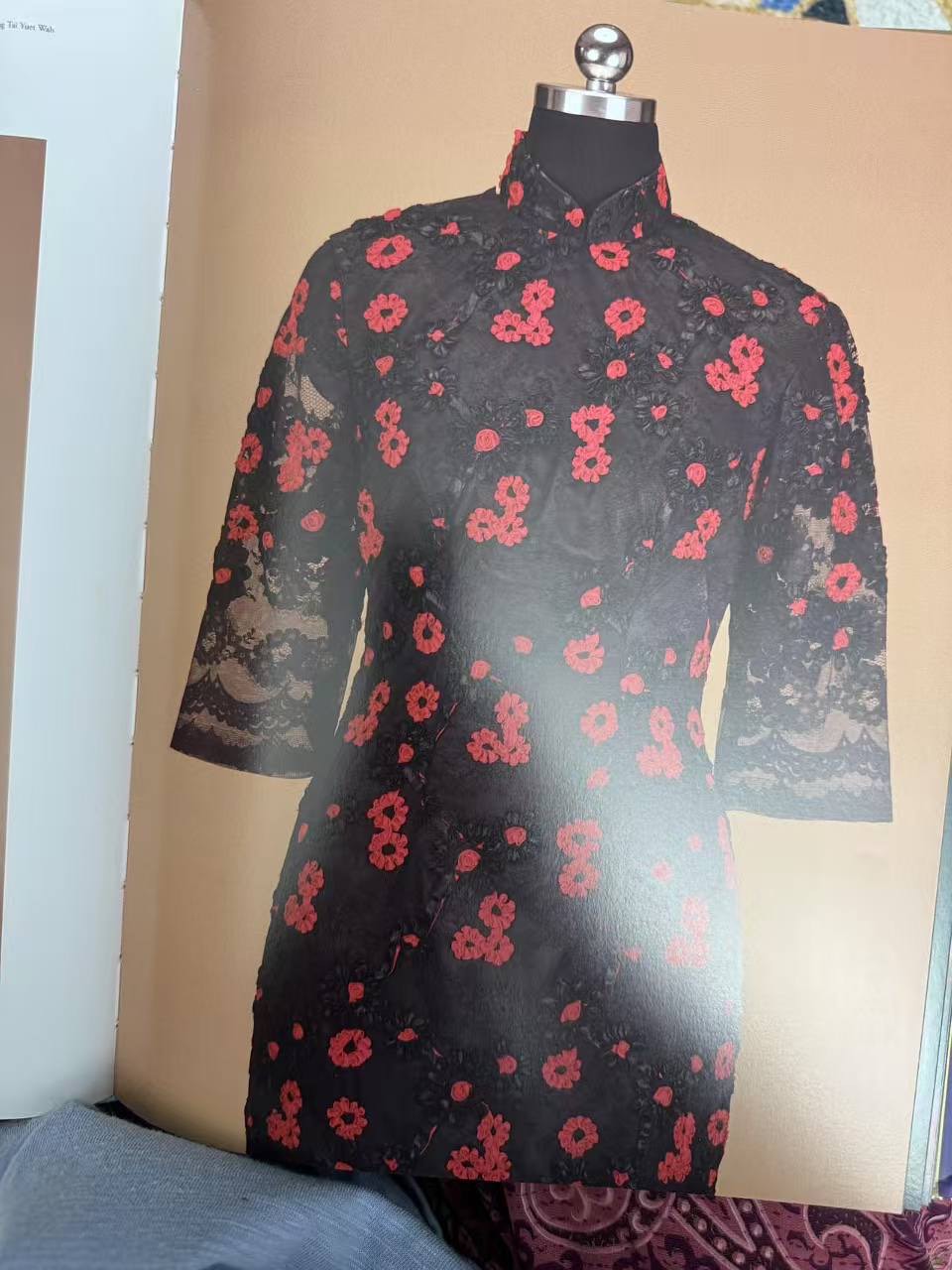
分享一件上世纪六十年代台湾产黑色蕾丝刺绣欧根纱斜襟古董旗袍。
黑如深夜绢帛,红似炽烈火焰——这件上世纪六十年代台湾产的黑色欧根纱机绣蕾丝旗袍,宛如从《捣练子》“金线绣衣裳”的古典画卷中走出,又带着六十年代摩登风骨。其花色与邓戴月华女士珍藏旗袍高度呼应,恰似《红楼梦》“红香绿玉”在现代的重现,将东方刺绣的雅致与蕾丝的轻盈,绣进了每一寸光影流转里。
衣身满布机绣花卉,黑欧根纱为底,红色丝线勾勒花枝,花瓣层叠,以散点式构图分布,疏密相间,暗合《园冶》“疏密有致,曲折入画”的章法;花蕊处点缀立体绣,如《楚辞·招魂》“红璧沙版,玄玉梁些”的华贵。
台湾纺织业档案馆仅存一件同款藏品(即邓戴月华女士旧藏),且款式细节略有差异,此袍将欧根纱蕾丝与机绣工艺完美融合,堪称“东方美学的现代变奏”。六十年代的台湾,正经历传统与现代的碰撞:西门町的爵士乐与庙口的歌仔戏交织,西方立体剪裁与东方平面裁剪在旗袍上达成和解。此袍的黑红碰撞象征东方的含蓄与西方的热烈,机绣蕾丝则吸纳西方装饰艺术(Art Deco)的璀璨,繁花印花在霓虹灯影下流转,恰似《牡丹亭》“姹紫嫣红”与“摩登时代”的完美交融。它不仅是衣物,更是台湾黄金年代的文化标本。
当红花在黑纱上绽放,当蕾丝在光影中流转,这件旗袍早已超越物质本身,成为时代精神与匠人智慧的双重见证。它在针脚间镌刻着台湾匠人的创新,在纹样中封存着六十年代的浮华与沧桑,更在花团锦簇的吉意里,诉说着东方美学永不褪色的传奇。每一寸光影流转,都是对“织物有魂,图案有灵”的最好诠释。
🖤 The Black Rose of Modernity: A Vintage 1960s Taiwanese Cheongsam in Black Organza with Machine Embroidery and Lace
Black as midnight silk, red as a blazing fire—this late 1960s Taiwanese cheongsam, made of black organza with machine-embroidered lace, seems to have stepped out of the classical painting described in the Daolianzi (捣练子), "embroidered robes with golden thread," yet it carries the modern spirit of the sixties. Its pattern highly resembles a cherished cheongsam preserved by Ms. Deng Dai Yuehua, like a modern reappearance of the "red fragrance and green jade" (红香绿玉) from Dream of the Red Chamber. It weaves the elegance of Oriental embroidery and the lightness of lace into every subtle shift of light and shadow.
The body of the robe is covered with machine-embroidered flowers. The base is black organza, with red silk threads outlining the branches. The petals are layered and distributed in a scattered compositional style (散点式构图), dense and sparse by turns, aligning with the rule from the Yuan Ye (The Craft of Gardens): "Dense and sparse with artful arrangement, twists and turns that enter the painting." The flower centers are embellished with dimensional embroidery (立体绣), reflecting the luxury of the "red jade tablet, dark jade beam" (红璧沙版,玄玉梁些) from the Songs of Chu: Summoning the Soul.
Only one item of the same style remains in the Taiwan Textile Archives (Ms. Deng Dai Yuehua's former collection), with slight variations in detail. This robe, which perfectly blends organza lace with machine embroidery, can be called a "modern variation of Oriental aesthetics." The 1960s in Taiwan were marked by a collision between tradition and modernity: the jazz of Ximending interwove with the Gezai Opera at the temple gates, and Western three-dimensional cutting achieved a reconciliation with Eastern flat cutting on the cheongsam. The black and red contrast of this robe symbolizes the contrast between Oriental subtlety and Western passion. The machine-embroidered lace absorbs the brilliance of Western Art Deco, and the vibrant floral print, shimmering under the neon lights, perfectly embodies the fusion of the "brilliant purples and reds" (姹紫嫣红) from The Peony Pavilion and the "Modern Era." It is more than mere clothing; it is a cultural specimen of Taiwan's Golden Age.
When red flowers bloom on the black sheer fabric, and lace flows in the light and shadow, this cheongsam transcends the material itself, becoming a dual witness to the spirit of the era and the wisdom of the artisan. It inscribes the innovation of Taiwanese craftsmanship in its stitches, seals the glamour and vicissitudes of the sixties in its motifs, and, through the auspicious meaning of the luxuriant floral clusters, narrates the never-fading legend of Oriental aesthetics. Every shift in light and shadow is the best interpretation of "the fabric has a soul, and the pattern has a spirit."