深圳溯源
Couldn't load pickup availability
衣服尺寸:
胸围/腰围/臀围:92/78/104 厘米
衣长:126 厘米
细节描述:
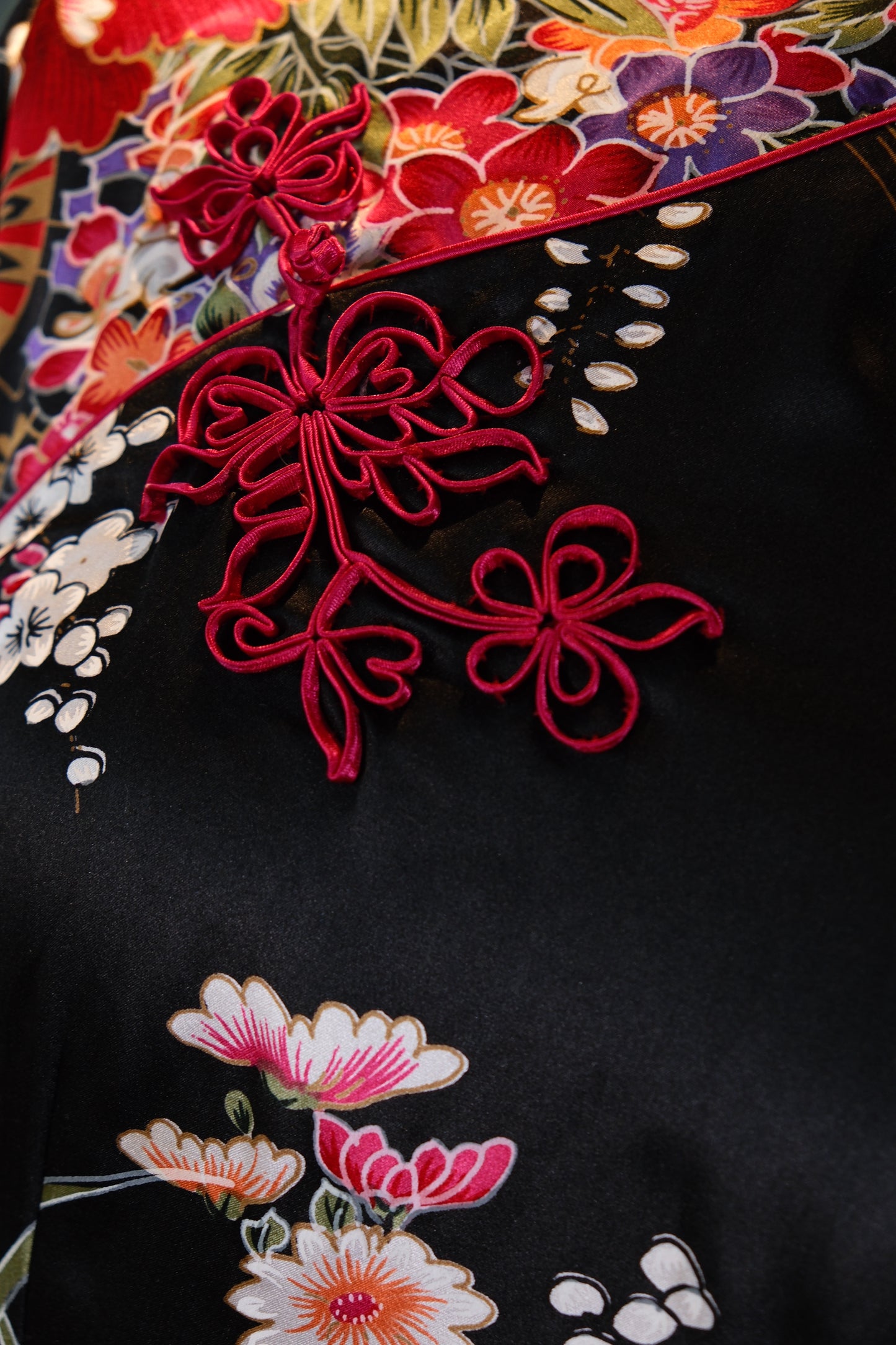
这件上世纪六十年代的台湾产古董旗袍,在黑色缎面上铺陈出浓墨重彩的“和风”印花,红色手工盘扣如点睛之笔,将东方美学的典雅与异域风情的绚烂熔于一炉。
它以“黑地繁花”的视觉张力,诉说着特殊年代里传统与时尚的碰撞,每一针每一线都凝结着匠人的心血,每一片花瓣都绽放着跨越时空的艺术生命力。
一、图案解析:和风意趣与东方美学的碰撞
旗袍以黑色丝缎为底,其上遍布浓艳的和风花卉纹样,主要图案可细分为三类:
- 主体花卉:以大朵牡丹、芍药为核心,花瓣层叠饱满,色彩以朱红、粉白、橙黄为主,间以紫色小花点缀,形成“万花丛中一点紫”的视觉焦点。牡丹在中国传统文化中象征“富贵”,而在日本和风中则常与“物哀”美学结合,暗含对繁华易逝的喟叹。
- 辅助纹样:穿插着樱花、紫藤、菊等典型和风元素。樱花以白色小朵呈现,如星子散落,呼应日本“花见”文化中对短暂之美的珍视;紫藤垂坠如瀑,线条柔美,暗合“藤花之可敬,如美人之可慕”的古典意象;菊花则以紫色、红色为主,形态饱满,既符合中国“菊傲霜雪”的气节,又呼应日本“菊纹”的皇室象征。
- 枝叶与留白:绿色枝叶以写意笔法勾勒,疏密有致,黑色底料上的留白处理,既凸显花卉的浓艳,又暗合中国传统绘画“计白当黑”的意境,使整体图案在繁复中见空灵,绚烂中藏雅致。
二、古董衣的故事:时代洪流中的时尚孤本
这件旗袍诞生于上世纪六十年代的台湾,彼时正值东西方文化交融的特殊时期。1949年后,大量大陆匠人迁台,将苏绣、京绣等传统工艺带入宝岛,而台湾作为当时东亚重要的纺织业中心,又深受日本和风文化影响(日据时期遗留的审美惯性)。这件旗袍正是两种文化碰撞的产物——它以中国传统旗袍的立领、盘扣、收腰剪裁为骨架,却大胆采用和风印花,既是对“正统”旗袍形制的坚守,又是对时代潮流的回应。
据考证,六十年代台湾的旗袍制作多采用“来料加工”模式,面料多从日本进口(尤其是和风印花绸),而裁剪与刺绣则由本地匠人完成。
三、艺术风格与稀缺性:引经据典的文化密码
从艺术风格看,这件旗袍完美诠释了“海派旗袍”的晚期特征——“中西合璧,古今交融”。正如张爱玲在《更衣记》中所言:“旗袍的作用不外乎烘云托月忠实地将人体轮廓曲曲勾出”。
其稀缺性体现在三方面:
- 面料稀缺:六十年代台湾产的和风印花丝缎,因当时纺织技术限制,色彩牢度与图案精细度远超同期大陆产品,存世量极少。
- 工艺稀缺:手工盘扣与印花的结合,需匠人具备“画、绣、裁”三重技艺,如今此类全手工旗袍已近乎绝迹。
- 文化稀缺:作为“冷战时期东亚文化交融”的实物见证,它承载着特殊历史时期的审美记忆,正如学者李欧梵所言:“旗袍是流动的文化符号,每一件古董旗袍都是一部微缩的时尚史。”
四、结语:穿在身上的历史,绽放在时光里的花
这件旗袍,是上世纪六十年代台湾时尚界的“孤本”,是东西方文化碰撞的“活化石”,更是中国传统工艺与和风美学交融的“艺术品”。它曾属于某位优雅的女性,或许在台北的咖啡馆里,或许在台南的古厝中,见证过那个年代的繁华与落寞。如今,它静静陈列,花瓣依旧绚烂,仿佛在诉说着:“美,从不因时光流逝而褪色,只会在岁月中沉淀出更醇厚的韵味。”
Measurements / Size Guide:
Bust / Waist / Hips: 92/78/104 cm
Total Length: 126 cm
Detailed Description:
This 1960s antique qipao from Taiwan unfolds a rich and vibrant "Wafuku" (Japanese-style) print across a black satin canvas. The crimson hand-fashioned flower buttons (Pankou) serve as the perfect "finishing touch," melting the elegance of Oriental aesthetics and the splendor of exotic flair into a single furnace.
Through the visual tension of "florals upon a black ground," it narrates the collision of tradition and fashion during a unique era. Every stitch condenses the artisan's soul, and every petal blooms with an artistic vitality that transcends time and space.
The qipao is built upon a black silk satin base, adorned with dense and vivid Japanese-inspired floral motifs. The patterns can be categorized into three distinct layers:
Primary Florals: Large peonies and herbaceous peonies form the core. The petals are layered and full, dominated by vermillion, powder-white, and orange-yellow, punctuated by small purple blossoms. In Chinese culture, the peony symbolizes "wealth and nobility," while in Japanese "Wabi-sabi" or "Mono no aware" aesthetics, it often hints at the fleeting nature of prosperity.
Auxiliary Motifs: Interspersed with quintessential Japanese elements such as cherry blossoms (Sakura), wisteria, and chrysanthemums. The cherry blossoms appear as tiny white stars, echoing the Japanese "Hanami" culture's reverence for transient beauty. The wisteria drapes like a waterfall with supple lines, matching the classical sentiment: "The wisteria is as venerable as a beautiful woman is admirable." The chrysanthemums, in deep purple and red, reflect both the Chinese "integrity amidst frost" and the Japanese Imperial "Kiku" symbolism.
Foliage and Negative Space: The green leaves are sketched with "freehand" (Xieyi) strokes. The use of black as negative space (Liu Bai) highlights the vividness of the flowers while aligning with the traditional Chinese painting principle of "treating white as black," allowing the complex pattern to maintain a sense of ethereal grace.
Born in 1960s Taiwan, this qipao emerged during a unique period of cultural convergence. After 1949, many mainland artisans migrated to the island, bringing traditional techniques like Suzhou and Beijing embroidery. Meanwhile, as a key East Asian textile hub, Taiwan was deeply influenced by Japanese aesthetic inertia from the colonial period. This qipao is the physical offspring of these two cultures—it uses the "skeleton" of a traditional high collar, pankou, and cinched waist, but boldly adopts Wafuku prints, serving as both a defense of "orthodox" form and a response to the trends of the times.
Research suggests that 1960s Taiwanese qipaos often followed an "imported material, local craft" model, where high-end printed silks were imported from Japan while the tailoring and finishing were completed by local masters.
Artistically, this piece perfectly interprets the late-stage characteristics of the "Haipai" (Shanghai-style) qipao—"fusing East and West, blending ancient and modern." As Eileen Chang noted in A Record of Changing Clothes: "The function of the qipao is to faithfully trace the contours of the human body."
Its rarity is manifest in three aspects:
Material Rarity: Due to the textile constraints of the 1960s, the color fastness and pattern precision of Taiwanese-produced Wafuku silk satin far surpassed mainland products of the same era. Surviving examples are extremely scarce.
Craft Rarity: The combination of hand-fashioned pankou and precision printing required the artisan to master "painting, embroidery, and tailoring." Such fully manual qipaos have nearly vanished today.
Cultural Rarity: As a witness to "East Asian cultural exchange during the Cold War," it carries the aesthetic memory of a specific historical window. As scholar Leo Ou-fan Lee remarked: "The qipao is a fluid cultural symbol; every antique qipao is a miniature history of fashion."
This qipao is a "unique specimen" of 1960s Taiwanese fashion—a "living fossil" of cultural collision. It once belonged to an elegant woman, witnessing the prosperity and solitude of an era in a Taipei cafe or a Tainan manor. Today, it stands quietly, its petals still brilliant, as if whispering: "Beauty never fades with time; it only settles into a more mellow charm within the years."