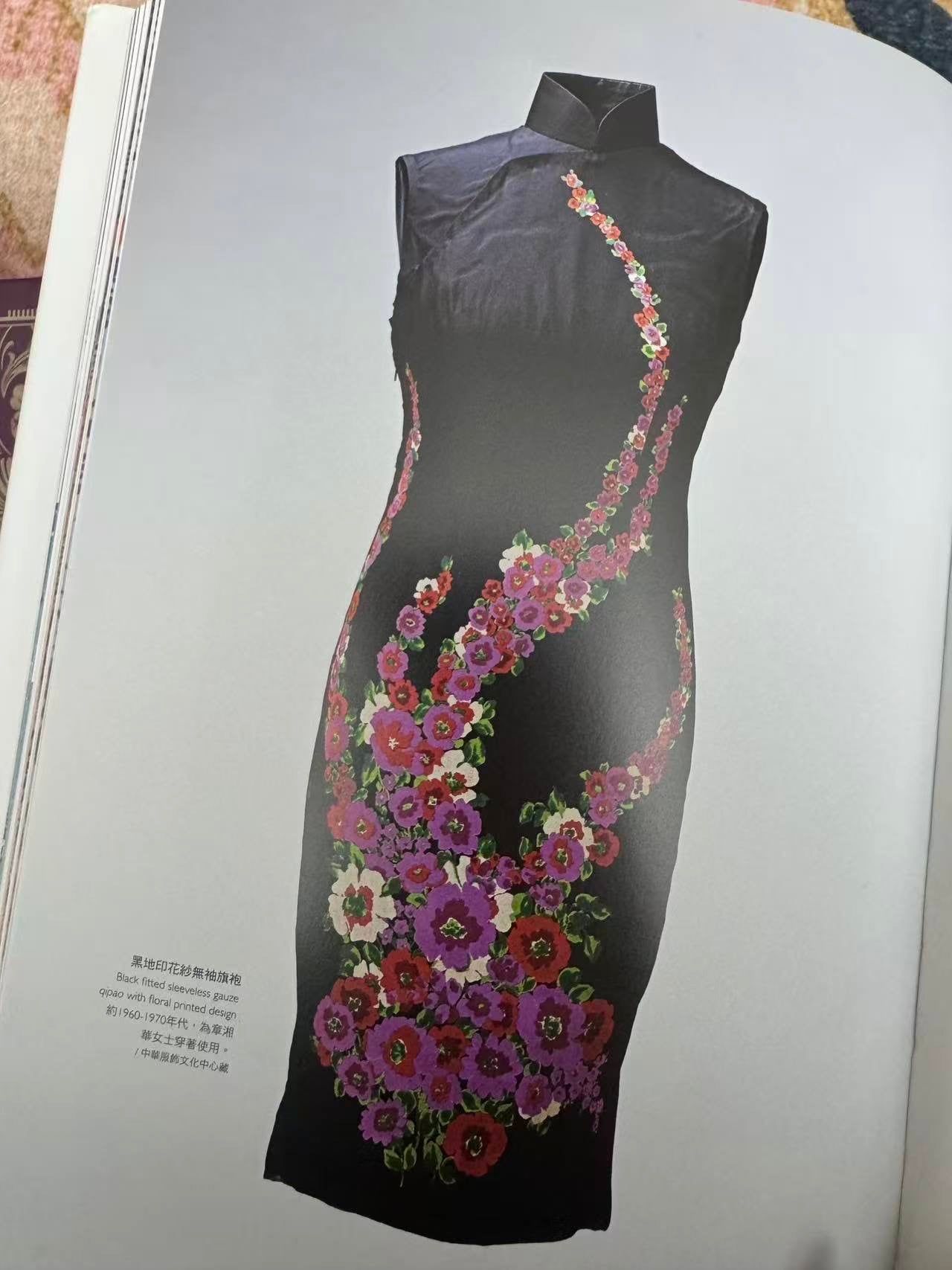
分享这件诞生于上世纪六十年代的斜纹印花香港产古董旗袍,是时光凝结成的墨宝。
墨色为底,钴蓝写意,牡丹、芭蕉、水仙等花卉以大写意笔法错落铺陈,笔触间可见“屋漏痕”式的沉郁张力,花瓣边缘的晕染与墨色浓淡变化,暗合吴昌硕“苦铁画气不画形”的金石趣味。如同1930年代《良友》画报中画家设计旗袍的先例,此作以面料为宣纸,以躯体为框,定格了海派艺术“雅俗共赏”的黄金瞬间。
斜纹面料的肌理感,为写意花卉增添了“纸墨相发”的生动气韵。1960年代的旗袍已进入“高腰窄摆”的极简主义阶段,此作肩线微削,腰臀比精准贴合“沙漏曲线”。这类“文人写意印花”旗袍,脱胎于上海“云裳”“民光”等绸缎庄的创新实践:他们将传统织锦、水墨画技法转译为面料语言,使旗袍从“日常衣物”升华为“移动的书画空间”,成为海派文化“不中不西、亦古亦今”的最佳注脚。
当旗袍在时代浪潮中演变为符号,此件作品以“蓝墨对话”留存的,不止是躯壳,更是那个年代对“衣”作为“艺术媒介”的虔诚实验——当画家在面料上挥毫,当女性以躯体作纸,传统与摩登、文雅与性感,便在一片写意花卉中,达成了永恒的和解。
(注:此旗袍可被视为研究1960年代海派服饰与文人审美互动的一手实物,其款识、面料工艺与版型特征,均具重要学术与收藏价值。)
Sharing this vintage qipao (cheongsam) from Hong Kong, produced in the 1960s with a twill print fabric—a true ink treasure solidified by time.
Against an ink-black base, cobalt blue and darker shades create an expressive, xieyi (freehand) rendering of flowers such as peonies, banana leaves, and narcissus. The brushstrokes reveal a heavy tension reminiscent of the "leaks in a crumbling wall" technique (wulouhen), while the subtle blending and ink wash variations along the petal edges echo the ancient stone-carving aesthetic (jinshi weidao) favored by artists like Wu Changshuo, who sought to "paint the spirit, not the form." Much like the early precedent set by artists designing qipaos for Liangyou Pictorial in the 1930s, this piece uses the fabric as rice paper (xuanzhi) and the body as a frame, capturing a golden moment of Shanghai-style art that appealed to both high and popular culture.
The tactile quality of the twill fabric enhances the vibrancy of the freehand florals, giving them a lifelike quality of "paper and ink resonating together." By the 1960s, the qipao had entered its minimalist phase, characterized by a high waist and narrow skirt. This piece features slightly trimmed shoulders and a precise hip-to-waist ratio, conforming accurately to the "hourglass silhouette." These "literati xieyi printed qipaos" emerged from the innovative practices of Shanghai silk houses like "Yunshang" and "Minguang": they translated traditional brocade and ink-wash painting techniques into a textile language, elevating the qipao from an "everyday garment" to a "mobile space for painting and calligraphy," becoming the perfect footnote to Shanghai culture's characteristic blend of "neither purely Chinese nor purely Western, neither entirely old nor entirely new."
As the qipao transformed into a cultural symbol amidst the waves of the era, this work, sustained by the "dialogue between blue and ink," preserves more than just the physical form; it retains that era's devout experimentation with the garment as an "artistic medium." As the painter wielded the brush upon the fabric and the woman used her body as the canvas, tradition and modernity, elegance and sensuality, achieved an eternal reconciliation within a field of freehand florals.
(Note: This qipao can be considered a firsthand physical specimen for studying the interaction between 1960s Shanghai-style fashion and literati aesthetics. Its style, fabric process, and tailoring characteristics hold significant academic and collection value.)