深圳溯源
Couldn't load pickup availability
衣服尺寸:
胸围/腰围/臀围:88/74/92 厘米
衣长:95 厘米
细节描述:
纹样解构:千年敦煌的几何回响
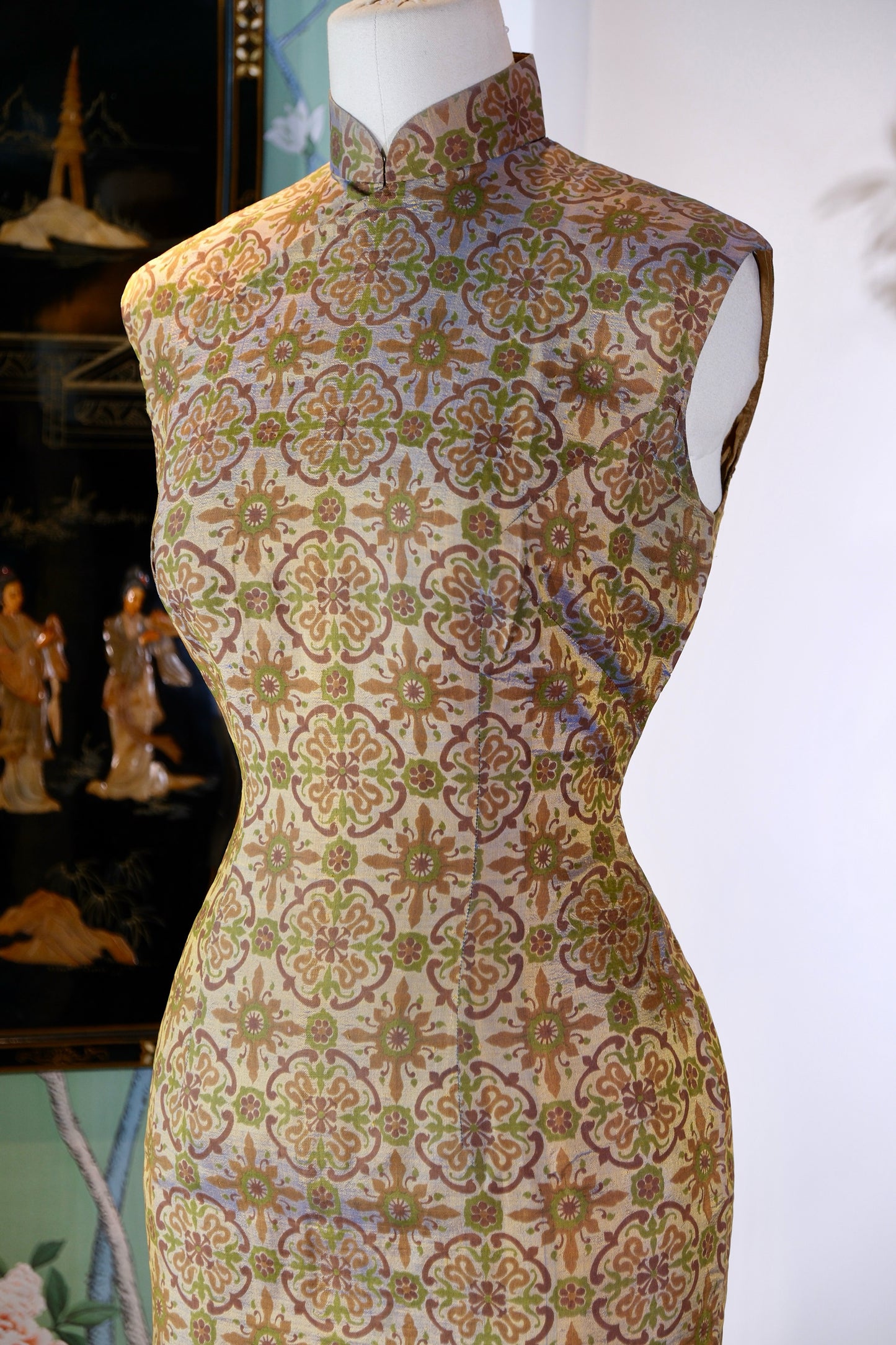
这件旗袍最令人瞩目的,莫过于其面料上繁复而秩序井然的纹样。这并非普通的花草描摹,而是极具唐代美学特征的“宝相花”纹样的几何化变体。
- 纹样源流:宝相花,盛行于唐代,是佛教艺术与中国传统花卉纹样结合的产物。它不特指某一种花,而是集合了莲花、牡丹、菊花的特征,寓意“宝相庄严”。在这件旗袍上,我们可以看到纹样以四方连续的方式排列,中心花蕊呈放射状,外层花瓣卷曲如云,周围辅以联珠纹与卷草纹的变体。
- 色彩美学:不同于清代宫廷的浓墨重彩,这件六十年代旗袍的配色显得尤为高级且克制。底色为温润的香槟金,纹样则采用了赭石、橄榄绿与暗紫褐色交织。这种配色方案既保留了敦煌壁画的古朴厚重感,又融入了现代主义的色块构成意识,呈现出一种“古韵新姿”的视觉效果。
材质与工艺:泰丝的光泽与香江的剪裁
这件旗袍的稀缺性,很大程度上源于其面料与产地的独特结合。
- 泰丝的独特质感:所谓的“泰丝”,在六十年代的香港时装界是“高级”的代名词。与普通丝绸不同,泰丝的丝线通常由手工缫制,表面具有独特的竹节纹理。在光线下,它不会像缎面那样刺眼,而是散发出一种如珍珠般内敛而深邃的哑光。这种面料挺括有型,极适合制作这种强调身体曲线的紧身旗袍。
- 六十年代香港剪裁:这是一件典型的“海派遗风,港式改良”的作品。
- 无袖设计:六十年代是旗袍长度最短、款式最现代化的时期。无袖设计打破了传统的保守,展露出手臂的线条,呼应了当时女性追求独立与解放的社会思潮。
- 归拔工艺:从照片中可以看出,旗袍在腰部和臀部的过渡极为流畅,这是传统手工“归拔”工艺的体现——通过高温熨烫改变织物经纬密度,使平面的布料立体化,完美贴合女性S型曲线,如“第二层肌肤”般包裹着身体。
历史叙事:流金岁月的文化孤本
每一寸面料都写满了故事。
- 时代的缩影:上世纪五六十年代的香港,是东西方文化剧烈碰撞的熔炉。那时的旗袍,不再仅仅是传统的礼服,而是成为了都市女性的日常着装。这件旗袍,或许曾属于一位在湾仔写字楼里工作的摩登女郎,或是参加赛马会的名媛。它见证了那个“花样年华”般的流金岁月,是那个时代审美自信的实物佐证。
- 稀缺性的学术注脚:在纺织史上,这种将敦煌元素进行几何化、现代化处理的泰丝面料,流行时间极短,存世量极少。如今,随着老一代制衣匠人的凋零,这种完全依赖手工归拔、对版型要求极高的传统旗袍制作工艺已近失传。这件旗袍,不仅是衣物,更是一件不可复制的“软雕塑”。
结语
它静默地伫立,却仿佛在诉说一个关于时间、关于美、关于那个回不去的东方巴黎的故事。这不仅仅是一件旗袍,这是一段被织物封存的六十年代香江旧梦。
Measurements / Size Guide:
Bust / Waist / Hips: 88/74/92 cm
Total Length: 95 cm
Detailed Description:
The most striking feature of this Qipao is the intricate yet orderly pattern on its fabric. This is not a common depiction of flora, but a geometric variation of the "Baoxiang Flower" (Flower of Precious Appearance), a motif deeply rooted in Tang Dynasty aesthetics.
Origin of the Motif: Popular during the Tang Dynasty, the Baoxiang Flower is a fusion of Buddhist art and traditional Chinese floral patterns. It does not refer to a specific flower but combines the features of the lotus, peony, and chrysanthemum, symbolizing "solemn dignity." On this Qipao, the pattern is arranged in a four-way continuous layout, with a radiating central stamen, cloud-like curled petals, and surrounding variations of pearl and scrolling grass motifs.
Color Aesthetics: Distinct from the heavy, intense palettes of the Qing court, the color scheme of this 1960s piece is remarkably sophisticated and restrained. The base is a warm champagne gold, while the patterns are woven with ochre, olive green, and dark plum-brown. This palette preserves the ancient, heavy charm of Dunhuang frescoes while integrating a modernist sense of color blocking, creating a visual effect of "ancient charm in a modern form."
The rarity of this Qipao stems largely from the unique combination of its fabric and its place of origin.
The Unique Texture of Thai Silk: In the 1960s Hong Kong fashion world, "Thai Silk" was synonymous with "High Fashion." Unlike ordinary silk, Thai silk is typically hand-reeled, featuring a distinctive slubbed texture on the surface. Under light, it does not dazzle like satin but radiates a restrained, deep matte glow akin to pearls. This fabric is crisp and structured, making it ideal for a form-fitting Qipao that emphasizes bodily curves.
1960s Hong Kong Tailoring: This is a classic example of "Shanghai Heritage, Hong Kong Modification."
Sleeveless Design: The 1960s marked the period when Qipaos reached their shortest lengths and most modern silhouettes. The sleeveless design broke traditional conservatism, revealing the arms and echoing the social trend of women pursuing independence and liberation at the time.
"Gui-Ba" Craftsmanship (Stretching and Shrinking): As seen in the photographs, the transition at the waist and hips is exceptionally fluid. This is the manifestation of the traditional "Gui-Ba" technique—using high-temperature ironing to alter the density of the fabric's warp and weft. This process transforms flat cloth into a three-dimensional form that perfectly contours the female S-curve, enveloping the body like a "second skin."
Every inch of the fabric is steeped in history.
A Microcosm of an Era: Hong Kong in the 1950s and 60s was a melting pot of intense collision between Eastern and Western cultures. At that time, the Qipao was no longer just traditional formal wear but became the daily attire of urban women. This piece may have belonged to a modern lady working in a Wan Chai office or a socialite attending a race club. It witnessed those "In the Mood for Love" golden years and serves as physical evidence of the era's aesthetic confidence.
Academic Note on Rarity: In textile history, Thai silk fabrics that treated Dunhuang elements with such geometric and modern precision were popular for only a very short time, making surviving pieces extremely rare. Today, with the passing of the older generation of garment masters, the traditional Qipao-making process—which relies entirely on manual "Gui-Ba" and exacting pattern-making—is nearly lost. This Qipao is not just clothing; it is an irreplaceable "soft sculpture."
It stands silently, yet seems to tell a story about time, beauty, and that lost "Paris of the East." This is more than a Qipao; it is a fragment of the 1960s Hong Kong dream, preserved in fabric.