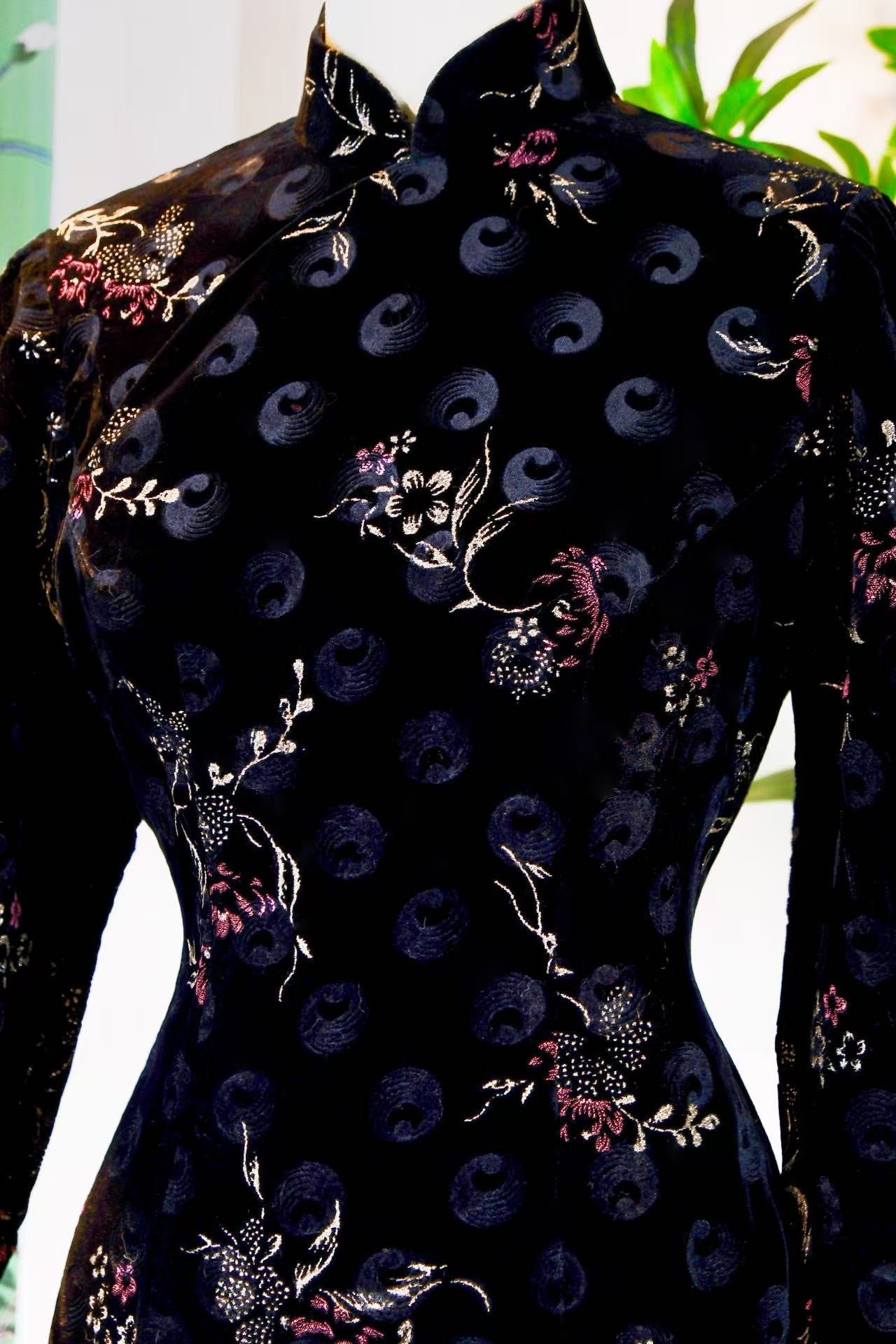
分享一件六十年代手绘描金香港古董旗袍:黑丝绒上的东方美学史诗。
此袍以黑丝绒为底,先经特殊机器高温压烫,形成螺旋云纹肌理,光影流转间如墨晕染;再以彩绘颜料手绘花枝,金粉勾勒花脉鸟羽,紫红点染花蕊,白描枝叶,技法承宋元工笔遗韵,兼得清代缂丝“丝缕藏诗”的雅意。
袍身遍布折枝花卉,或为梅兰竹菊“四君子”,暗合《楚辞》“纫秋兰以为佩”的君子品格;或绘绶带鸟栖于枝头,《诗经·小雅》有“鸳鸯在梁,戢其左翼”,绶带象征祥瑞,与卷草纹交织,承唐代“陵阳公样”窦师纶创“瑞锦”之遗风。袖口散落小花,似李贺“石榴花发满溪津”的烂漫,又如苏轼“竹外一枝斜更好”的疏影横斜,方寸间藏山水意境。
香港六十年代旗袍融合岭南工艺与海派摩登,此袍采用机器压纹与手绘彩绘结合的技法,需工匠经月绘制。其工艺承晚清宫廷织造遗脉,又启现代中式美学,正如《周礼·考工记》所言“天有时,地有气,材有美,工有巧”,四美具而此袍成,堪称行走的东方艺术史。
一袭黑绒如夜,金粉花枝似星,云纹暗涌若流云。此袍非衣,乃六十年代香港华服的绝响,以丝线为笔,以岁月为纸,写就东方美学的永恒诗篇。
✍️ An Oriental Aesthetic Epic on Black Velvet: A Vintage 1960s Hong Kong Hand-Painted Cheongsam with Gilt Accents
This robe uses black silk velvet as its ground. It is first subjected to a special high-temperature machine press to create a spiral cloud pattern texture (螺旋云纹肌理), which, in the shifting light, blends like an ink wash. Then, it is painted with colored pigments, using gold powder to outline flower veins and bird feathers, purplish red to accent flower stamens, and ink outlines (baimiao) for the branches and leaves. The technique inherits the enduring grace of Song and Yuan meticulous painting (gongbi), while possessing the refined elegance of Qing Dynasty kesi (tapestry weaving) where "silk threads conceal poetry."
The robe is covered with cut-off branch motifs. Some are the "Four Gentlemen" (梅兰竹菊—plum, orchid, bamboo, chrysanthemum), subtly aligning with the gentlemanly integrity of the Songs of Chu: "I string the autumn orchids for my girdle." Others depict the Paradise Flycatcher (绶带鸟) perched on branches; the Classic of Poetry: Lesser Odes contains the line, "The mandarin duck is on the beam, resting its left wing," and the Paradise Flycatcher symbolizes auspiciousness. Interwoven with scroll patterns, it carries the legacy of the "Lingyang Gong Style" of brocade created by Dou Shirun in the Tang Dynasty. Small flowers are scattered on the cuffs, resembling the vibrancy of Li He's "pomegranate flowers bloom over the stream," and the sparse, oblique shadows of Su Shi's "a single branch diagonally outside the bamboo is even better." Within this small space, the atmosphere of landscape painting is contained.
1960s Hong Kong cheongsams fused Lingnan craftsmanship with Shanghai modernity. This robe employs a technique combining machine embossing with hand-painting. It required artisans to spend months on the drawing. Its craftsmanship inherits the lineage of late Qing imperial weaving while pioneering modern Chinese aesthetics. Just as the Rites of Zhou: Examiner of Works stated, "Heaven has its seasons, the Earth has its vital forces, the material has its beauty, and the craftsperson has their skill," this robe, possessing all four perfections, is a walking history of Oriental art.
A single robe of black velvet is like the night; the golden floral branches are like stars; the dark-surging cloud patterns are like flowing clouds. This robe is not mere clothing; it is the ultimate resonance of Hong Kong high fashion in the sixties, using silk thread as a pen and the passage of time as paper, writing the eternal poem of Oriental aesthetics.