深圳溯源
Couldn't load pickup availability
衣服尺寸:
胸围/腰围/臀围:84/74/92 厘米
衣长:115 厘米
细节描述:
一、图案描述:剪花绒织银的视觉美学
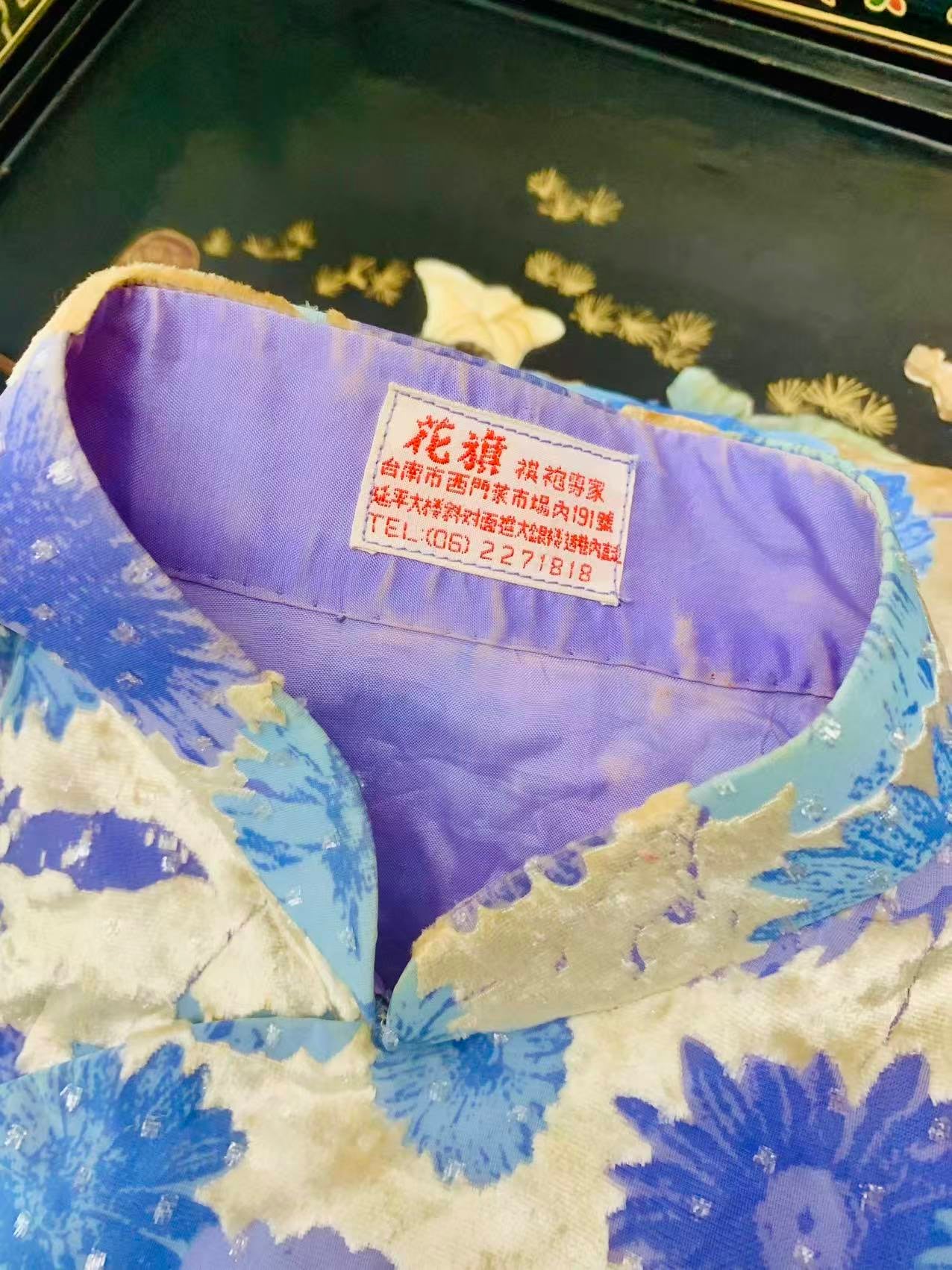
这套古董旗袍以“剪花绒织银”工艺为底,
色彩上,蓝紫与金棕交织,冷暖色调碰撞却不失和谐,
二、古董衣的故事:台南西门的“花旗”往事
这件旗袍的标签上写着“花旗 旗袍专家”,这不仅是店铺信息,更是一段鲜活的历史切片。
“花旗”作为台南最大的旗袍定制品牌之一,
六十年代的台湾旗袍,已从民国时期的“修身显曲线”转向更宽松、
三、艺术风格与稀缺性:从“剪花绒”到文化符号
“剪花绒”工艺源于中国传统丝织技术,通过控制绒毛的长短、
从文化角度看,这件旗袍是台湾六十年代社会风貌的缩影。彼时,
四、引经据典:旗袍中的文化密码
张爱玲曾说:“衣服是一种语言,随身带着的是袖珍戏剧。”
此外,旗袍上的银线,亦可与《红楼梦》中的“金丝八宝攒珠髻”
结语:穿越时空的华服
这件“花旗”旗袍,不仅是一件衣服,更是一段历史的见证,
Measurements / Size Guide:
Bust / Waist / Hips: 84/74/92 cm
Total Length: 115 cm
Detailed Description:
I. Pattern Description: The Visual Aesthetics of Cut-Pile Velvet with Silver Weaving
This antique qipao utilizes the "Cut-Pile Velvet with Silver Weaving" (Jianhua Rong Zhiyin) technique as its foundation. The fabric presents a unique velvet texture—soft and substantial to the touch, with a luster that is both restrained and magnificent. The motif centers on blue-violet floral patterns with full silhouettes and distinct layers of petals. By employing the "cut-pile" technique, the artisan creates a three-dimensional effect through varying heights of the fabric's nap, making the blossoms appear to leap off the surface. Interspersed among the flowers are delicate silver threads, scattered like starlight, weaving a scintillating effect into the velvet base. From a distance, it resembles asters blooming in the twilight; up close, one sees the shifting flow of silver light, showcasing the exquisite precision of the craft.
In terms of color, the intertwining of blue-violet and golden-brown creates a harmonious collision of cool and warm tones, preserving the elegance of a traditional qipao while infusing it with the fashionable flair of the 1960s. The floral distribution is masterfully balanced: denser patterns at the collar and cuffs create visual focal points, while the skirt becomes more spacious and rhythmic—aligning with the Chinese painting philosophy of being "dense enough to stop the wind, yet sparse enough for a horse to gallop through."
II. The Story of the Antique Garment: The "Huaqi" Legacy of Tainan’s West Gate
The label on this qipao reads "Huaqi: Qipao Expert." This is more than just shop information; it is a vivid slice of history. In the 1960s, Taiwan was on the brink of its economic takeoff—a time when tradition and modernity intertwined. As an essential garment for both daily life and social interaction, the qipao carried cultural memories and reflected the shifts of the era.
"Huaqi" was one of the largest bespoke qipao brands in Tainan, and its location choice is intriguing. Rooted in the bustling West Gate market—the heart of civic life filled with human clamor—it suggests that "Huaqi" did not serve only the elite but also met the daily sartorial needs of ordinary citizens. While 1960s Taiwanese qipaos were transitioning toward looser, more practical styles, "Huaqi" maintained traditional tailoring combined with high-difficulty "cut-pile velvet," indicating a clientele of the middle class who demanded quality.
III. Artistic Style and Scarcity: From "Cut-Pile" to Cultural Symbol
The "Cut-Pile Velvet" craft originates from traditional Chinese silk weaving, where patterns are formed by controlling the length and density of the pile—a task requiring immense skill and manual operation by experienced artisans. "Silver Weaving" involves integrating silver threads during the weaving process to give the fabric a metallic sheen. By the 1960s, this process was gradually declining due to high costs and complex procedures, reserved mostly for haute couture or formal gowns. Combining both techniques, this qipao preserves the essence of traditional craft while embracing contemporary aesthetics, making it a "living artifact."
Culturally, this qipao is a microcosm of 1960s Taiwanese society. As women began to step out of the home and participate in social activities, the qipao became their "armor"—it needed to embody feminine softness while adapting to the convenience of daily life. The fit of this garment—tailored but not restrictive, warm but not heavy—is a perfect manifestation of those era-specific needs.
IV. Cultural Allusions: The Codes Within the Qipao
Eileen Chang once said: "Clothes are a language; what one carries with them is a pocket drama." This qipao is precisely the "pocket drama" of a 1960s Taiwanese woman. Its blue-violet blossoms evoke the "gathering plantains" in the Book of Songs, symbolizing a femininity that is both soft and resilient. The "cut-pile velvet" craft echoes the records in Tiangong Kaiwu (The Exploits of the Works of Nature), representing a perfect marriage of ancient technique and modern beauty.
Furthermore, the silver threads within the qipao call to mind the "golden eight-treasure hairpins" from Dream of the Red Chamber. Though intended for common wear, it manifests refinement through detail, reflecting a folk aesthetic wisdom that exists beyond formal rites.
Conclusion: A Splendid Garment Across Time
This "Huaqi" qipao is more than an article of clothing; it is a witness to history and a vessel of heritage. It carries the life memories of 1960s Taiwanese women, condenses the ingenuity of traditional craft, and reflects the unique spirit of its time. Today, as we gaze upon this qipao, we can almost hear the bustle of Tainan's West Gate and see the woman who once walked the alleys wearing it. Her silhouette has long merged with this splendid garment, becoming an unfading landscape in the flow of time.