深圳溯源
Couldn't load pickup availability
Within the sweeping currents of history, certain artifacts emerge like masterfully polished pearls, emitting a gentle, eternal luminescence. This antique qipao ensemble, conceived during the mid-1960s, stands as a pristine monument to cross-cultural design—a rare textile treasure embodying the pinnacle of Eastern and Western aesthetics while recording the legacy of its legendary custodian, Ms. Woo. As a co-director of a major Canadian enterprise, Ms. Woo moved seamlessly across the global luxury landscapes of Europe, Canada, and Hong Kong, establishing herself as a true vanguard of mid-century style.
The genesis of this ensemble is a profound narrative of uncompromising taste and artisan dedication. As remembered by Ms. Woo’s son, his mother approached fashion with an absolute requirement for structural perfection. Each year, she embarked on deliberate sourcing journeys across Europe to personally secure advanced, trend-setting textile volumes. These precious material acquisitions were subsequently routed back to Hong Kong, where her trusted master tailors transformed the raw yardage into bespoke, custom silhouettes engineered precisely to her anatomical measurements. This time-intensive synthesis of European luxury procurement and custom Eastern craftsmanship represented an elite, forward-thinking lifestyle, guaranteeing that this garment possessed an extraordinary pedigree and absolute historical scarcity from the moment of its creation.
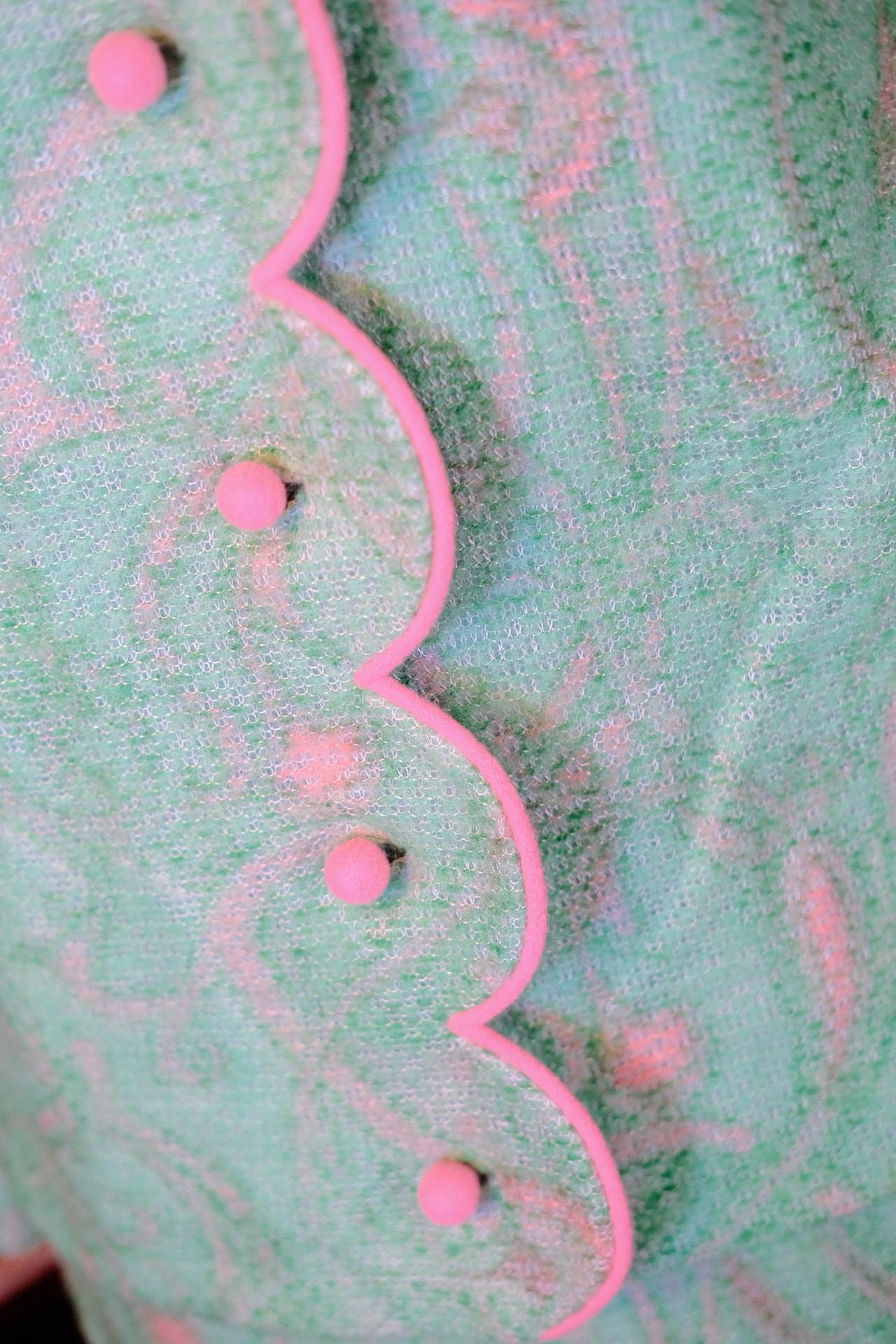
The structural foundation of this ensemble resides in a premium tweed canvas imported directly from Europe. Tweed, historically rooted in traditional Scottish wool weaving, is globally celebrated for its deep tactile relief, exceptional insulating warmth, and proud structural skeleton. During the 1960s, while remaining the premier choice for the European elite’s leisure presentations, this material was famously brought into the absolute highest echelons of haute couture by legendary designers like Coco Chanel, establishing it as the ultimate material cipher for timeless refinement. Ms. Woo’s exceptional eye led her to cross-pollinate this classic Western textile with the sacred, serene framework of the traditional Chinese qipao, yielding a brilliant hybrid masterpiece.
The ultimate allure of the two-piece suit lies in its precision-engineered design geometries and meticulous edge-work. The outerwear jacket adopts a streamlined, minimalist round-neck architecture, drawing a clean, unbroken line that balances Eastern composure with the sharp, defensive posture of Western business uniforming. The visual centerpiece of the garment is the striking, undulating wave-shaped pink binding running flawlessly along the asymmetric front placket. This stylized wave edge functions like a vibrant ray of twilight breaking across a dark canvas, instantly illuminating the dense texturing of the tweed with an added layer of soft, playful dimension. Nestled tightly along this curved boundary are custom-wrapped circular buttons executed in the identical pastel pink textile. Operating simultaneously as functional fasteners and structural adornments, they compose a highly continuous, rhythmic visual harmony.
This bespoke personal artifact functions far beyond the boundaries of an archival wardrobe item; it operates as a living, wearable piece of fashion history. It documents the exact historical moment when progressive global style movements intercepted one another, highlighting Hong Kong's mid-century golden era as a premier epicenter of international couture, while permanently preserving the romance, industry, and cultural authority of Ms. Woo’s extraordinary life.
Having survived more than half a century, this pristine antique ensemble maintains an impeccable level of preservation—its color theory remains vivid, and its textural structural integrity remains flawlessly warm. It stands now as a silent, peerless chronicler of a bygone golden era, demonstrating a brilliant, sculptural beauty that easily escapes the limitations of time. For the serious archivist, it represents not only a rare monument of immense artistic and historical worth, but a tangible, hereditary dream of absolute elegance.