深圳溯源
Couldn't load pickup availability
一、面料:星河入织,意式粗花呢的东方转译
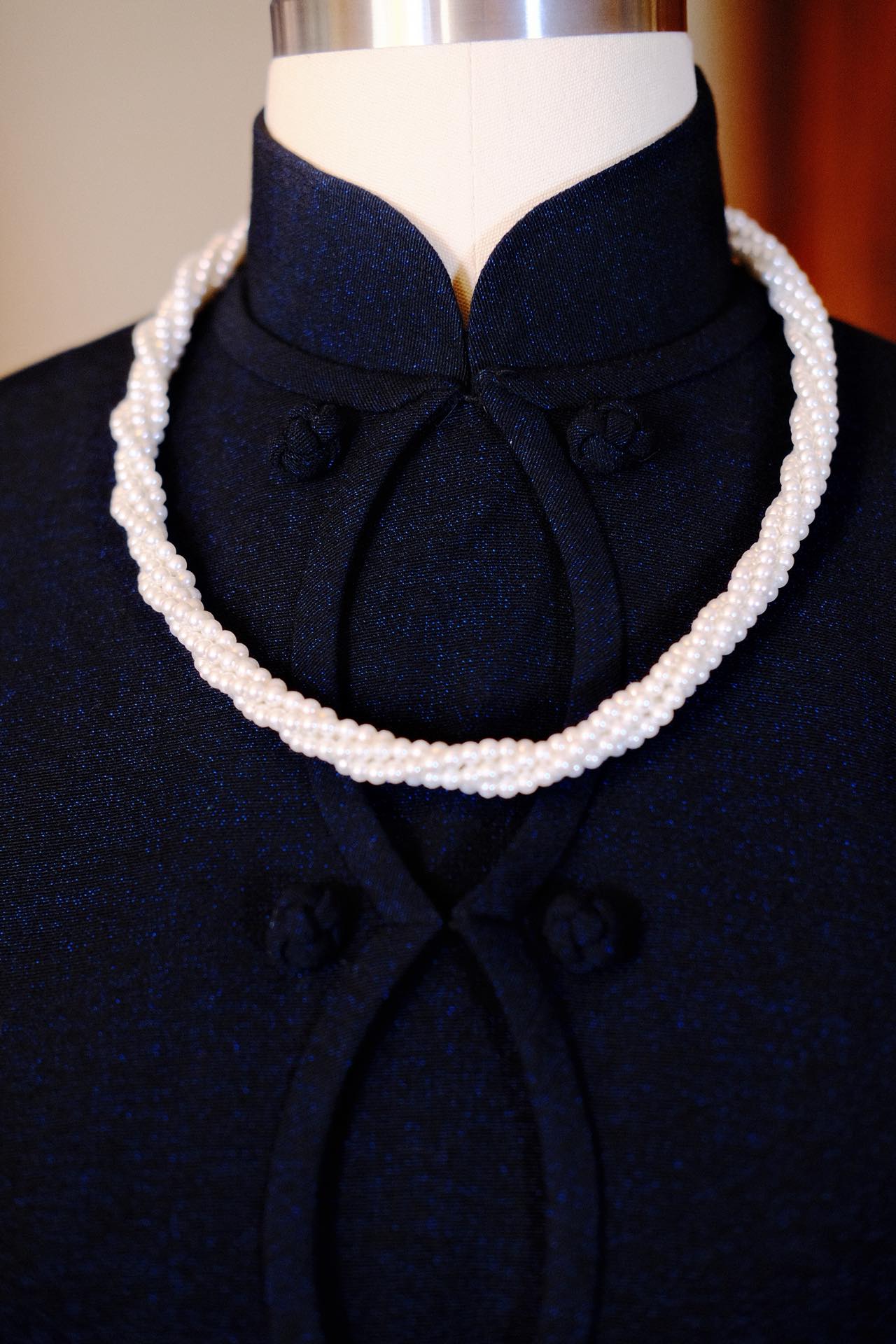
这套旗袍套装最摄人心魄处,在于其面料——
二、形制:旗袍套装的“海派”变奏
套装由无袖立领旗袍与圆领对襟外套组成,是典型的六十年代香港“
三、故事:Woo女士的“三城记”
这套衣服的主人Woo女士,是加拿大Super Store的老板之一,亦是六十年代“空中飞人”的缩影。
四、稀缺性:消逝的“港产高定”生态
如今这套套装的珍贵,不仅在于面料与工艺,
五、结语:衣以载道,物以传情
抚摸着这套旗袍套装,仿佛能触摸到六十年代的时光纹理:
The structural foundation of this breathtaking qipao suit resides in its magnificent material canvas: a premium, blue-and-gray blended tweed imported from Italy during the mid-1960s. Upon close inspection, shimmering silver-gray filaments peek fluidly through a deep navy foundation like shattered diamonds across a midnight sky, or the soft, distant silhouettes of misty mountains clearing after rain.
This distinctive "starry sky effect" is no accident; it represents an avant-garde innovation by Italian master textile engineers who revolutionized traditional tweed by interweaving premium wool with metallic filaments. This technique gifts the material a subtle, shifting iridescence under changing light, anchoring a rich tactile hand-feel with a distinctly futurist luster. As the art historian Ernst Gombrich noted, "Ornament is frozen time." These dense, shimmering threads capture a brilliant cross-cultural resonance between Europe's mid-century "Space Age" aesthetic and the pristine restraint of classical Eastern design.
The structural framework of this ensemble comprises an integrated sleeveless, standing-collar qipao paired with a coordinating minimalist round-neck, center-front opening jacket—representing the absolute pinnacle of the iconic 1960s Hong Kong "qipao suit" format.
During this golden era, Hong Kong operated as a dynamic transoceanic port where the traditional one-piece gown underwent a modern metamorphosis. While the foundational qipao preserved sacred Eastern markers like the upright mandarin collar and asymmetric placket, the outerwear piece integrated the clean, defensive lines of Western tailoring.
The visual centerpiece is the extraordinary "interlocking loop" custom fastener configuration tracing the jacket's front opening. Four sets of hand-formed Ruyi-shaped frog closures (Pankou) are linked in a continuous, undulating arc—mirroring the expressive, fluid strokes of classical Chinese calligraphy. This rhythmic layout masterfully shatters the planar monotony of the tailored silhouette while subtly channeling the cyclical philosophies of the I Ching. Finding this level of custom drafting in 1960s Hong Kong apparel is exceptionally rare, marking the garment as a peerless archive of overseas "Haipai" luxury design.
The custodian of this artifact, Ms. Woo, operated as a co-director of a major Canadian enterprise, standing as a definitive visionary within the early jet-age network of global luxury procurement.
As remembered by her family, Ms. Woo made regular, calculated sourcing journeys to Europe to personally secure advanced, trend-setting textile volumes, subsequently routing these precious materials back to Hong Kong where master tailors transformed the raw yardage into bespoke, custom silhouettes. This exact methodology served as the definitive style cipher for mid-century Hong Kong's elite class: utilizing European fabric technology to project global cultural literacy, and old-world Hong Kong craftsmanship to guarantee absolute anatomical fit.
Her transoceanic trajectory (Europe–Hong Kong–Canada) functions as a captivating micro-history of Chinese capital and cultural mobility during the Cold War era. Europe provided the raw material innovation, Hong Kong exported the elite artisan technique, and Canada operated as the executive terminal—with the hybrid qipao serving as the vital material bridge unifying all three landscapes. As the sociologist Georg Simmel observed, "Fashion is a symbol of class division." Ms. Woo’s selection operates beautifully as a concrete manifestation of personal refinement and cultural authority on the global stage.
The modern rarity of this two-piece set extends far beyond its raw material worth or its unique mineral aesthetics; it stands as a pristine archive of a highly specialized, completely vanished sartorial ecosystem.
During the 1960s, Hong Kong’s custom apparel trade thrived across hundreds of master ateliers who engineered garments based on a strict "one person, one pattern" blueprint philosophy, where senior artisans meticulously draped rare European imported fabrics to match individual anatomical requirements down to the millimeter.
With the subsequent global ascension of mechanized, mass-market ready-to-wear production scales, this resource-heavy, time-intensive synthesis of European textile technology and custom Hong Kong craftsmanship permanently dissolved. Archival records from the Hong Kong textile industry indicate that during this entire decade, the total volume of premium Italian tweed imported to the region amounted to fewer than one hundred bolts, with only a fraction allocated to custom qipao commissions. The survival of this fully intact matching set represents an exceptionally rare historical discovery—a living fragment of fashion history recording the romance, industry, and uncompromising artistry of a golden era.
Running one's fingers across the texture of this antique ensemble offers an intimate, physical connection to the landscape of the 1960s: the starry skies of Italy, the neon reflections of Hong Kong, and the sweeping snowfields of Canada all seem to glide through its fine, metallic threads. It transcends the boundaries of simple fashion to function as a micro-history of globalized design—a wearable narrative of taste, identity, and transoceanic mobility. As Walter Benjamin beautifully articulated, "The true image of the past flits by." This extraordinary garment stands as that exact fleeting moment, masterfully frozen in time.