深圳溯源
Couldn't load pickup availability
衣服尺寸:
胸围/腰围/臀围:86/70/96 厘米
衣长:108 厘米
细节描述:
一、图案:蕾丝经纬间的东方诗意
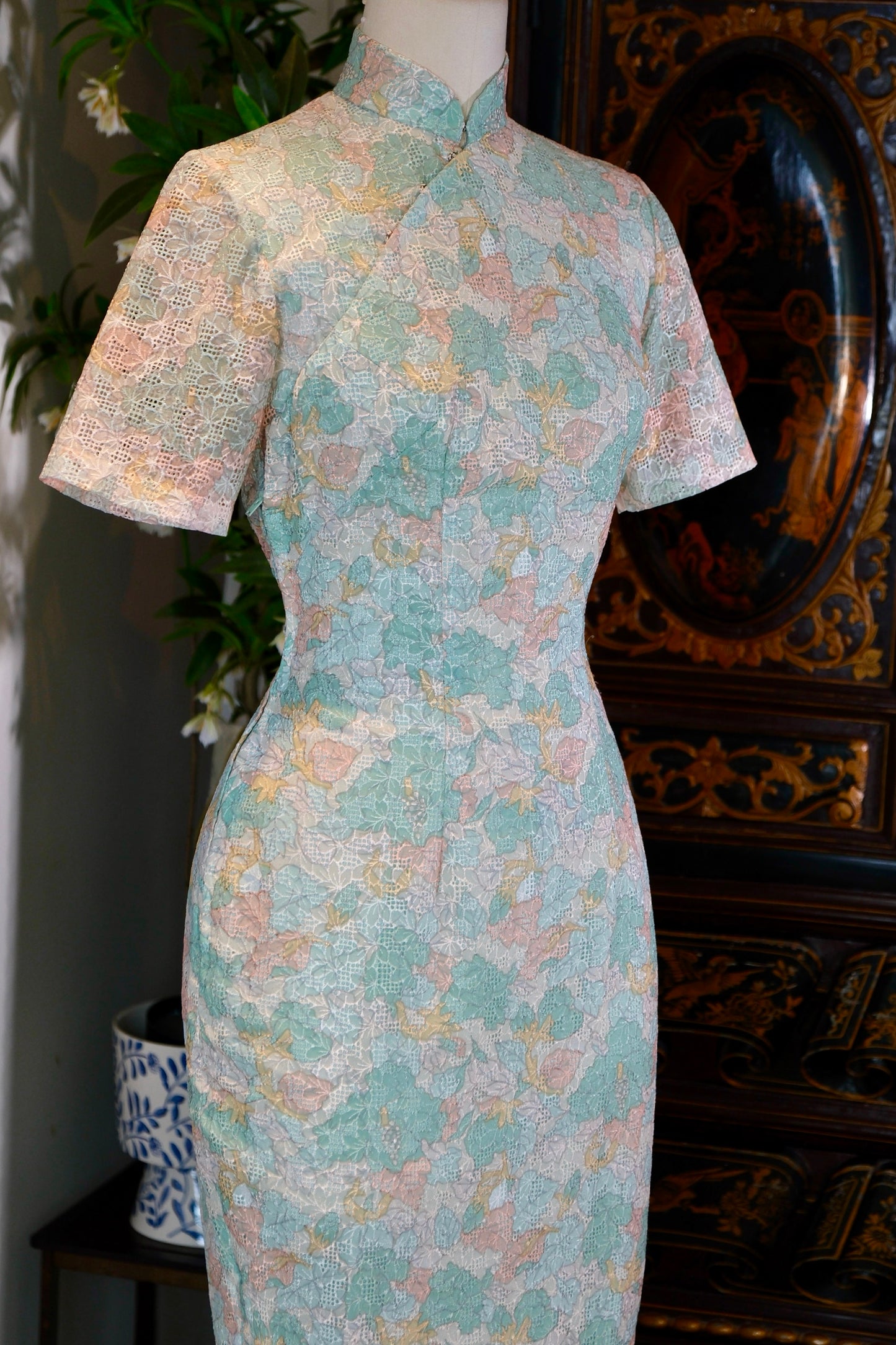
这件旗袍的面料,是上世纪六十年代意大利进口的纯棉蕾丝印花——一种在当时极为奢侈的选择。蕾丝本为西方工艺,却在东方裁缝的巧思下,化作流动的“冰裂纹”与“缠枝莲”:浅碧色的底子上,粉紫、鹅黄、月白的花卉纹样若隐若现,似江南春雨浸润后的花影,又似宋瓷开片里凝固的时光。
蕾丝的镂空肌理并非简单的装饰,而是“透”与“藏”的东方美学实践。正如《长物志》所言“贵其精而便,简而裁”,这种半透明的质感,既保留了旗袍“含蓄露肤”的传统,又赋予其现代性的呼吸感——衣料随步履轻颤时,肌肤与花纹在光影中若即若离,恰如晚明文人笔下“隔帘花影动,疑是玉人来”的朦胧意境。
二、故事:香江裁缝铺里的东西方协奏
1960年代的香港,是东西方文化碰撞的熔炉。彼时,殖民地的摩登女性既向往西方的自由风尚,又难舍东方的典雅韵致。这件旗袍的诞生,正是这种时代精神的缩影:意大利蕾丝远渡重洋,在香港裁缝的剪刀下,被赋予立领、斜襟、收腰、开衩的经典廓形——每一道弧线都暗合《周易》“曲成万物而不遗”的哲学,每一寸针脚都藏着“海派旗袍”向“港式旗袍”转型的密码。
据香港服装史学者考证,六十年代的香港旗袍已进入“国际化定制”阶段:面料多从欧洲进口,剪裁则融合西方立体裁剪与东方平面制版,形成独特的“港式修身”风格。这件旗袍的腰线收得极窄,下摆开衩至膝上三寸,既保留了传统旗袍的“S”型曲线,又暗合西方“New Look”的优雅廓形,堪称“穿在身上的文化混血”。
三、稀缺:时光淬炼的孤品美学
如今,这样的古董旗袍已近乎绝迹。其稀缺性首先在于面料:六十年代意大利纯棉蕾丝本就产量有限,且多用于高级定制,能留存至今者凤毛麟角;其次在于工艺:香港老裁缝的“归拔”技艺(通过熨烫使面料自然贴合人体曲线)已濒临失传,现代机器难以复刻这种“人衣合一”的温润感;更在于时代性:它是冷战时期香港作为“东方十字路口”的物证,是全球贸易与在地文化交融的活化石。
正如本雅明在《机械复制时代的艺术作品》中所言,古董衣的“光晕”(Aura)正来自于其“此时此地”的独特性——它曾见证过某个女子的青春,参与过某场香江夜色中的舞会,衣料上的每一处细微磨损,都是时光亲手写下的注脚。
四、结语:当旗袍遇见当代
这件旗袍并非博物馆里的标本,而是可以穿在身上的艺术史。当你将它披上身,蕾丝的凉意会唤醒六十年代香江的海风,而你的身影,将成为连接过去与现在的诗意桥梁——毕竟,真正的经典从不会老去,它只是在等待下一个懂它的人,续写未完的故事。
Measurements / Size Guide:
Bust / Waist / Hips: 86/70/96 cm
Total Length: 108 cm
Detailed Description:
The fabric of this qipao is a pure cotton printed lace imported from Italy in the 1960s—an incredibly luxurious choice for its time. While lace is a Western craft, under the ingenious vision of Eastern tailors, it is transformed into fluid "ice-crackle" and "intertwining lotus" motifs. Against a pale celadon base, floral patterns in powdery purple, goose-yellow, and moon-white appear faintly, like flower shadows drenched in Jiangnan spring rain, or time frozen within the crackle of Song dynasty porcelain.
The openwork texture of the lace is not merely decorative but a practice of the Oriental aesthetic of "revealing and concealing." As the Treatise on Superfluous Things (Zhang Wu Zhi) suggests, "Value refinement and convenience; simplicity and tailoring." This translucent quality preserves the qipao's tradition of "reserved exposure" while imbuing it with a modern sense of breathability. As the fabric ripples with each step, the skin and the patterns drift together and apart in the light, capturing the misty mood described by Late Ming literati: "Flower shadows move behind the curtain; one wonders if the jade-like beauty has arrived."
Hong Kong in the 1960s was a melting pot of Eastern and Western cultures. At that time, the modern colonial woman yearned for Western stylistic freedom yet could not part with Eastern classical grace. The birth of this qipao is a microcosm of this zeitgeist: Italian lace crossed the oceans to be shaped by a Hong Kong tailor’s shears into the classic silhouette of the standing collar, diagonal closure, cinched waist, and side slits. Every curve aligns with the philosophy of the I Ching—"Rounding out all things without omission"—and every inch of stitching hides the code of the transition from "Shanghai-style" to "Hong Kong-style" qipao.
According to Hong Kong fashion historians, qipaos in the 1960s entered a stage of "internationalized customization." Fabrics were often imported from Europe, while tailoring merged Western 3D draping with Eastern flat pattern-making. This created a unique "Hong Kong-style slim fit." This qipao’s waistline is cinched exceptionally narrow, with slits reaching three inches above the knee, preserving the traditional "S-curve" while echoing the elegant silhouette of the Western "New Look." It is truly a "cultural hybrid worn on the body."
Today, such antique qipaos have nearly vanished. Their scarcity lies first in the fabric: 1960s Italian pure cotton lace was produced in limited quantities, mostly for haute couture, and very few pieces remain. Second is the craftsmanship: the "Gui-Ba" technique (shaping fabric through steam and ironing to naturally fit human curves) is a dying art, and modern machines cannot replicate this "unity of person and garment." Most importantly, it is a physical witness to Hong Kong as the "Crossroads of the East" during the Cold War—a living fossil of global trade and local cultural fusion.
As Walter Benjamin noted in The Work of Art in the Age of Mechanical Reproduction, the "Aura" of an antique garment comes from its "here and now"—its uniqueness. It witnessed a woman’s youth, participated in a dance under the Hong Kong night sky, and every subtle wear on the fabric is a footnote handwritten by time itself.
This qipao is not a museum specimen but a wearable history of art. When you drape it over your shoulders, the coolness of the lace awakens the sea breeze of 1960s Hong Kong, and your silhouette becomes a poetic bridge connecting the past and the present. After all, true classics never grow old; they simply wait for the next person who understands them to continue the unfinished story.