深圳溯源
Couldn't load pickup availability
衣服尺寸:
胸围/腰围/臀围:86/78/96 厘米
衣长:103 厘米
细节描述:
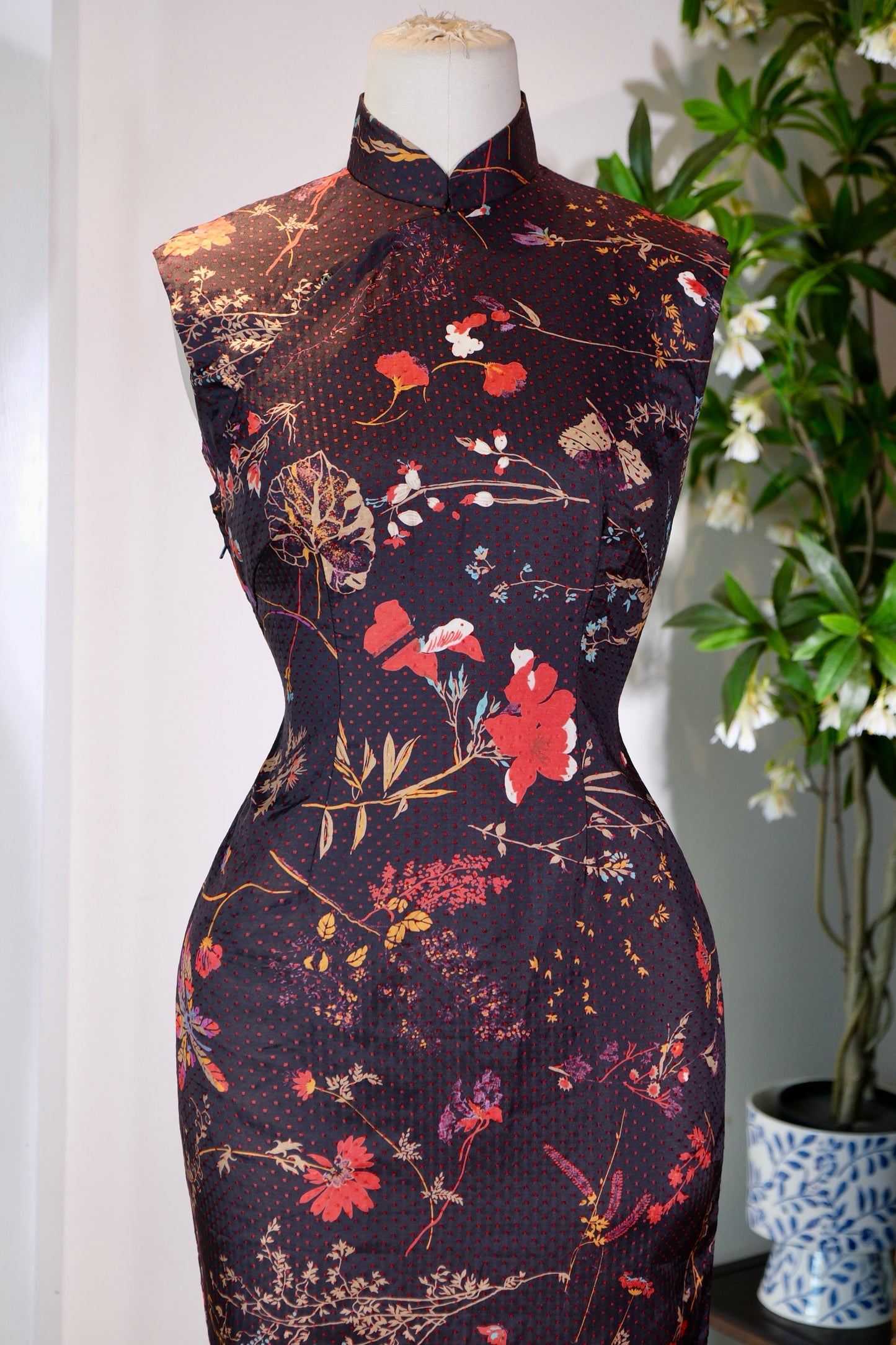
在时光的长河中,有些衣物早已超越了蔽体与装饰的实用功能,它们如同凝固的诗篇,记录着一个时代的审美、工艺与精神。眼前这件诞生于上世纪六十年代香港产的波点提花古董旗袍,便是这样一件承载着东方美学密码的艺术品。它不仅是一件衣裳,更是一段历史的缩影,一种文化的传承,一份稀缺的、不可复制的东方传奇。
图案:波点与花卉的交响,东方与西方的对话
这件旗袍的图案设计,堪称东西方美学交融的典范。其底色为深邃的藏蓝或墨黑,如夜幕般沉静,为图案的铺陈提供了绝佳的舞台。其上,规律而细密的红色波点,如同夜空中闪烁的星辰,又似江南园林中漏窗投下的斑驳光影,为整体增添了一份现代感与韵律感。波点,这一源自西方的经典元素,在六十年代的全球时尚浪潮中,被香港的设计师巧妙地融入东方服饰的语境,展现出海纳百川的包容与创新。
在波点的基底之上,盛开着繁复而精致的花卉图案。这些花卉并非写实,而是带有中国传统工笔画的意蕴,线条流畅,色彩雅致。我们可以看到大朵的红色牡丹或芍药,花瓣层叠,色泽饱满,象征着富贵与吉祥;亦有姿态各异的菊花、兰花,或含苞待放,或迎风绽放,展现出文人雅士所推崇的高洁与风骨。花卉的枝叶以金色或赭石色勾勒,蜿蜒伸展,与波点形成虚实相生的对比,既丰富了视觉层次,又赋予了画面以生命力。
故事:香江旧梦,海派风华的延续
六十年代的香港,正处于东西方文化激烈碰撞与融合的时期。一方面,它继承了上海“孤岛时期”及战后迁港的裁缝师傅们带来的精湛旗袍制作技艺,延续了海派旗袍的精致与考究;另一方面,它又吸收了西方现代设计的理念与元素,形成了独具特色的“港式旗袍”风格。这件旗袍,正是这一历史背景下的产物。
我们可以想象,在那个年代,一位优雅的香港女性,身着这件旗袍,漫步于中环的街头,或出入于高级的社交场合。旗袍的立领,衬托出她修长的脖颈;无袖的设计,展露了她纤细的手臂;收腰的剪裁,勾勒出她曼妙的身姿。波点的活泼与花卉的典雅在她身上和谐统一,既展现了东方女性的含蓄与内敛,又不失现代女性的自信与活力。
这件旗袍,或许曾见证过一场浪漫的邂逅,或许曾陪伴主人度过无数个重要的时刻。它的面料,经过岁月的洗礼,依然保持着良好的光泽与质感,这得益于当年香港纺织业的发达与对品质的追求。它的剪裁,精准地贴合人体曲线,体现了裁缝师傅高超的技艺与对美的极致追求。它不仅仅是一件衣服,更是一个时代的见证者,一个关于东方女性优雅与坚韧的故事。
艺术风格与稀缺性:引经据典,价值所在
从艺术风格上看,这件旗袍融合了多种美学元素。其图案设计,既有西方波点的现代感,又有中国传统花卉画的古典美,体现了“中学为体,西学为用”的文化融合思想。其提花工艺,继承了中国古代丝织技术的精髓,展现了东方手工艺的精湛与细腻。其整体造型,遵循了旗袍“立领、收腰、开衩”的经典结构,同时又融入了六十年代的时尚元素,如无袖设计,展现了“传承与创新”的艺术理念。
正如《考工记》所言:“天有时,地有气,材有美,工有巧,合此四者,然后可以为良。”这件旗袍,正是在特定的时代(天时)、特定的地域(地气)、选用优质的面料(材美)、经由巧手的裁缝(工有巧)共同作用下诞生的“良品”。
其稀缺性,主要体现在以下几个方面:
- 年代久远:六十年代的古董旗袍,存世量本就不多,保存完好的更是凤毛麟角。
- 工艺复杂:提花工艺耗时耗力,现代机器印花难以完全复刻其立体感与质感。
- 文化价值:它承载了特定历史时期的文化记忆与审美趣味,具有不可复制的历史价值。
- 独特设计:波点与花卉的结合,在当时是极具创新性的设计,如今看来依然时尚且富有艺术感。
这件六十年代香港产波点提花古董旗袍,不仅是一件可以穿着的衣物,更是一件值得收藏的艺术品。它如同一本打开的历史书,向我们诉说着那个时代的繁华与优雅;它又如同一首无声的诗,吟唱着东方美学的永恒魅力。拥有它,便是拥有了一段历史,一份文化,一种独一无二的东方风情。
Measurements / Size Guide:
Bust / Waist / Hips: 86/78/96 cm
Total Length: 103 cm
Detailed Description:
In the long river of time, some garments have long transcended their practical functions of covering and decorating. They are like solidified poems, recording the aesthetics, craftsmanship, and spirit of an era. This vintage 1960s Hong Kong-made polka-dot jacquard cheongsam (qipao) is such a masterpiece, carrying the secret codes of Eastern aesthetics. It is not merely a garment but a microcosm of history, a heritage of culture, and a rare, unrepeatable Oriental legend.
The pattern design of this cheongsam is a paragon of the fusion between Eastern and Western aesthetics. Its base color—a profound navy or ink-black—is as tranquil as the night sky, providing an excellent stage for the patterns to unfold. Upon it, regular and dense red polka dots resemble shimmering stars in the night or the dappled light and shadows cast through lattice windows in a Jiangnan garden, adding a sense of modernity and rhythm to the overall look. Polka dots, a classic Western element, were skillfully integrated into the context of Oriental dress by Hong Kong designers during the global fashion waves of the 1960s, showcasing an inclusive and innovative spirit.
Atop the polka-dot foundation bloom complex and exquisite floral motifs. These flowers are not realistic but carry the charm of traditional Chinese Gongbi (meticulous) painting, with fluid lines and elegant colors. We see lush red peonies or herbaceous peonies with layered petals and full hues, symbolizing wealth and auspiciousness; there are also chrysanthemums and orchids in various postures, either budding or blooming in the wind, displaying the nobility and integrity esteemed by scholars. The stems and leaves are outlined in gold or ochre, winding and stretching to form a contrast of "substance and void" with the polka dots, which enriches the visual layers and endows the imagery with vitality.
Hong Kong in the 1960s was in a period of intense collision and fusion between Eastern and Western cultures. On one hand, it inherited the exquisite qipao-making skills brought by master tailors who migrated from Shanghai during the "Isolated Island" period and the post-war era, continuing the refinement of Shanghainese style. On the other hand, it absorbed Western modern design concepts, forming the unique "Hong Kong Style" qipao. This garment is a direct product of this historical background.
One can imagine an elegant Hong Kong woman of that era, dressed in this cheongsam, strolling through the streets of Central or moving through high-end social circles. The standing collar accentuates her slender neck; the sleeveless design reveals her delicate arms; the cinched waist contours her graceful figure. The playfulness of the polka dots and the elegance of the flowers harmonize within her, showcasing both the modesty of an Eastern woman and the confidence of a modern one.
This cheongsam might have witnessed a romantic encounter or accompanied its owner through countless important moments. Its fabric, having weathered the years, still maintains an excellent luster and texture—a testament to the prosperity and quality pursuit of Hong Kong's textile industry back then. Its cut fits the human curves precisely, reflecting the superb skills of the tailor and an ultimate pursuit of beauty.
Artistically, this cheongsam merges multiple aesthetic elements. Its design embodies the cultural fusion of "Chinese essence with Western application." The jacquard craft inherits the essence of ancient Chinese silk weaving, showcasing the delicacy of Eastern handiwork. Its overall silhouette follows the classic "standing collar, cinched waist, and side slits" structure while integrating 1960s fashion elements, such as the sleeveless cut, demonstrating the philosophy of "inheritance and innovation."
As stated in The Artificers' Record (Kao Gong Ji): "Heaven has its seasons, Earth has its energy, materials have their beauty, and craftsmanship has its skill. Only when these four are combined can a fine work be created." This cheongsam is a "fine work" born from a specific era (Heaven), a specific region (Earth), premium materials, and a skillful tailor.
Its scarcity is reflected in several aspects:
Temporal Rarity: Surviving 1960s vintage cheongsams are few, and those perfectly preserved are even rarer.
Complex Craftsmanship: The jacquard process is time-consuming and labor-intensive; modern machine printing cannot fully replicate its three-dimensionality and texture.
Cultural Value: It carries the cultural memory and aesthetic taste of a specific historical period, possessing unrepeatable historical value.
Unique Design: The combination of polka dots and floral patterns was a highly innovative design at the time, and it remains fashionable and artistic today.
This 1960s Hong Kong-made polka-dot jacquard cheongsam is not just a wearable garment but a collectible work of art. It is like an open history book telling us of the prosperity and elegance of that era, and a silent poem singing of the eternal charm of Eastern aesthetics. To own it is to own a piece of history, a slice of culture, and a unique Oriental romance.