深圳溯源
Couldn't load pickup availability
衣服尺寸:
胸围/腰围/臀围:90/78/92 厘米
衣长:100 厘米
细节描述:
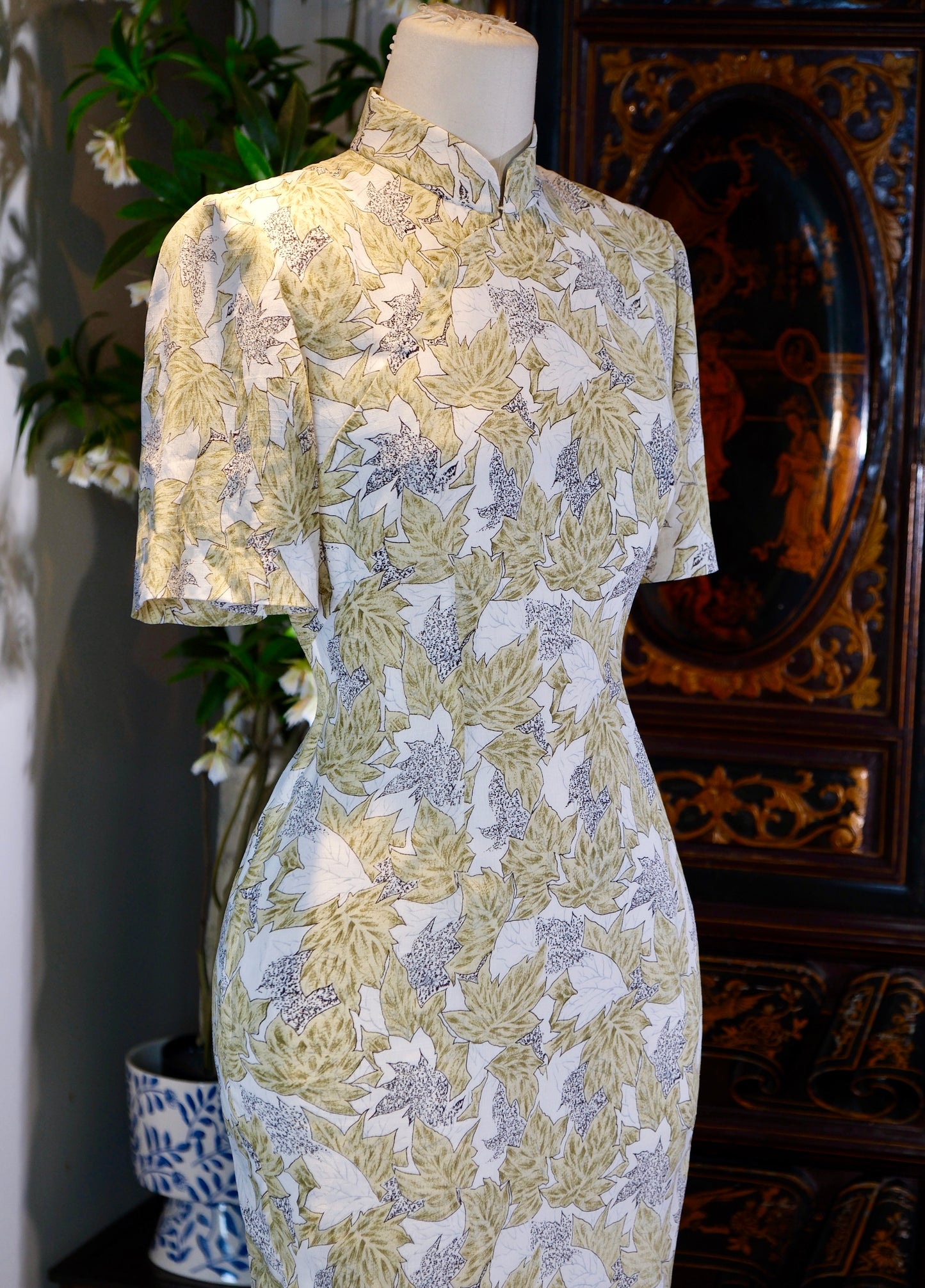
图案描述:植物诗学与手工温度
这件旗袍的面料,是一首写在亚麻上的植物诗。浅黄与灰绿交织的梧桐叶纹样,以不规则的疏密排布铺陈开来——叶片边缘带着手工印花特有的轻微晕染,叶脉以细密的黑色点绘勾勒,仿佛将秋风中摇曳的梧桐枝叶凝固在布面上。底色是未经漂白的亚麻本白,带着天然纤维的粗粝质感,与植物纹样的写意笔触形成微妙对话。这种“以叶代花”的图案选择,在六十年代的台湾服饰中颇为独特:彼时主流旗袍多偏爱牡丹、梅花等传统花卉,而这件作品却以梧桐(古人谓之“嘉木”)为意象,暗合《诗经·大雅》“凤凰鸣矣,于彼高冈;梧桐生矣,于彼朝阳”的高洁寓意,更显文人雅趣。
古董衣的故事:岛屿时光里的裁缝手泽
这件旗袍诞生于1960年代的台湾,那是一个传统与现代激烈碰撞的年代。彼时的台北迪化街布庄里,进口的化学纤维面料正逐渐流行,但这件旗袍的主人却选择了本土手工印花的亚麻——或许是位受过新式教育却眷恋传统的女性,又或许是位旅居海外的华人,特意托亲友从台湾订制这件“有土地味道”的衣裳。
裁缝的手泽藏在每一处细节里:立领的高度经过精心计算,既保留传统旗袍的端庄,又因亚麻的挺括而不显局促;腰线的收省位置精准贴合人体曲线,却未采用西式紧身剪裁,留有一分东方女性含蓄的余量;侧边的开衩高度恰到好处,行走时露出小腿线条,暗合六十年代“改良旗袍”的审美风潮。更难得的是,面料上的印花并未因岁月褪色,反而因亚麻纤维的自然氧化,泛出一种温润的旧色,如同老照片里的光影,记录着某个夏日午后的阳光与风。
艺术风格与稀缺性:跨文化语境下的孤品价值
从艺术风格而言,这件旗袍是“东方写意”与“现代构成”的奇妙融合。梧桐叶纹样的排布看似随意,实则暗合平面构成中的“重复与变异”原则——叶片的大小、方向、色彩深浅皆有变化,形成视觉上的韵律感;而手工印花的“不完美”(如局部颜色的轻微渗透、线条的细微抖动),恰恰赋予面料以手工艺术的独特温度,与当时批量生产的机印面料形成鲜明对比。
其稀缺性更体现在三个维度:
- 材质稀缺:六十年代台湾虽有亚麻种植,但手工印花亚麻面料多用于外销,本土留存极少。这种面料需经“织布-刻版-调浆-手工刮印-晾晒”等多道工序,成本高、产量低,远不如化学纤维面料普及。
- 工艺稀缺:手工印花的刻版师傅需具备绘画功底,调浆比例全凭经验,每一块面料都是独一无二的“孤品”。随着工业化进程,这种传统工艺在七十年代后逐渐式微,如今已难觅踪迹。
- 时代稀缺:六十年代的台湾旗袍正处于“传统长款”向“现代短款”过渡的阶段,这件旗袍的长度(及膝下)与剪裁(收腰明显但不过分紧身),恰好定格了这一转型期的审美特征,是研究华人服饰现代化的重要实物标本。
结语:穿在身上的历史切片
这件旗袍不是博物馆里冰冷的展品,而是一块可以触摸的历史切片。当指尖拂过亚麻布面的纹理,仿佛能感受到六十年代台湾裁缝铺里的熨斗温度;当目光流连于梧桐叶纹样,仿佛能听见那个年代知识女性在书房里吟诵“梧桐更兼细雨”的低语。它见证了一个岛屿在传统与现代之间的文化选择,也承载了一位女性对“美”的私人定义——不随波逐流,而是在时代浪潮中,坚持用一针一线、一花一叶,书写属于自己的优雅叙事。
如今,这件旗袍静立于展柜中,亚麻的粗粝与印花的温润仍在对话,梧桐叶的影子仍在时光里摇曳。它提醒我们:真正的时尚,从来不是转瞬即逝的潮流,而是能在岁月中沉淀出故事的艺术品。
Measurements / Size Guide:
Bust / Waist / Hips: 90/78/92 cm
Total Length: 100 cm
Detailed Description:
The fabric of this qipao is a botanical poem written on linen. Intertwining patterns of Firmiana (Chinese Parasol) leaves in pale yellow and grayish-green are laid out in an irregular, rhythmic density. The edges of the leaves bear the slight bleeding characteristic of hand-block printing, while the veins are traced with fine black stippling, as if freezing the swaying branches of an autumn breeze onto the cloth. The base is an unbleached, natural off-white linen, its raw texture engaging in a subtle dialogue with the freehand strokes of the botanical motifs. This choice of "leaves over flowers" was quite unique in 1960s Taiwan; while mainstream qipaos favored traditional blooms like peonies and plum blossoms, this piece uses the Firmiana—venerated by ancients as a "noble tree"—to echo the lofty sentiment of the Book of Songs: "The phoenix sings on the high ridge; the Firmiana grows facing the morning sun."
Born in 1960s Taiwan, this qipao emerged during an era of intense collision between tradition and modernity. While synthetic fibers were becoming trendy in the textile shops of Taipei’s Dihua Street, the owner of this piece chose locally hand-printed linen. Perhaps she was a woman of the new education who still clung to tradition, or an overseas Chinese who specifically commissioned this "scent of the soil" from Taiwan.
The tailor’s mastery is hidden in every detail: the height of the standing collar is precisely calculated to maintain dignity without feeling constricted; the waist darts are positioned to contour the body while retaining a modest "buffer" characteristic of Oriental grace. The side slits are cut to the perfect height, revealing the calf in line with the "Modified Qipao" trends of the sixties. Remarkably, the prints have not faded with time; instead, the natural oxidation of the linen fibers has imparted a warm, vintage patina, like the light and shadow in an old photograph.
Artistically, this qipao is a marvelous fusion of "Oriental Freehand" and "Modern Composition." The arrangement of the leaves follows the principles of "repetition and variation"—the size, direction, and color depth of the leaves all shift, creating a visual cadence. The "imperfections" of hand-printing (such as slight ink penetration or fine tremors in the lines) grant the fabric a handcrafted warmth that stands in stark contrast to the mass-produced machine prints of the time.
Its scarcity is reflected in three dimensions:
Material Scarcity: Although linen was grown in 1960s Taiwan, hand-printed linen was mostly for export, with very little remaining locally. The process involved multiple steps: weaving, block carving, dye mixing, manual scraping, and sun-drying—a high-cost, low-yield endeavor.
Craft Scarcity: The masters who carved the printing blocks required a background in painting, and the dye-mixing ratios relied entirely on experience. Every bolt of fabric was a unique "sole copy." Following industrialization, this traditional craft vanished after the 1970s.
Era Scarcity: 1960s Taiwanese qipaos were in transition from "traditional long" to "modern short." The knee-length cut and tailored-but-not-tight fit of this piece perfectly freeze the aesthetic characteristics of this transformation period.
This qipao is not a cold museum specimen but a tactile slice of history. When your fingertips brush the texture of the linen, you can almost feel the heat of the iron in a 1960s Taiwanese tailor shop. It witnessed an island’s cultural choices between tradition and modernity and carries a woman’s private definition of beauty—not following the crowd, but insisting on writing her own elegant narrative through every stitch, leaf, and flower.