深圳溯源
Couldn't load pickup availability
衣服尺寸:
胸围/腰围/臀围:96/84/104 厘米
衣长:110 厘米
细节描述:
一、图案解构:几何符号的视觉狂欢
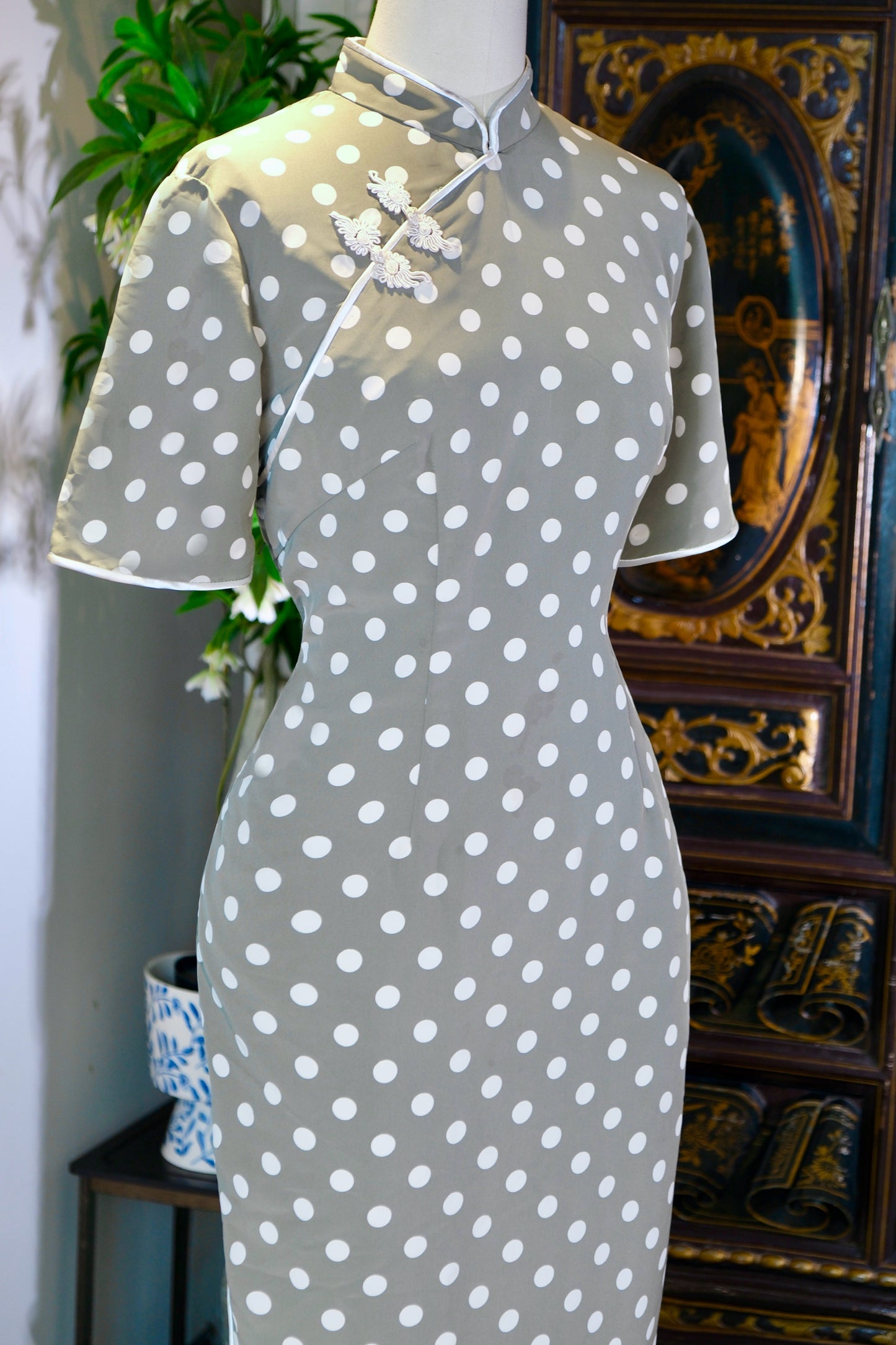
这件旗袍的基底色调为低饱和度的灰绿色,宛如宣纸上晕染开的“雨过天青”,其上密布着大小均等的白色圆点,形成强烈的视觉韵律。这种“波点”图案并非简单的几何重复,而是暗合了六十年代波普艺术对“日常符号的放大与重构”——如同安迪·沃霍尔将坎贝尔汤罐变为艺术图腾,这些圆点将传统旗袍从“花卉缠枝”的东方审美中解放,转而拥抱工业时代的机械美学。
细观圆点排列,并非绝对规整的网格,而是随布料经纬略作微调,形成微妙的“呼吸感”。领口、襟边的白色滚边如工笔白描,勾勒出旗袍的轮廓,与圆点形成“面与线”的对话。襟前的立体盘扣尤为精妙:以同色系丝线盘成蝴蝶结造型,既呼应波普艺术的“趣味性”,又保留了传统工艺的“手作温度”,堪称“东方刺绣与西方解构主义的共生”。
二、时代叙事:冷战夹缝中的时尚突围
这件旗袍诞生于1960年代的香港——彼时东西方文化在此激烈碰撞,亦在此奇妙融合。波普艺术正从伦敦、纽约席卷全球,而香港作为“东方好莱坞”,其电影明星(如林黛、乐蒂)的银幕造型常成为时尚风向标。这件旗袍的“波点”元素,恰是当时香港裁缝对西方潮流的本土化回应:既保留旗袍的“立领、收腰、开衩”等经典形制,又以大胆的几何图案打破传统旗袍的“含蓄内敛”,折射出殖民地都市的开放与焦虑。
据香港纺织业档案记载,1960年代香港旗袍工坊多采用进口人造丝或混纺面料,以适应批量生产需求。但这件旗袍的面料手感柔滑且带有天然纤维的微光,推测为当时香港富裕阶层定制的“出口级”面料——彼时香港旗袍不仅服务于本地名媛,更通过“远东时尚”的标签远销东南亚与欧美华人社区,成为冷战时期“东方主义”想象的物质载体。
三、艺术史坐标:波普与旗袍的跨文化共振
从艺术史维度审视,这件旗袍的“波点”与同时期草间弥生的“无限镜屋”、罗伊·利希滕斯坦的“本戴点”形成跨时空对话。草间弥生以圆点消解个体与宇宙的边界,利希滕斯坦用网点模拟印刷术的机械感,而这件旗袍的圆点则试图在“东方身体”与“西方符号”之间寻找平衡——当穿着者行走时,圆点随身体曲线流动,仿佛将波普艺术的“静态平面”转化为“动态雕塑”。
更值得玩味的是其“稀缺性”:1960年代香港旗袍虽产量颇丰,但采用波普风格图案者极为罕见。多数现存古董旗袍仍以花卉、山水、龙凤等传统纹样为主,而这件旗袍的“波点”设计,恰是当时香港时尚界“西学为体,中学为用”的激进实验。正如艺术史家贡布里希所言:“艺术史是观念的碰撞史。”这件旗袍正是冷战时期东西方文化碰撞的“活化石”,其每一颗圆点都凝结着时代的躁动与创造力。
四、结语:穿在身上的文化密码
这件波点旗袍不仅是一件衣物,更是一段被缝入经纬的历史。它见证了1960年代香港在全球化浪潮中的身份焦虑与时尚突围,也预示着后现代主义“拼贴美学”的来临。当我们在当下凝视这件古董衣,看到的不仅是波普艺术的视觉狂欢,更是一个时代在布料上留下的“文化指纹”——它提醒我们,真正的时尚从不是对潮流的盲目追随,而是在传统与革新之间,找到属于自己的“东方波普”。
备注:瑕疵特价
Measurements / Size Guide:
Bust / Waist / Hips: 96/84/104 cm
Total Length: 110 cm
Detailed Description:
The base tone of this Qipao is a low-saturation greyish-green, reminiscent of the "celestial blue after rain" blooming on Xuan paper. It is densely populated with white polka dots of uniform size, creating a powerful visual rhythm. This "polka dot" pattern is not a simple geometric repetition, but a subtle nod to the 1960s Pop Art movement's "magnification and reconstruction of everyday symbols." Much like Andy Warhol transformed Campbell’s soup cans into artistic totems, these dots liberate the traditional Qipao from the Oriental aesthetic of "floral vines," embracing instead the mechanical aesthetics of the industrial age.
A closer look at the arrangement reveals that the dots are not in an absolutely rigid grid; they adjust slightly with the warp and weft of the fabric, creating a subtle "sense of breath." The white piping at the collar and edges acts like a fine-line gongbi drawing, outlining the Qipao's silhouette and creating a dialogue between "surface and line." The 3D pankou (frog buttons) on the chest are particularly exquisite: crafted from silk thread in the same color family into a bow shape, they echo the "playfulness" of Pop Art while preserving the "handmade warmth" of traditional craftsmanship—a true symbiosis of Oriental embroidery and Western deconstructionism.
This Qipao was born in 1960s Hong Kong—a time when Eastern and Western cultures collided fiercely and merged miraculously. As Pop Art swept the globe from London and New York, Hong Kong, as the "Hollywood of the East," saw its movie stars (such as Lin Dai and Betty Loh Ti) become fashion trendsetters. The "polka dot" element of this Qipao was precisely the localized response of Hong Kong tailors to Western trends: while preserving classic forms like the mandarin collar, fitted waist, and side slits, it broke the traditional "reservedness" of the Qipao with bold geometric patterns, reflecting the openness and anxiety of a colonial metropolis.
According to Hong Kong textile archives, Qipao workshops in the 1960s often used imported rayon or blended fabrics to meet mass production needs. However, the smooth touch and natural fiber shimmer of this fabric suggest it was an "export-grade" material customized for Hong Kong’s elite. At that time, the Hong Kong Qipao served not only local socialites but was also exported to Southeast Asia and Chinese communities in Europe and America under the label of "Far East Fashion," becoming a physical carrier of "Orientalist" imagination during the Cold War.
Examined through the lens of art history, the dots on this Qipao form a trans-temporal dialogue with Yayoi Kusama’s "Infinity Mirror Rooms" and Roy Lichtenstein’s "Ben-Day dots" from the same period. While Kusama used dots to dissolve the boundaries between the individual and the universe, and Lichtenstein used dots to simulate the mechanical feel of printing, the dots on this Qipao seek a balance between the "Oriental body" and "Western symbols." When the wearer moves, the dots flow with the body's curves, as if transforming the "static plane" of Pop Art into a "dynamic sculpture."
Even more noteworthy is its "rarity." Although Hong Kong produced Qipaos in large quantities during the 1960s, those featuring Pop Art patterns are extremely rare. Most surviving vintage Qipaos still feature traditional motifs like flowers, landscapes, or dragons and phoenixes. This polka-dot design was a radical experiment in "Western learning for practical use, Chinese learning for the essence" within the Hong Kong fashion world. As art historian E.H. Gombrich said, "The history of art is a history of the collision of ideas." This Qipao is a "living fossil" of the cultural collision during the Cold War, with every dot condensing the restlessness and creativity of the era.
This polka-dot Qipao is not just a garment; it is a piece of history sewn into the warp and weft. It witnessed Hong Kong’s identity anxiety and fashion breakthrough in the wave of globalization during the 1960s and foreshadowed the arrival of postmodern "collage aesthetics." When we gaze upon this vintage piece today, we see not only a visual carnival of Pop Art but also a "cultural fingerprint" left by an era on fabric. It reminds us that true fashion is never a blind pursuit of trends but finding one's own "Oriental Pop" between tradition and innovation.
Notes: Defect Clearance / Special Offer