深圳溯源
Couldn't load pickup availability
在时尚的长河中,有些衣物不仅是蔽体之物,更是凝固的时光,是穿行于历史经纬间的优雅信使。眼前这套上世纪六十年代的意大利进口织银粗花呢小香风旗袍套装,便是这样一件承载着多重文化记忆与个人传奇的艺术品。它静默地陈列,却仿佛在低声诉说着一段关于品味、迁徙与东西方美学交融的往事。
一、视觉的诗篇:图案与材质的交响
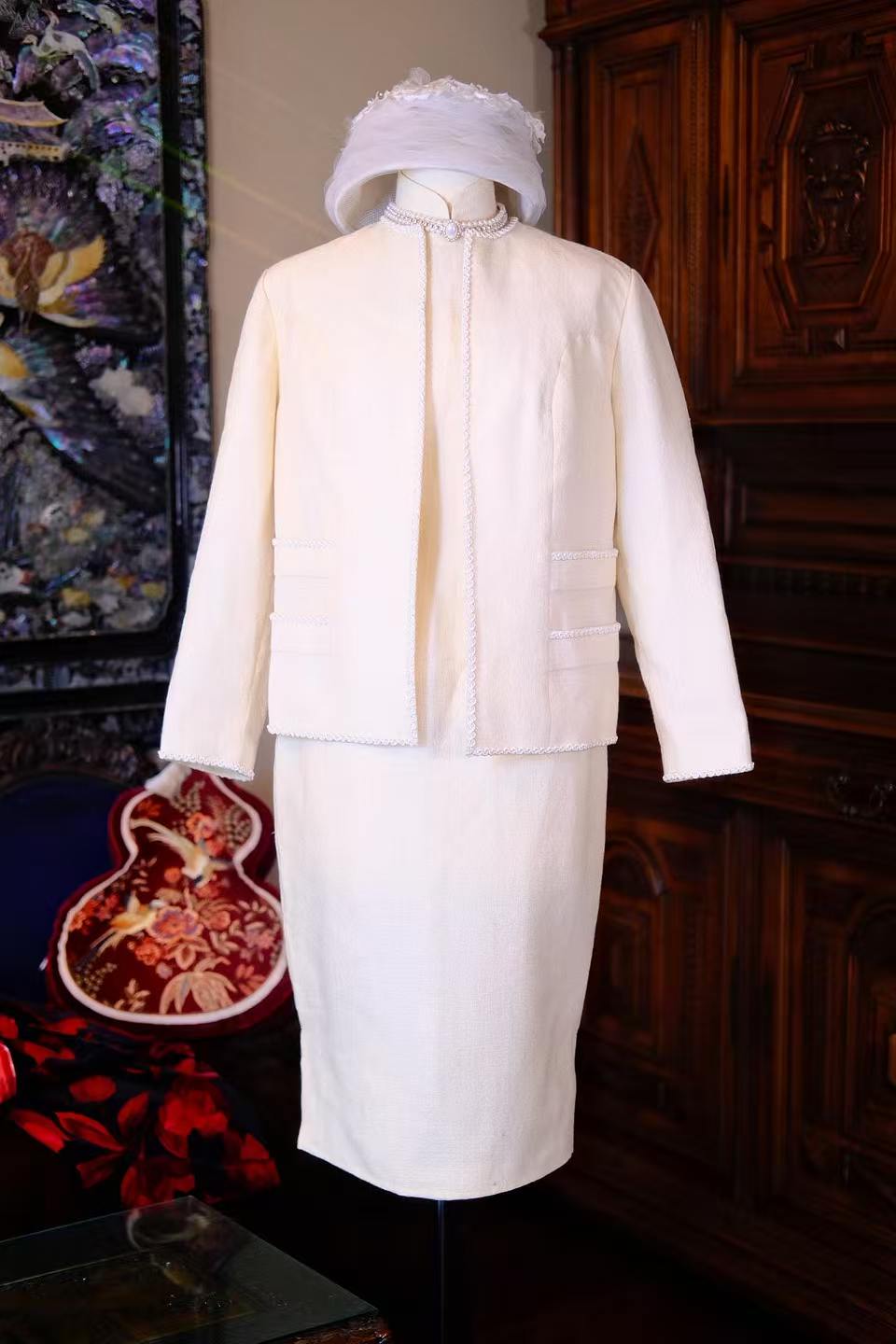
这套套装由一件及膝的直筒旗袍与一件短款外套组成,通体采用一种极为特殊的米白色面料。它并非寻常的素色,而是意大利进口的粗花呢(Tweed),其肌理感丰富,纱线中巧妙地织入了纤细的银丝。在光线下,这些银丝如同星辰般闪烁,为沉稳的粗花呢注入了灵动与奢华,这正是“小香风”(Chanel Style)的精髓所在——在简约的廓形中暗藏精致的细节。
外套的设计尤为考究,其边缘、口袋及门襟处,均以白色丝线绣制了连续的、如海浪般起伏的卷草纹饰边。这种纹样,在中国传统纹样中被称为“卷草纹”或“唐草纹”,它源自古希腊的茛苕叶纹,经由丝绸之路传入东方,在唐代达到鼎盛,象征着生生不息与吉祥如意。
二、衣以载道:一段横跨东西的个人史诗
这件华服的背后,是一位名为Woo的女士的个人史诗。作为加拿大Super Store的创始人之一,她的身份本身就极具时代象征意义——一位在二十世纪中叶便已活跃于国际商界的华人女性。她的故事,是那个时代全球流动与华人 diaspora(离散)的缩影。
据其子所述,Woo女士常年穿梭于欧洲、加拿大与香港之间。她的旅程并非简单的商务差旅,而是一场对美的执着追寻。她会亲赴欧洲,甄选当时最前卫、最顶级的面料,如同朝圣者寻觅圣物。而后,她将这些承载着欧洲时尚脉搏的织物带回香港,交由技艺精湛的本地裁缝,量身定制成符合东方女性身形与气质的旗袍。
这一行为本身,便是一种极具创造性的文化实践。她并非被动地接受西方的时尚,而是主动地将其“本土化”,将西方的材质与东方的剪裁、西方的廓形与东方的纹样融为一体。这件套装,正是这种“文化混血”的产物,它既非纯粹的西式套装,亦非传统的中式旗袍,而是一种全新的、属于那个特定时代与特定人群的“第三空间”美学。
三、艺术的稀缺:在历史坐标中的定位
从艺术史与时尚史的角度看,这件套装的稀缺性体现在多个层面。
- 材质的稀缺:上世纪六十年代,能够进口意大利顶级织银粗花呢,本身就证明了其主人的非凡财力与品味。这种面料在当时是高级定制与奢侈成衣的专属,其生产成本高昂,产量稀少。
- 工艺的稀缺:将西式外套与中式旗袍组合成套,并在细节处融入如此考究的传统刺绣,这在当时并非流水线生产的成衣所能企及。它必然是出自一位深谙东西方美学、且技艺高超的裁缝之手,是真正的“高级定制”(Haute Couture)精神的体现。
- 历史的稀缺:它是一件“活”的历史文物。它见证了战后经济的复苏、全球旅行的兴起、以及华人女性在海外社会地位的提升。它不仅仅是一件衣服,更是一个时代精神的物质载体,是Woo女士个人奋斗史与审美追求的物证。
正如法国思想家罗兰·巴特所言,服装是一种符号系统。这套旗袍套装,以其独特的材质、图案与背后的故事,构建了一个丰富而多义的符号世界。它向我们展示了,真正的时尚,从来不是对潮流的盲目追随,而是个人品味、文化背景与时代精神的完美结晶。它是一件可以穿着的艺术品,一段可以触摸的历史,一份穿越半个多世纪依然熠熠生辉的优雅遗产。
In the vast river of fashion, certain garments are more than mere coverings; they are frozen moments in time, elegant messengers traveling through the warp and weft of history. This 1960s Italian-imported silver-woven tweed "Chanel-style" qipao ensemble is an artistic masterpiece bearing multi-layered cultural memories and personal legends. Resting in quiet elegance, it speaks in soft tones of a legacy built on taste, migration, and the harmonious union of Eastern and Western aesthetics.
This ensemble consists of a knee-length, straight-cut (Zhitong) qipao paired with a matching cropped jacket, rendered entirely in a highly unique cream-white textile.
The Material: Rather than a simple solid fabric, it utilizes an imported Italian tweed. Its rich, tactile texture is subtly interwoven with slender silver metallic threads. Under shifting light, these silver threads shimmer like stardust, injecting a fluid luxury into the grounded stability of the tweed—the very essence of the "Chanel Style" (Xiaoxiangfeng), where exquisite details lie hidden within a clean, minimalist silhouette.
The Ornamentation: The jacket design is exceptionally refined. The edges, pockets, and placket are bordered with continuous, undulating scrolling vine patterns embroidered in white silk thread. In traditional Chinese iconography, this is known as the "Scrolling Vine Pattern" (Juancaowen) or "Tang Grass Pattern" (Tangcaowen). Originating from the ancient Greek acanthus leaf motif, it traveled along the Silk Road to the East, reaching its peak during the Tang Dynasty as a symbol of endless vitality, longevity, and auspiciousness.
Behind this magnificent attire lies the personal epic of Ms. Woo. As a co-founder of the Canadian supermarket giant Superstore, her identity carries immense historical weight—a Chinese-Canadian woman actively thriving in the international business landscape of the mid-20th century. Her narrative stands as a poignant microcosm of global mobility and the Chinese diaspora of that era.
According to her son, Ms. Woo traveled constantly between Europe, Canada, and Hong Kong. Her journeys were not mere commercial trips, but a dedicated pursuit of beauty. She would travel directly to Europe to hand-pick the most avant-garde, top-tier textiles of the period, much like a collector seeking rare artifacts. Afterward, she brought these fabrics—pulsing with the rhythm of European haute couture—back to Hong Kong, placing them in the hands of master local tailors to be custom-made into qipaos tailored precisely to her posture and temperament.
This act itself was a highly creative form of cultural practice. She did not passively consume Western fashion; instead, she actively "localized" it, fusing Western materiality with Eastern tailoring, and Western silhouettes with Eastern iconography. This ensemble is the sublime hybrid of that cross-cultural dialogue—neither a purely Western suit nor a strictly traditional Chinese qipao, but an entirely new aesthetic belonging to a distinct "Third Space."
From the perspective of art and fashion history, the scarcity of this ensemble manifests across several dimensions:
Material Scarcity: In the 1960s, sourcing top-grade Italian tweed woven with genuine silver thread was an absolute luxury, reflecting the exceptional wealth, global connections, and avant-garde taste of its wearer. Such textiles were the exclusive domain of luxury houses and European haute couture, characterized by prohibitive production costs and extremely low yields.
Craft and Concept Scarcity: Combining a classic Western structured jacket with a Chinese qipao as a cohesive, matching set—while incorporating such meticulous traditional embroidery along the trim—was entirely beyond the reach of assembly-line ready-to-wear fashion. It required a master tailor who was completely bilingual in the visual languages of both East and West, creating a true piece of Bespoke Wear (Gaozhi) that bridges continents.
Historical Scarcity: It stands as a living historical artifact. It witnessed post-war economic revival, the rise of global commercial travel, and the ascending social standing of Chinese women in global diaspora communities. It is a material manifestation of the mid-century zeitgeist and an irreplaceable physical proof of Ms. Woo’s personal journey and aesthetic pursuits.
As the French thinker Roland Barthes posited, clothing operates as a system of signs. This qipao ensemble, through its singular material choices, patterns, and provenance, constructs a rich and polysemic semiotic universe. It reveals that true fashion is never a blind adherence to trends, but a perfect crystallization of personal taste, cultural lineage, and the spirit of an era. It remains a wearable work of art, a tangible piece of history, and an elegant legacy that continues to radiate brilliance more than half a century later.