深圳溯源
Couldn't load pickup availability
衣服尺寸:
胸围/腰围/臀围:86/74/90 厘米
衣长:110 厘米
细节描述:
一、衣上纹章:暗涌的东方诗学
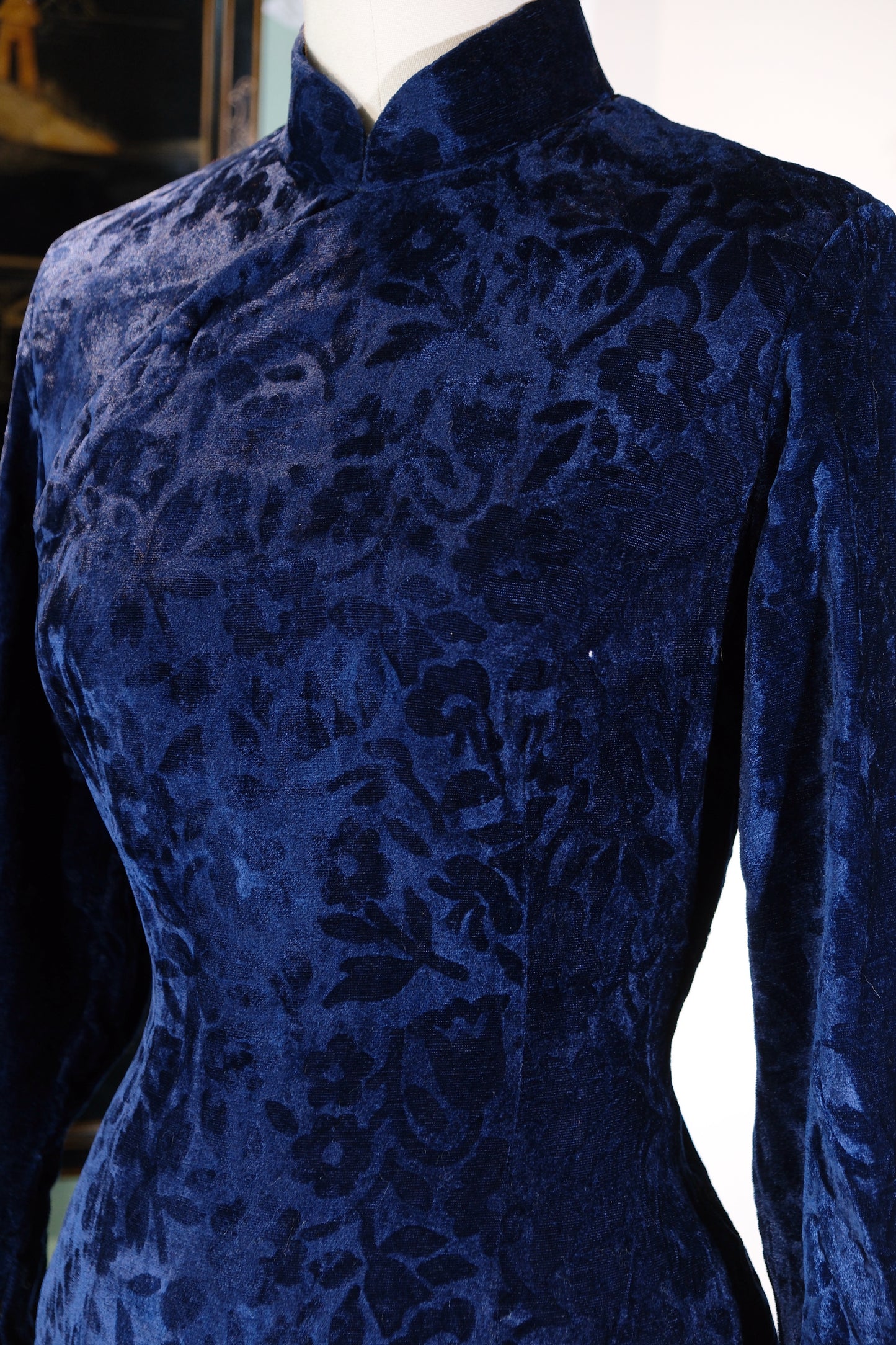
这件深海蓝烤花丝绒旗袍的图案,是传统纹样与现代审美的精妙共振。以缠枝花卉为主体,枝蔓如游龙般蜿蜒舒展,花朵或含苞或盛放,叶片以写意笔法勾勒,形成“花叶相扶,枝脉相连”的韵律感。烤花工艺使纹样在丝绒底布上呈现微妙的凹凸肌理,光线流转间,暗纹若隐若现,恰似“月移花影动,疑是玉人来”的朦胧诗意。这种“隐而不露”的装饰手法,既承袭了宋代瓷器“雨过天青”的含蓄美学,又暗合六十年代台湾纺织业对西方立体浮雕工艺的本土化转译,在丝绒的柔软触感与纹样的刚劲线条间,构建出东方女性“外柔内刚”的精神隐喻。
二、衣史钩沉:海岛上的旗袍余韵
1960年代的台湾,旗袍作为“国服”的文化符号,在海岛的特殊语境中演化出独特的生命力。彼时大陆旗袍因社会变革渐趋式微,而台湾因承接上海裁缝技艺与日本纺织技术,成为旗袍工艺的“活化石”保存地。这件旗袍诞生于台北迪化街的丝绸作坊,其深海蓝丝绒面料由台湾纺织厂从日本引进,经本土匠人以传统“烤花”工艺二次加工——通过高温压纹使花卉纹样在丝绒表面形成浮雕效果,既保留了丝绒的华贵质感,又赋予图案现代立体感。彼时台湾社会正处于“传统与现代”的转型期,旗袍的修身剪裁(收腰、开衩)暗合西方审美,而高领元素则坚守东方身份认同,这件旗袍正是这种文化张力的物质载体。
三、艺术风格:古典主义的现代性突围
从艺术史维度审视,这件旗袍堪称“新古典主义”的典范。深海蓝的选用极具象征意义:在中国传统色谱中,“深蓝”对应“玄色”,是“天色”与“水色”的融合,《周易》有云“天玄地黄”,此色既显庄重,又因丝绒的光泽感而具流动感,恰似“青出于蓝而胜于蓝”的东方智慧。烤花纹样的布局更见匠心:胸前纹样密集如“锦上添花”,裙摆处渐疏如“疏影横斜”,形成“上密下疏”的视觉节奏,既符合人体活动的舒展需求,又暗合中国画“留白”的美学意境。
四、稀缺性:时光淬炼的孤品价值
作为台湾产古董旗袍,其稀缺性体现在几重维度:
- 历史见证:它是台湾“纺织业黄金时代”的物证,彼时台湾丝绸出口量占全球1/3,这件旗袍的面料与工艺正是这一历史阶段的缩影;
- 文化符号:在全球化语境下,旗袍作为“东方身体美学”的代表,其“修身而不紧身”的剪裁哲学,与当代可持续时尚“以人为本”的理念不谋而合,成为跨越时空的文化对话载体。
这件深海蓝烤花丝绒旗袍,不仅是一件衣物,更是一部穿在身上的历史——它以丝绒为纸,以烤花为墨,书写着六十年代台湾的文化记忆,也诉说着东方美学在现代性浪潮中的坚守与蜕变。当指尖抚过那凹凸有致的纹样,仿佛能触摸到半个世纪前台北街头的风,听见丝绸摩擦时的细语,那是属于旗袍的黄金时代,也是我们与历史对话的温柔契机。
Measurements / Size Guide:
Bust / Waist / Hips: 86/74/90 cm
Total Length: 110 cm
Detailed Description:
I. The Emblem on the Garment: Dark Currents of Oriental Poetics The pattern of this Deep Sea Blue burn-out (deboré) velvet Qipao is a sophisticated resonance between traditional motifs and modern aesthetics. With intertwining floral vines as the main theme, the tendrils meander and stretch like swimming dragons. Flowers appear either in bud or full bloom, sketched with freehand brushwork to create a rhythmic sense of "flowers and leaves supporting each other, branches and veins connected." The burn-out process creates a subtle embossed texture on the velvet base. As light flows, the hidden patterns flicker in and out of sight, capturing the hazy poetry of "the moon shifts the flower shadows; one wonders if a jade-like beauty has arrived." This "hidden but not exposed" decorative approach inherits the reserved aesthetics of Song Dynasty "rain-washed blue" ceramics while aligning with the localized translation of Western 3D relief techniques in the 1960s Taiwan textile industry. Between the soft touch of velvet and the vigorous lines of the patterns, it constructs a spiritual metaphor for the Oriental woman: "soft on the outside, resilient within."
II. Uncovering Clothing History: The Lingering Charm of Qipao on the Island In 1960s Taiwan, the Qipao, as a cultural symbol of the "National Dress," evolved with unique vitality within the island's specific context. While the Qipao on the mainland gradually faded due to social changes, Taiwan became a "living fossil" for Qipao craftsmanship by inheriting Shanghainese tailoring skills and Japanese textile technology. This Qipao was born in the silk workshops of Dihua Street, Taipei. Its deep sea blue velvet fabric was imported from Japan by Taiwanese textile mills and secondary-processed by local artisans using the traditional "burn-out" technique—using high-temperature embossing to create a relief effect on the velvet surface. This preserved the luxurious texture of velvet while endowing the patterns with a modern, three-dimensional feel. At a time when Taiwanese society was transitioning between "tradition and modernity," the slim-fit tailoring (narrow waist, side slits) aligned with Western aesthetics, while the high collar maintained Oriental identity. This Qipao is the material carrier of that cultural tension.
III. Artistic Style: A Modern Breakthrough of Classicism Examined from the perspective of art history, this Qipao is a paragon of "Neoclassicism." The choice of deep sea blue is highly symbolic: in the traditional Chinese color spectrum, "deep blue" corresponds to "Xuan" (mystic black), a fusion of the colors of "heaven" and "water." As the I Ching states, "Heaven is Xuan and Earth is Yellow." This color is both solemn and fluid due to the luster of the velvet, embodying the Oriental wisdom of "blue extracted from indigo, yet surpassing it." The layout of the burn-out patterns shows even more ingenuity: dense at the chest like "adding flowers to brocade," and gradually thinning at the hem like "sparse shadows leaning horizontally," creating a visual rhythm of "dense above and sparse below." This meets the functional need for body movement while echoing the aesthetic concept of "white space" (liubai) in Chinese painting.
IV. Rarity: The Value of a Unique Piece Tempered by Time As an antique Qipao made in Taiwan, its rarity is reflected in several dimensions:
Historical Witness: It is physical evidence of Taiwan's "Golden Age of Textiles," a time when Taiwan's silk exports accounted for one-third of the global market. The fabric and craftsmanship of this Qipao are a microcosm of this historical stage.
Cultural Symbol: In a globalized context, the Qipao represents "Oriental body aesthetics." Its tailoring philosophy of "shaping without tightening" coincides with the "people-oriented" concept of contemporary sustainable fashion, making it a vehicle for cross-temporal cultural dialogue.
This deep sea blue burn-out velvet Qipao is not just a garment, but a history worn on the body. Using velvet as paper and burn-out as ink, it writes the cultural memory of 1960s Taiwan and tells the story of the persistence and transformation of Oriental aesthetics in the wave of modernity. When your fingertips brush across the embossed patterns, it feels as if you are touching the wind of Taipei streets from half a century ago and hearing the whisper of silk—it belongs to the golden age of the Qipao and serves as a gentle opportunity for us to converse with history.