深圳溯源
Couldn't load pickup availability
衣服尺寸:
胸围/腰围/臀围:96/90/100 厘米
衣长:110 厘米
细节描述:
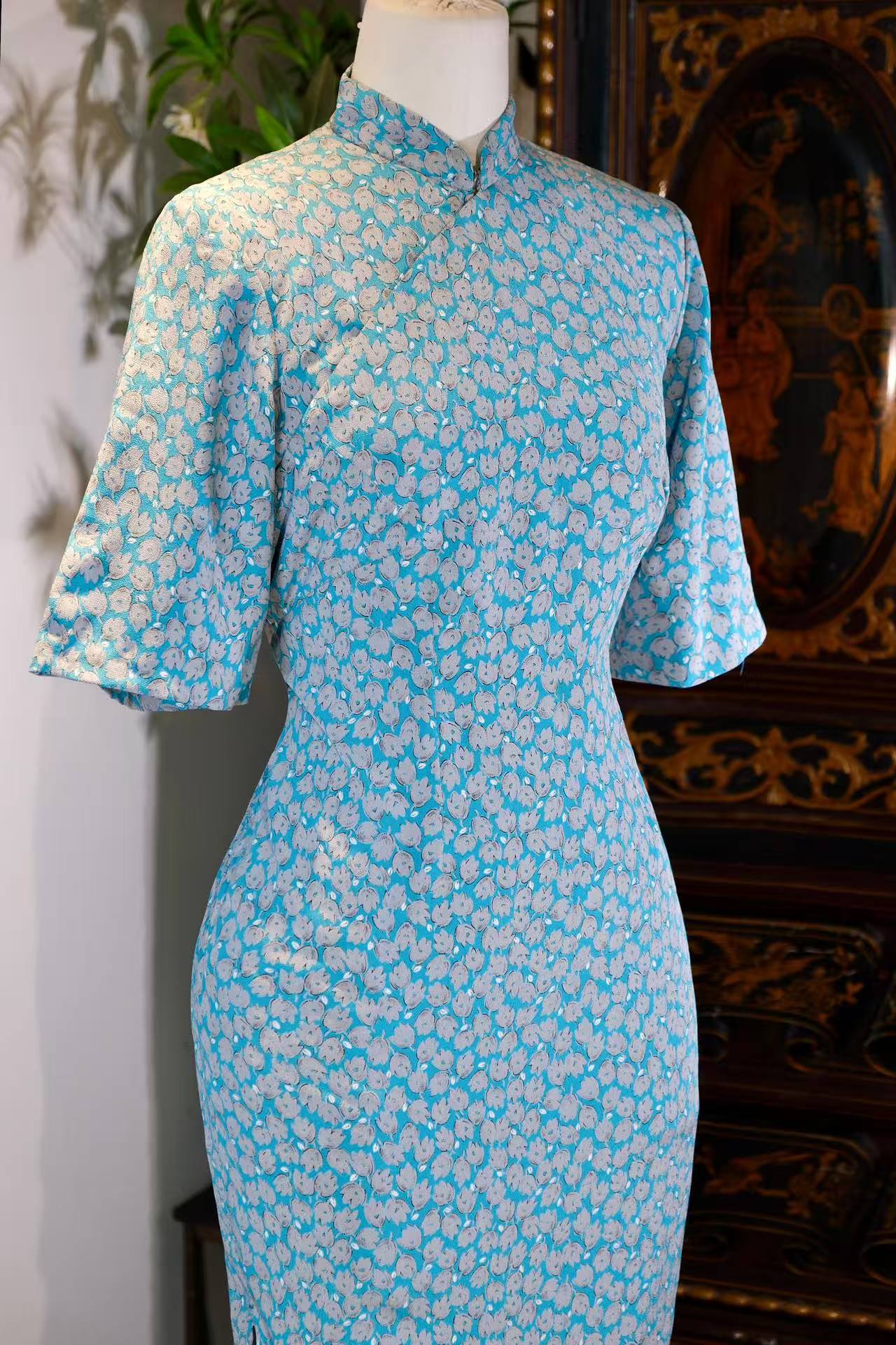
这件古董旗袍,宛如一首凝固的抒情诗,以针线为笔,在湖蓝底色上写满了那个年代独有的浪漫与雅致。
一、纹样考据:湖蓝底色上的“落英缤纷”
这件旗袍的面料,是典型的六十年代台湾产“人造丝”或“棉麻混纺”印花布。其底色并非纯正的蔚蓝,而是一种更为温润、带有灰度的湖蓝,如同雨后初晴的湖面,宁静致远。
图案细节
其上的纹样,并非传统意义上的牡丹或龙凤,而是一种极具现代主义装饰风格的抽象碎花。这些花朵形态简约,似梅非梅,似樱非樱,花瓣边缘带有手绘般的粗粝感,色彩以淡紫、灰白为主,疏密有致地散落在蓝底之上。
艺术风格
这种图案设计深受当时西方“中世纪现代风格”的影响,同时也保留了中国传统文人画中“折枝花卉”的写意神韵。它摒弃了清代旗袍繁复堆砌的刺绣,转而追求平面构成的节奏感。正如宗白华在《美学散步》中所言:“错彩镂金,不如芙蓉出水。”这种碎花图案正是六十年代审美从“繁”向“简”、从“宫廷”向“市井”转型的生动注脚。
二、剪裁与形制:西风东渐下的海派余韵
这件旗袍的剪裁,是典型的“改良旗袍”样式,它完美地融合了西方的立体剪裁与东方的含蓄审美。
- 领口与襟型:采用了经典的中高立领,领口高度适中,既修饰颈部线条,又不失端庄。襟型为传统的右衽斜襟,但在线条处理上更加流畅圆润,盘扣细小精致,隐没在花纹之中,不喧宾夺主。
- 袖型与腰线:袖长约为七分袖,袖口微敞,露出手腕最纤细处,这是六十年代女性追求干练与优雅的体现。腰线收得极高且紧致,利用“省道”技术(Darts)勾勒出女性的胸腰差,这与民国早期的H型直筒剪裁截然不同,是当时台湾受好莱坞电影影响,推崇曲线美的直接证据。
- 裙摆与开衩:裙长及膝下,开衩高度适中,行走间隐约露出腿部线条,既方便日常活动,又保留了东方女性的神秘感。
三、时光故事:宝岛旧梦与稀缺价值
这件旗袍,不仅仅是一件衣物,它是一段被封存的历史。
时代背景
上世纪六十年代的台湾,正处于经济起飞的前夜,社会风气相对保守但正在悄然发生变化。当时的纺织业开始蓬勃发展,台湾产的印花布因其色彩鲜艳、价格亲民而风靡一时。这件旗袍很可能出自一位家境殷实的台湾仕女,或是当时某位归国华侨的日常着装。
稀缺性分析
- 面料的不可复制性:六十年代的印染技术(如滚筒印花)与现代数码印花不同,其色彩渗透力强,且具有独特的时代色感。如今这种特定的湖蓝底色与灰调碎花的搭配,在当代市场上已极难寻觅。
- 保存状况:历经半个多世纪的沧桑,这件旗袍依然保持色泽鲜亮,无明显破损或虫蛀,实属难得。它像一位穿越时空的优雅妇人,静静地诉说着那个“慢车马、慢邮件”年代的从容与精致。
四、结语
这件六十年代台湾产碎花古董旗袍,是“旧时王谢堂前燕,飞入寻常百姓家”的真实写照。它以湖蓝为底,以碎花为墨,书写了那个时代女性对美的追求。
它适合在午后,配上一串温润的珍珠项链,泡一壶乌龙茶,让穿着者在举手投足间,流露出一种“由于懂得,所以慈悲”的岁月静好。这不仅是一件衣服,更是一件值得收藏的艺术品,一段触手可及的民国遗梦。
Measurements / Size Guide:
Bust / Waist / Hips: 96/90/100 cm
Total Length: 110 cm
Detailed Description:
This antique qipao is like a solidified lyric poem, using needle and thread as a pen to write a narrative of romance and elegance unique to its era upon a lake-blue canvas.
The fabric of this qipao is a quintessential 1960s Taiwanese "rayon" or "cotton-linen blend" print. The base color is not a sharp azure, but a gentler, desaturated lake blue—reminiscent of a tranquil lake surface just after the rain cleared.
Pattern Details: The motifs are not traditional peonies or dragons, but abstract broken flowers featuring a strong Modernist decorative style. These floral forms are minimalist—resembling plum blossoms yet not quite, similar to cherry blossoms yet distinct. The petal edges possess a hand-painted, raw texture, with colors dominated by pale purple and ash white, scattered with balanced density across the blue ground.
Artistic Style: This pattern design was heavily influenced by the Western "Mid-Century Modern" style of the time, while retaining the "broken branch" (zhezhi) freehand charm of traditional Chinese literati painting. It abandons the heavy, stacked embroidery of Qing Dynasty qipaos in favor of a rhythmic planar composition. As Zong Baihua noted in Aesthetics Promenade: "Intricate gold inlay is inferior to a lotus emerging from water." This ditsy floral pattern is a vivid footnote to the 1960s aesthetic transition from "complex" to "simple," and from "courtly" to "everyday."
The cut of this qipao is a classic "Improved Qipao" style, perfectly merging Western 3D draping with Eastern subtle aesthetics.
Collar and Placket: It features a classic mid-high standing collar of moderate height, which flatters the neckline while maintaining dignity. The placket is a traditional right-side overlap (youren), but the lines are processed to be smoother and more rounded. The frog buttons (pankou) are small and exquisite, blending into the patterns without overpowering the design.
Sleeves and Waistline: The sleeves are approximately three-quarter length with slightly flared cuffs, revealing the slenderest part of the wrist—a reflection of the 1960s woman's pursuit of capability and elegance. The waistline is cinched high and tight, utilizing "darts" technology to outline the bust-to-waist ratio. This is diametrically opposed to the H-line straight cut of the early Republican era, serving as direct evidence of Hollywood’s influence on Taiwan's promotion of curvy silhouettes.
Hem and Slit: The skirt reaches below the knee with a moderate slit height, faintly revealing the leg lines during movement. This ensures practicality for daily activities while preserving the mystery of the Oriental woman.
This qipao is more than a garment; it is a segment of sealed history.
Historical Background: In 1960s Taiwan, the society was on the eve of an economic takeoff—social atmosphere was relatively conservative but quietly changing. The textile industry began to flourish, and Taiwanese printed fabrics became a sensation for their vibrant colors and accessible pricing. This piece likely belonged to a lady from a wealthy Taiwanese family or was the daily attire of a returning overseas Chinese.
Scarcity Analysis:
Irreproducible Fabric: 1960s printing techniques (such as roller printing) differ from modern digital prints; they offer deep color penetration and a unique period color-sense. This specific pairing of lake-blue with ash-toned ditsy florals is extremely difficult to find in contemporary markets.
Preservation Condition: After more than half a century, this qipao remains vibrant in color with no obvious damage or moth holes. It is like an elegant woman traveling through time, quietly narrating the composure and refinement of an era when "carriages and mail moved slowly."
This 1960s Taiwanese ditsy floral antique qipao is a true portrayal of "the swallows from the halls of the old nobility flying into the homes of ordinary people." With lake-blue as the paper and florals as the ink, it scripts the pursuit of beauty by the women of that era.
It is best suited for an afternoon paired with a strand of warm pearls and a pot of Oolong tea, allowing the wearer to exude a sense of "tranquil years" born of deep understanding and compassion. This is not just a dress; it is a collectible work of art—a touchable dream of a bygone era.