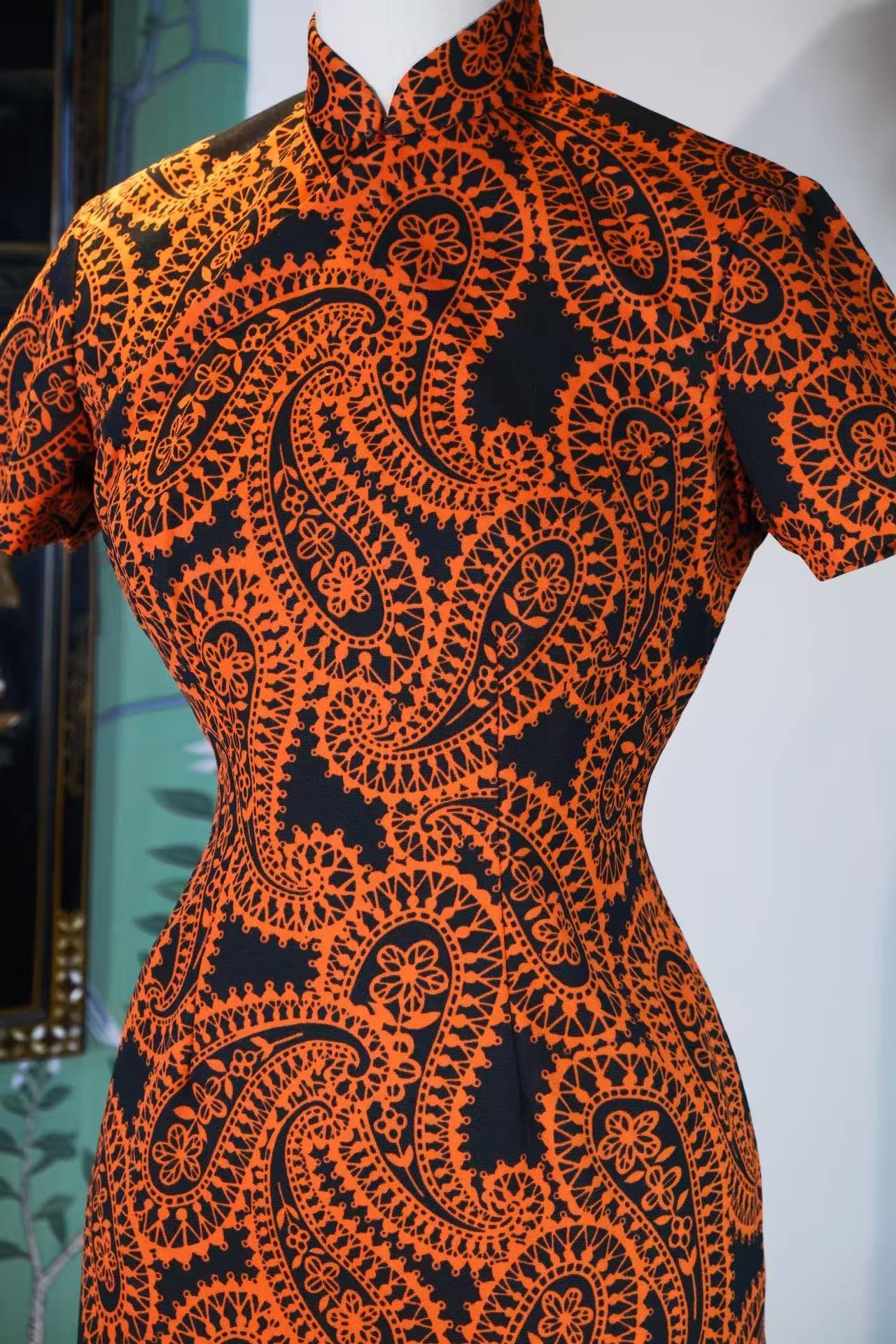
火焰纹样里的百年孤独——六十年代香港佩斯利印花古董旗袍
这件藏于时光褶皱中的香港古董旗袍,以焦糖色为经,藏青色为纬,在斜裁的桑蚕丝经纬间,缠绕着源自古波斯的神秘纹样——佩斯利。这种被西方称为“生命之树”的涡旋纹,在东方匠人的妙笔下,幻化为缠枝莲与如意云头的共生体:橙红线条如火焰般盘旋,勾勒出八瓣莲花的核心,藏青底色似深潭般沉静,托举着涡纹的流动。每一处卷曲都暗藏玄机,六十四瓣针脚细密的缠枝纹,在立领与开衩处形成回旋的韵律,恰似《考工记》所言“天有时,地有气,材有美,工有巧”的绝妙注脚。
上世纪六十年代的香港,恰逢东方美学与西方现代性碰撞的黄金时代。这件旗袍的面料采用当时最先进的活性印染工艺,使佩斯利纹样的边缘呈现出微妙的晕染感,恍若敦煌壁画中飞天衣袂的飘逸。而紧身收腰的剪裁,则承袭了海派旗袍的遗风,在腰节处收进七厘米的弧度,勾勒出东方女性独有的“S”型曲线,与同期好莱坞影星黄柳霜钟爱的改良旗袍如出一辙。
更为珍罕的是,其面料纹样暗合《营造法式》中“卷草纹”的构图法则——主纹如龙脊般贯穿全身,辅纹似藤蔓缠绕其间,而每个涡纹中心的四叶花,恰是唐代“陵阳公样”的遗存。这种跨越千年的纹样传承,使这件旗袍成为中西纺织史交汇的活化石:既可见印度棉布贸易带来的异域风情,又藏着岭南刺绣的留白意境,更暗合了六十年代“迷幻美学”的时代精神。
在当代时尚的洪流中,它如一件行走的文物,衣摆摇曳间,仿佛能听见兰心大戏院的丝竹声与皇后大道的电车铃交织。焦糖色在岁月中沉淀为琥珀般的温润,佩斯利纹在光影里幻化为流动的火焰,诉说着香港作为“东方之珠”的独特宿命——既是传统文化的守护者,又是世界美学的交融地。收藏这件旗袍,便是收藏了一段凝固的时光,让六十年代的东方浪漫,在现代衣香鬓影间,续写未完的传奇。
One Hundred Years of Solitude in Flaring Patterns: 1960s Hong Kong Paisley Antique Qipao
"Caramel as the warp, navy as the weft; within the biased silk lies the swirling mystery of ancient Persia—the Paisley."
Hidden within the folds of time, this Hong Kong antique Qipao features the swirling Paisley motif, known in the West as the "Tree of Life." Under the masterful hand of Oriental artisans, it transforms into a symbiosis of the Intertwining Lotus and Ruyi Cloud: orange-red lines spiral like flames, outlining the core of an eight-petaled lotus, while the navy base remains as serene as a deep pool, cradling the flow of the vortices. Every curve harbors a secret; the sixty-four meticulously stitched vine patterns create a swirling rhythm at the standing collar and side slits, serving as a perfect footnote to the philosophy of Kao Gong Ji: "The season of Heaven, the breath of Earth, the beauty of Material, and the skill of Craft."
In 1960s Hong Kong, Oriental aesthetics collided with Western modernity during a golden era. The fabric utilizes the then-pioneering reactive printing process, giving the Paisley edges a subtle bleeding effect reminiscent of the ethereal robes of the "Flying Apsaras" in Dunhuang murals. The tight-waisted silhouette inherits the legacy of the Shanghai school, cinching seven centimeters at the waist to contour the "S-curve" unique to Oriental women—mirroring the modified Qipao favored by Hollywood star Anna May Wong.
What makes it even rarer is how the pattern aligns with the composition rules of "Scrolling Grass" in Yingzao Fashi—the primary motif runs through the body like a dragon's spine, while secondary vines entwine around it. The four-leaf flower at the center of each vortex is a remnant of the Tang Dynasty's "Lingyang Gong Style." This millennial inheritance makes this Qipao a living fossil of East-West textile history: it reflects the exoticism brought by the Indian calico trade, the "negative space" aesthetic of Lingnan embroidery, and the "psychedelic aesthetics" of the 1960s spirit.
In the torrent of contemporary fashion, this garment is a walking artifact. As the hem sways, one can almost hear the silk-and-bamboo music of the Lyceum Theatre interlaced with the tram bells of Queen’s Road. The caramel color has settled into an amber-like warmth over the decades; the Paisley patterns transform into flowing flames under the light, speaking of Hong Kong’s destiny as the "Pearl of the Orient"—both a guardian of tradition and a melting pot of global aesthetics. To collect this Qipao is to preserve a frozen segment of time, allowing the Oriental romance of the 1960s to continue its legend amidst the modern fragrance of silk and shadows.