深圳溯源
Couldn't load pickup availability
衣服尺寸:
胸围/腰围/臀围:88/62/92 厘米
衣长:98 厘米
细节描述:
一、图案与形制:素面上的“无饰之饰”
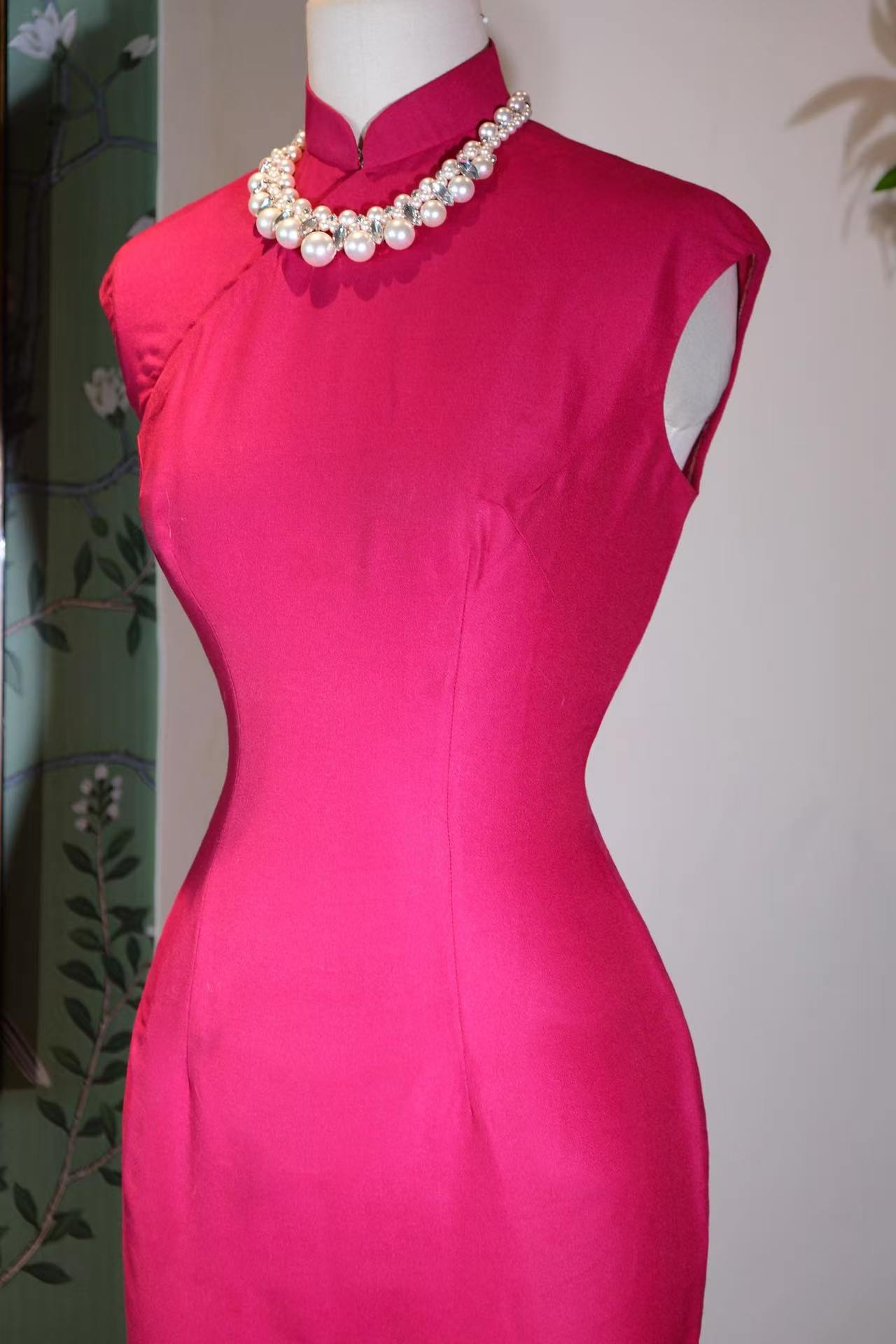
这件玫红色无袖旗袍以台湾产混纺素绉为料,通体无任何刺绣或印花,却在“无饰”中见极致匠心。面料光泽如秋水凝脂,垂坠感极佳,贴合人体曲线时自然形成流畅的褶皱,恰如《考工记》所言“天有时,地有气,材有美,工有巧”——素绉的肌理本身便是最动人的“图案”,它以材质的纯粹性,将东方美学中“大音希声,大象无形”的哲思具象化。
形制上,旗袍延续六十年代台湾旗袍的经典轮廓:高立领修饰颈部线条;无袖设计露出肩臂,既符合热带气候的实用性,又暗合当时西方“简约主义”的审美潮流;侧缝开衩至膝上15厘米,行走时裙摆微扬,步履间暗藏风情。整体剪裁遵循“人体工程学”原理,腰省、胸省精准收束,将女性曲线勾勒得含蓄而饱满,堪称“东方版的高级定制”。
二、古董衣的故事:海岛上的“旗袍黄金时代”
上世纪六十年代,台湾成为旗袍工艺的“避难所”与“革新场”。1949年后,大批上海裁缝随国民政府迁台,将海派旗袍的精髓带到宝岛。彼时台湾经济尚未腾飞,但中产阶级女性对“体面”的追求催生了旗袍的“本土化改良”:面料多采用台湾本地生产,剪裁上则融合海派的“立体剪裁”与台湾的“实用主义”,形成“简约而不简单”的风格。
这件玫红旗袍的主人,或许是一位台北的“新女性”——她可能是大学教授的妻子,也可能是外贸公司的职员。在那个“旗袍是日常装”的年代,她穿着这件玫红旗袍参加婚宴、拜访亲友,甚至在午后咖啡馆里读张爱玲的小说。旗袍的玫红色,既非传统正红的庄重,也非粉色的柔媚,而是带着几分“叛逆”的鲜亮,恰如六十年代台湾女性在传统与现代夹缝中绽放的生命力。
三、艺术风格与稀缺性:六十年代台湾旗袍的“绝唱”
从艺术风格看,这件旗袍是“中西合璧”的典范:
- 东方神韵:立领、斜襟、开衩等元素,延续民国旗袍的基因,却以“减法”去除繁缛装饰,回归“衣以载道”的本质;
- 西方影响:无袖设计、修身剪裁,暗合1960年代西方“迷你裙革命”前的“简约风潮”,却又以东方女性的含蓄将其柔化;
- 材质创新:台湾素绉的厚重感与光泽度,既区别于上海旗袍的轻薄软缎,又不同于香港旗袍的艳丽印花,形成独特的“海岛质感”。
其稀缺性更值得珍视:
- 时代孤本:六十年代台湾旗袍因经济条件限制,存世量远少于上海、香港同期作品,且多为素色无饰,这件玫红款因色彩鲜亮、保存完好,堪称“凤毛麟角”;
- 工艺绝响:台湾老裁缝多已离世,传统“归拔”工艺(通过熨烫塑造立体曲线)濒临失传,这件旗袍的精准剪裁,是“活态遗产”的见证;
- 文化符号:它不仅是衣物,更是六十年代台湾社会转型的缩影——从“大陆遗风”到“本土自觉”,从“传统闺秀”到“现代女性”,每一道针脚都缝着时代的密码。
四、结语:穿在身上的“历史诗行”
张爱玲曾说:“旗袍是中国的时装。”这件玫红无袖旗袍,恰如一首“无声之诗”:它以素绉为纸,以剪裁为笔,写下六十年代台湾女性的优雅与坚韧;它以无饰为饰,以简约为繁,诠释东方美学中“空故纳万境”的智慧。当指尖抚过那温润的缎面,仿佛能触摸到半个世纪前台北街头的阳光,与那位穿着它的女子,在历史长河中留下的、永不褪色的倩影。
Measurements / Size Guide:
Bust / Waist / Hips: 88/62/92 cm
Total Length: 98 cm
Detailed Description:
Crafted from Taiwan-produced blended plain crepe, this rose-red sleeveless qipao (cheongsam) features no embroidery or prints, yet achieves a pinnacle of ingenuity through its "plainness." The fabric’s luster is as refined as autumn water, possessing an exceptional drape that creates natural, fluid folds along the body’s curves. As noted in Kao Gong Ji: "Heaven has its seasons, Earth its vital energy, materials their beauty, and craftsmanship its ingenuity." The texture of the plain crepe itself becomes the most moving "pattern," reifying the Eastern philosophical concept that "great music is faintly heard; great images have no form" through its material purity.
In terms of form, the garment retains the classic silhouette of 1960s Taiwan qipaos: a high standing collar to refine the neckline; a sleeveless design that exposes the shoulders—a practical choice for the tropical climate that also aligned with the Western "Minimalism" trend of the time. The side slits rise to 15cm above the knee, allowing the hem to sway gracefully with every step. The tailoring follows "ergonomic" principles, with darts at the waist and bust precisely placed to outline a silhouette that is both subtle and full—an Eastern version of Haute Couture.
In the 1960s, Taiwan became both a "sanctuary" and an "innovation hub" for qipao craftsmanship. After 1949, a large number of Shanghainese tailors migrated to Taiwan, bringing the essence of Shanghai-style (Haipai) qipaos to the island. While the economy had not yet fully surged, the middle-class woman’s pursuit of "decency" led to the "localization and reform" of the garment. Fabrics were often sourced locally, while the tailoring integrated Shanghainese "3D draping" with Taiwanese "pragmatism," resulting in a style that was "simple but not simplistic."
The original owner of this rose-red piece might have been a "New Woman" in Taipei—perhaps the wife of a university professor or an employee at a foreign trade firm. In an era when the qipao was daily attire, she might have worn this to a wedding, to visit relatives, or even to read Eileen Chang in an afternoon café. The rose-red hue is neither the solemnity of traditional vermilion nor the softness of pink; it carries a hint of "rebellious" vibrancy, mirroring the vitality of Taiwanese women blooming in the gaps between tradition and modernity.
Artistically, this qipao is a paragon of "East meets West":
Eastern Spirit: The collar, lapel, and slits carry the DNA of Republican-era qipaos, yet employ "subtraction" to remove superfluous decoration, returning to the essence of "clothing as a vessel for Tao."
Western Influence: The sleeveless cut and slim fit resonated with the pre-"Miniskirt Revolution" minimalist trends of 1960s Western fashion, softened by Eastern reserve.
Material Innovation: The weight and luster of Taiwanese plain crepe differ from the light silks of Shanghai or the vivid prints of Hong Kong, creating a unique "Island Texture."
Its scarcity is particularly noteworthy:
Era-Specific Unique Specimen: Due to economic constraints at the time, the survival rate of 1960s Taiwan qipaos is much lower than those from Shanghai or Hong Kong. Plain, unadorned pieces in such a vibrant color and pristine condition are "as rare as phoenix feathers."
Artisanal Echoes: Many of the old Taiwanese masters have passed away, and the traditional "Gui-Ba" technique (shaping the fabric through strategic steam-pressing) is on the verge of extinction. The precise fit of this garment is a witness to a "living heritage."
Cultural Symbol: It is more than clothing; it is a microcosm of Taiwan’s social transition—from "continental legacies" to "local consciousness," and from the "cloistered lady" to the "modern woman."
Eileen Chang once said: "The qipao is the fashion of China." This rose-red sleeveless qipao is indeed a "silent poem." With plain crepe as paper and tailoring as the brush, it writes of the elegance and resilience of 1960s Taiwanese women. By choosing simplicity over complexity, it interprets the wisdom of Eastern aesthetics—"Emptiness contains ten thousand realms." When fingertips brush the warm satin surface, one can almost touch the sunlight of Taipei streets half a century ago and see the silhouette of the woman who wore it, left unfading in the river of history.