深圳溯源
Couldn't load pickup availability
衣服尺寸:
胸围/腰围/臀围:98/86/104 厘米
衣长:108 厘米
细节描述:
一、金丝绒上的时光肌理
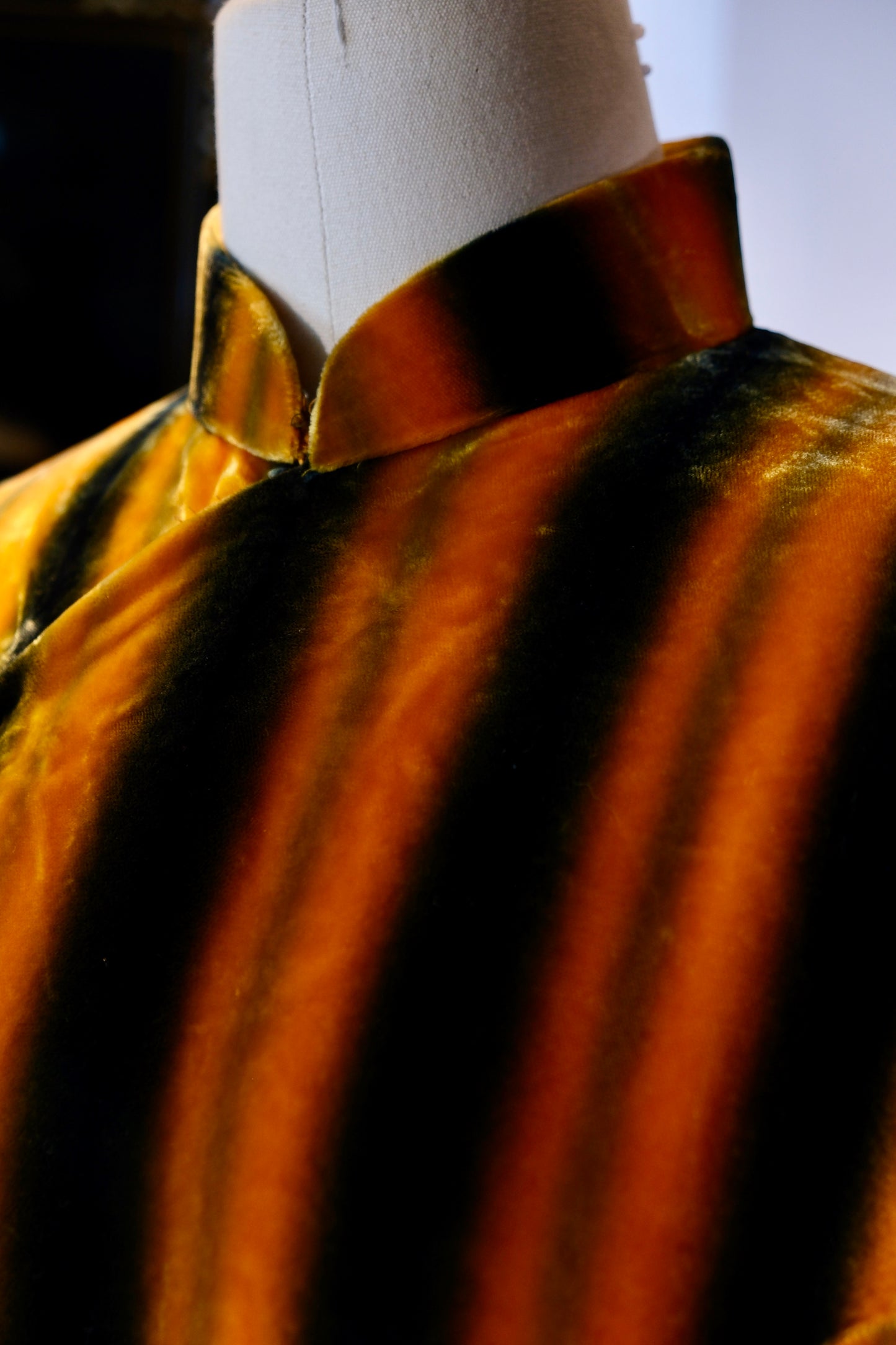
这件旗袍的面料选用日本进口的金丝绒,其绒毛细密如秋蝉之翼,在光线流转间呈现出琥珀与墨玉交织的色泽。金丝绒(velvet)本为欧洲宫廷织物,经日本工匠改良后,于二十世纪中叶成为东亚高级定制的象征——其绒毛长度控制在1.2毫米,既保留了丝绒的华贵垂坠感,又避免了传统丝绒易褶皱的缺陷。旗袍表面的喷绘印花工艺尤为罕见:工匠以手工喷枪将黑、金、赭三色颜料雾化,在绒面上晕染出宽窄不一的竖条纹,条纹边缘如云雾般自然过渡,远观似古铜器上的饕餮纹在光影中流动,近看则见绒毛间隙中沉淀着细碎的金粉,仿佛将敦煌壁画的矿物颜料研磨后洒落于布面。这种“喷绘晕染”技法在六十年代台湾旗袍制作中仅见于少数高端工坊,因需反复调试颜料浓度与喷枪气压,每件作品的条纹肌理皆独一无二,堪称“穿在身上的水墨画”。
二、剪裁里的文化密码
旗袍的廓形遵循1960年代台湾“改良旗袍”的经典范式:立领高度约4.5厘米,领型微微外翻,既保留了传统旗袍的含蓄,又通过领线的弧度增添了几分现代女性的干练。衣身采用“省道剪裁”,在胸部与腰部设置隐形省道,使金丝绒面料紧密贴合身形,勾勒出流畅的S型曲线——这种剪裁借鉴了西方立体裁剪技术,却以东方审美为内核,正如《考工记》所言“天有时,地有气,材有美,工有巧”,将人体工学与传统服饰的“宽衣文化”完美融合。下摆长度及小腿中部,侧边开衩高度适中,行走时隐约露出腿部线条,恰如张爱玲在《更衣记》中所写:“旗袍的作用不外乎烘云托月忠实地将人体轮廓曲曲勾出”,在保守与性感间找到了精妙的平衡。
三、稀缺性的历史注脚
这件旗袍的稀缺性,源于其诞生的特殊时代背景。1960年代的台湾正处于“出口导向型经济”初期,纺织业作为支柱产业,大量进口日本高端面料用于出口成衣制作。彼时台湾旗袍工坊多以“来料加工”模式运营,日本金丝绒因成本高昂,仅用于制作出口欧美或本地高端定制的旗袍,内销市场极为罕见。而喷绘印花工艺的运用,更与当时台湾纺织业的技术革新密切相关:1962年台湾首次引进喷绘印花机,但手工喷绘因更具艺术表现力,仍被高端工坊保留,成为机器印花时代最后的“手工余韵”。这件旗袍的保存状态堪称完美,金丝绒未出现倒绒、褪色现象,喷绘条纹依旧清晰立体,实为研究六十年代东亚纺织贸易与服饰文化的“活化石”。
四、古董衣的时空对话
抚摸着旗袍上凹凸的绒毛,仿佛能触摸到那个年代的温度:1963年的台北,一位身着此旗袍的女子走过中山北路的咖啡馆,金丝绒在霓虹灯下泛着微光,喷绘条纹随步伐摇曳生姿,成为街头一道流动的风景线。这件旗袍不仅是服饰,更是一个时代的缩影——它见证了日本纺织技术对台湾的影响,记录了台湾旗袍从传统平面剪裁向立体剪裁的转型,也承载了六十年代女性对“现代性”的追求。正如艺术史家贡布里希所言:“没有艺术,只有艺术家”,这件无名工匠制作的旗袍,以其精湛的工艺与独特的艺术风格,在时光长河中留下了属于自己的印记,成为连接过去与现在的文化纽带。
Measurements / Size Guide:
Bust / Waist / Hips: 98/86/104 cm
Total Length: 108 cm
Detailed Description:
The fabric of this qipao features imported Japanese golden velvet, with a pile as fine and dense as a cicada's wing, revealing an interlaced luster of amber and dark jade as light shifts across it. Originally a European court textile, velvet was refined by Japanese craftsmen in the mid-20th century to become a hallmark of East Asian haute couture—maintaining a pile height of exactly 1.2 mm to preserve a luxurious drape while avoiding the structural fragility of traditional velvets. The airbrushed (spray-painted) printing process on the surface is exceptionally rare: craftsmen used manual airbrushes to atomize black, gold, and ochre pigments, creating vertical stripes of varying widths. The edges of these stripes transition naturally like drifting mist; from a distance, they resemble the flowing Taotie motifs found on ancient bronzes, while up close, fine gold dust remains settled within the gaps of the velvet pile, as if mineral pigments from Dunhuang murals had been ground and scattered across the cloth. This "airbrushed gradient" technique was found only in a few high-end Taiwanese workshops during the 1960s. Due to the need for constant adjustment of pigment concentration and air pressure, the texture of each piece's stripes is entirely unique—a "wash painting worn on the body."
The silhouette follows the classic paradigm of 1960s Taiwanese "Improved Qipao": a standing collar approximately 4.5 cm high with a slight outward flare, preserving traditional modesty while adding a touch of modern female decisiveness through its curvature. The torso utilizes "dart tailoring," with invisible darts at the bust and waist that allow the velvet to cling closely to the form, tracing a fluid S-curve. This technique draws from Western 3D cutting while maintaining an Oriental aesthetic core. As noted in the Kao Gong Ji: "Heaven has its seasons, Earth its vitality, materials their beauty, and craftsmen their skill," perfectly merging ergonomics with the traditional "loose garment" culture. The hem reaches mid-calf with moderate side slits, subtly revealing the leg line during movement. As Eileen Chang wrote in A Record of Changing Clothes: "The function of the qipao is nothing more than to faithfully trace the contours of the human body," finding a sophisticated balance between conservatism and sensuality.
The rarity of this qipao stems from the specific era of its birth. In the 1960s, Taiwan was in the early stages of an "export-oriented economy," with the textile industry serving as a pillar, importing vast amounts of high-end Japanese fabrics for export-grade garments. At that time, Taiwanese qipao workshops often operated on a "processing with supplied materials" model. Japanese golden velvet, due to its high cost, was reserved for qipaos exported to Europe and America or for elite local commissions, making it extremely rare in the general domestic market. The use of airbrushed printing was closely linked to the technological innovations of the Taiwanese textile industry: although airbrush printing machines were first introduced in 1962, manual airbrushing was retained by high-end workshops for its superior artistic expression, serving as the "final manual resonance" in the age of machine printing. The preservation state of this piece is impeccable—the velvet shows no crushing or fading, and the airbrushed stripes remain sharp and three-dimensional, making it a "living fossil" for studying mid-century East Asian textile trade and costume culture.
Tracing the undulating pile of the qipao feels like touching the temperature of that era: Taipei in 1963, a woman in this garment walking past a café on Zhongshan North Road, the velvet shimmering under neon lights, the airbrushed stripes swaying with her gait—a flowing landscape on the street. This qipao is not merely clothing but a microcosm of an era: it witnesses the influence of Japanese textile technology on Taiwan, records the transition of the qipao from traditional flat cutting to 3D tailoring, and carries the 1960s woman's pursuit of "modernity." As art historian E.H. Gombrich stated: "There really is no such thing as Art. There are only artists." This qipao, crafted by an anonymous master, leaves its own mark in the river of time through exquisite skill and unique style, serving as a cultural bridge connecting the past to the present.