深圳溯源
Couldn't load pickup availability
如果说之前的驼色套装是Woo女士的“日装”,那这套出自香港“
一、视觉的诗篇:蕾丝的繁复与珍珠的温润
这套套装最引人注目的,莫过于其通体覆盖的精致蕾丝。
- 色彩:这是一种极难驾驭的“香芋紫”或“薰衣草紫”。
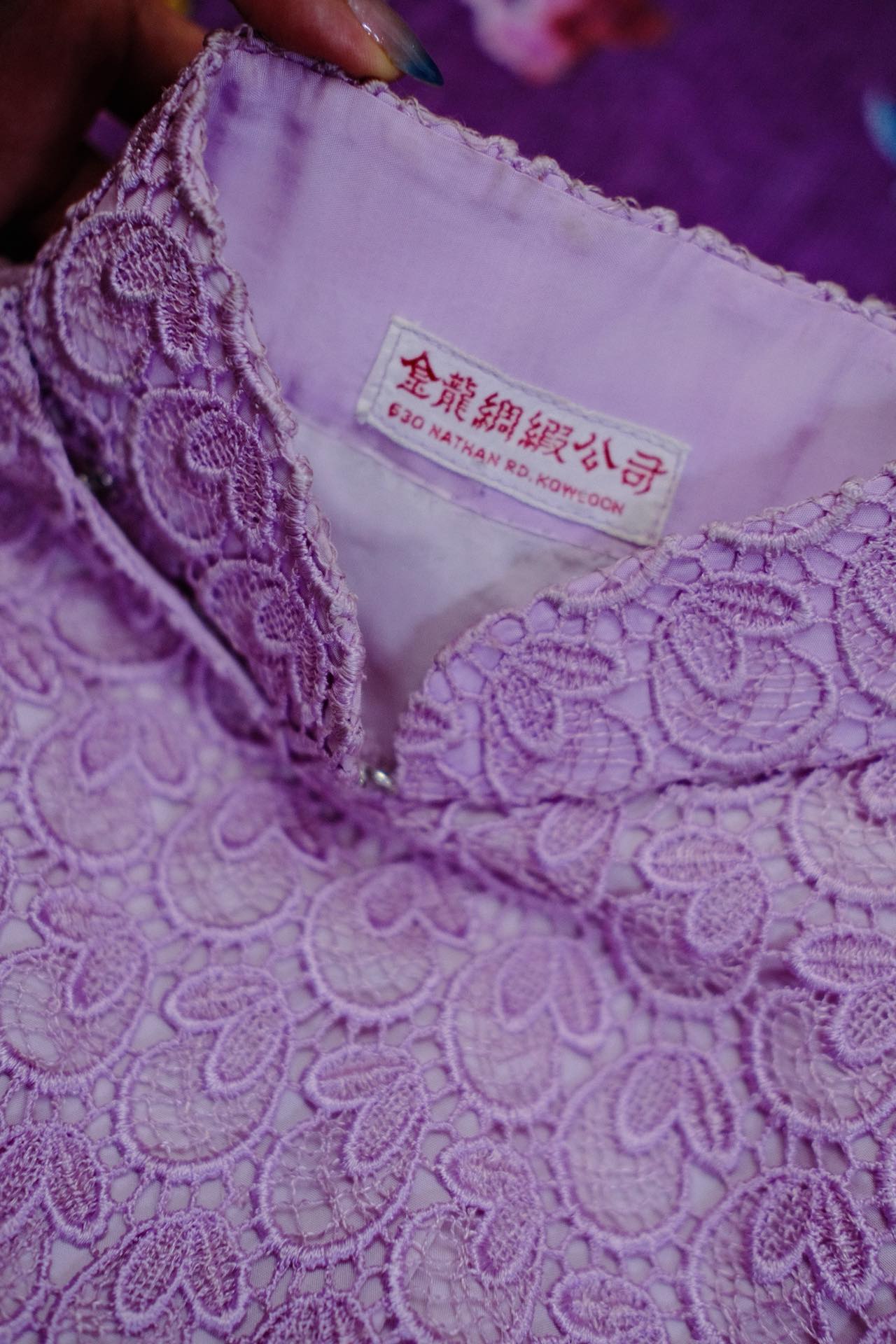
- 面料与图案:面料采用了法国进口的刺绣蕾丝。
- 剪裁与细节:
- 无袖旗袍与短外套:内搭是一件修身的无袖旗袍,
- 领口:经典的旗袍立领,领口处点缀着一串双层珍珠项链,
- 帽子:搭配的白色网纱礼帽,点缀着立体的白色小花,
二、衣以载道:弥敦道630号的时尚印记
衣服内衬的标签上清晰地印着“金龍綢緞公司,630 NATHAN RD. KOWLOON”。
弥敦道,九龙半岛的“香榭丽舍大道”,是香港最繁华的商业街。
Woo女士的故事在这里得到了最完美的诠释。
这套衣服,是她对美的极致追求的体现。她不仅要穿得得体,
If the previously detailed camel suit served as Ms. Woo’s authoritative "daywear," this taro-purple lace ensemble—crafted by the prestigious "Golden Dragon Silk Company" (金龍綢緞公司) in Hong Kong—stands as the breathtaking "evening wear" movement of her style anthology. This gentle, regal shade of lavender mirrors the twilight haze lingering over Victoria Harbour at dusk, carrying both the subtle restraint of the East and the sweeping romance of the French coast.
The most captivating element of this evening coordinates set is the masterful, full-body execution of fine openwork textile:
The Lavender Chromaticism: The garment is enveloped in an elusive "taro-purple" or "lavender mist" hue. In 1960s luxury circles, this specific palette signified dreamlike elegance—possessing more gravitas than pastel pink, yet maintaining a lighter, more ethereal bounce than deep violet. It was highly favored for its exceptional ability to illuminate and flatter East Asian skin tones.
The French Textile & Geometry: The fabric features imported French embroidered lace. Rather than scattered botanical sprays, the lace layout follows a highly structured, geometric fusion of "Medallion Flowers" (Tuanhua) and scrolling vines. The bodice showcases closely nested heart- and leaf-shaped filigrees, which gracefully transition along the skirt into radiating Art Deco-inspired medallion clusters—complex, architectural, yet perfectly balanced.
Silhouettes & Accessories:
The Inner Qipao & Jacket: The base layer is a sleeveless, form-fitting qipao that cleanly articulates the neckline and shoulders. It is layered with a matching three-quarter sleeve cropped jacket, which introduces formal poise and sophisticated modularity to the outfit.
The Illusion Neckline: Accentuating the traditional mandarin collar is an integrated strand of double-layer pearls culminating in a singular, oversized pearl pendant. Its soft, luminescent sheen offers a luminous counterpoint to the matte texture of the surrounding embroidery.
The Millinery: The look is completed by a white net-veil fascinator hat adorned with three-dimensional white blossoms. This addition injects a youthful, cinematic romance reminiscent of Audrey Hepburn's iconic mid-century styling.
Stitched into the inner lining is a pristine silk woven label that reads: "Golden Dragon Silk Co., 630 NATHAN RD. KOWLOON."
Nathan Road—often heralded as the Champs-Élysées of the Kowloon Peninsula—reigned as Hong Kong's glittering commercial spine. In the 1960s, framed by dense neon signs and endless streams of traffic, Nathan Road housed the colony's most elite silk merchants, textile importers, and master tailors. It was the absolute epicentre of Hong Kong fashion and the definitive pilgrimage site for Ms. Woo whenever her ocean-crossing flights touched down in the city.
Here, Ms. Woo’s identity as a visionary tastemaker comes into sharp focus. As an astute entrepreneur, she was a true global buyer, identifying premier raw materials across continents—be it French lace or British wool. Yet, she remained the ultimate curator of her own image, entrusting these global luxury materials to Hong Kong's master couturiers to be sculpted into garments uniquely optimized for her posture.
This ensemble bridges three worlds: French romanticism (the lace), Chinese classicism (the qipao silhouette), and the soaring post-war cosmopolitan energy of Hong Kong.
From a curatorial perspective, this ensemble occupies an incredibly rare niche in vintage textile archives:
Fragility and Survival: Unlike sturdy wools or tweeds, 1960s French embroidered lace is exceptionally fragile and prone to fiber degradation. To find a two-piece evening set with its openwork net structure entirely intact, free of snagging, and unfaded by time is a remarkable archival occurrence.
The Golden Age of Nathan Road Silk Houses: "Golden Dragon Silk Company" was synonymous with elite fabric sourcing, catering exclusively to high society and wealthy diasporic clients. Following the commercial shifts of the late 20th century, these legendary fabric institutions disappeared, transforming this set into a finite historical record of Hong Kong's high-end textile trade.
A Material Memoir of Diaspora High Society: The piece stands as physical documentation of how pioneering Chinese-Canadian women utilized couture to assert status, grace, and cultural fluency within international executive and social circles.