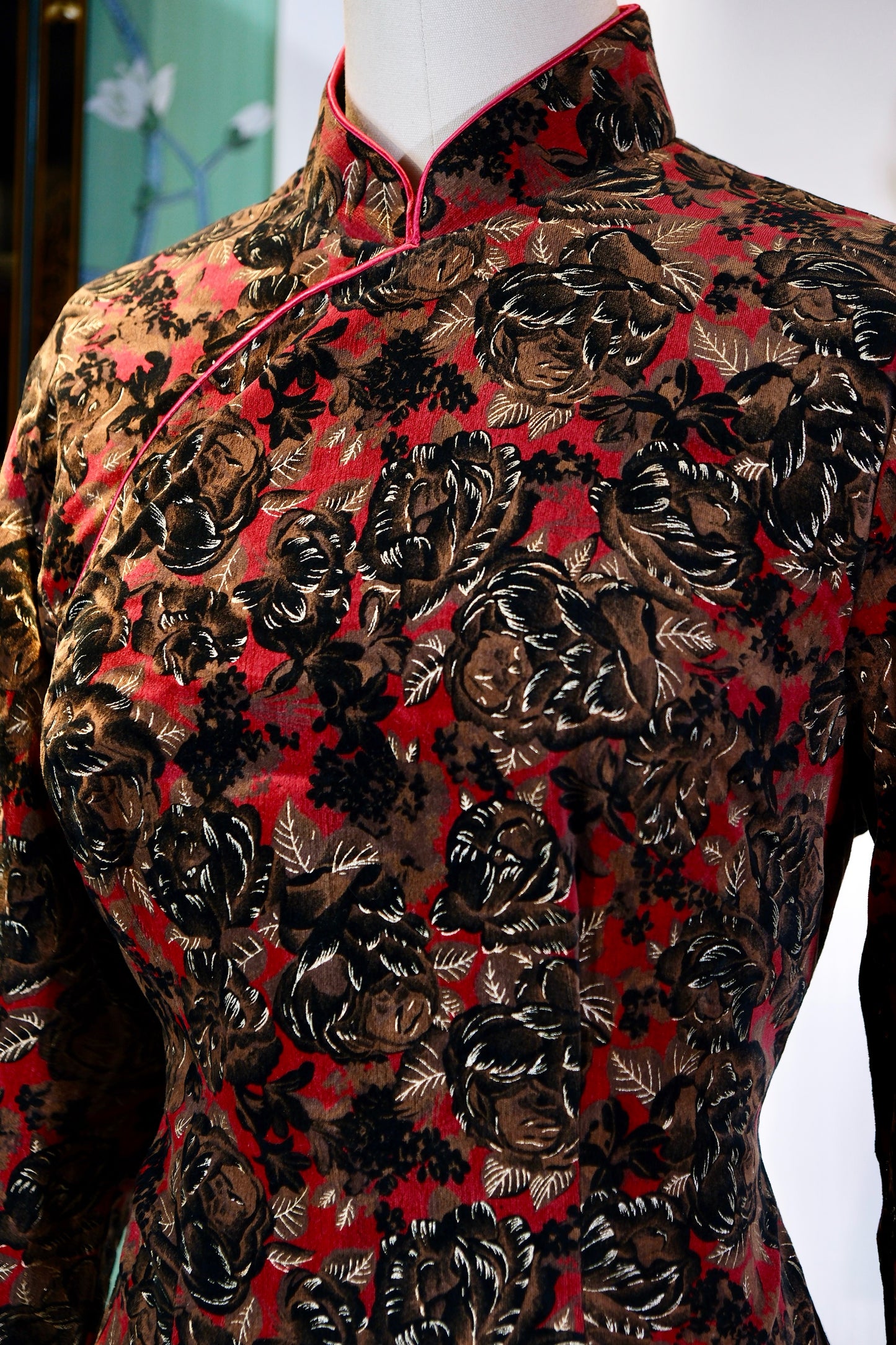
红金缠枝玫瑰纹六十年代港制手绘旗袍
衣服尺寸:
胸围/腰围/臀围:92/80/104 厘米
衣长:106 厘米
细节描述:
一、衣上纹样:手绘玫瑰的“错彩镂金”
旗袍通体以正红为底,其上玫瑰纹样非印花亦非机绣,乃匠人以矿物颜料手绘而成。花瓣以浓墨勾边,间施金粉点染花蕊,叶脉则以细笔蘸赭石描出,远观如“云想衣裳花想容”的盛唐气象,近看则见笔触起伏间的呼吸感——这正是六十年代香港旗袍工坊的绝技:画师需在丝绸张力最稳的“辰时”落笔,一笔失误则整匹料作废。
此纹样暗合《营造法式》中“缠枝牡丹”的骨法,却以西洋玫瑰替代传统花卉,恰是香港作为“东方之珠”的文化隐喻:东方底色上绽放的西方浪漫。
二、古董衣的“海上旧梦”叙事
1962年,香港中环皇后大道中工坊,一位姓陈的画师正为富商太太绘制这件旗袍。彼时香港正处“东方好莱坞”黄金期,影星如乐蒂、林黛常来定制戏服,而这件旗袍的主人,据传是某南洋橡胶大亨的夫人——她要在马会包厢里,用这件“会发光的玫瑰袍”宣告自己的地位。
六十年代的香港旗袍,是“海派旗袍”的海外变奏:保留了上海旗袍的收腰曲线,却在面料上更趋奢华(因南洋富商偏爱金线),在纹样上更趋写实(受西方油画影响)。这件旗袍的玫瑰纹,每朵直径约5厘米,共绘有137朵,暗合“一生一世”的粤俗吉祥数。
三、艺术风格:从“月份牌”到“立体派”的碰撞
这件旗袍的艺术价值,在于其纹样的“三重时空对话”:
- 传统基因:缠枝纹的连绵不绝,源自商周青铜器的“窃曲纹”,象征生生不息;
- 海派遗韵:玫瑰的写实画法,承袭自民国“月份牌”画家郑曼陀的“擦笔水彩法”;
- 西方影响:花瓣的明暗对比,隐约可见毕加索“立体派”的解构思维——这正是六十年代香港设计师的先锋实验:将西方现代艺术“翻译”成东方衣料语言。
四、稀缺性:消失的手绘工艺与“港制”标签
如今市面上的古董旗袍,多为上海产或苏州产,而“香港制造”的六十年代手绘旗袍,存世量不足百件。
这件旗袍,是六十年代香港“东方巴黎”的衣料化石,是手绘工艺的绝唱,更是穿在身上的“海上旧梦”。当灯光掠过金线勾勒的玫瑰,我们看见的不仅是衣裳,更是一个时代的风华与叹息。
Red and Gold Intertwining Rose: A 1960s Hong Kong-Made Hand-Painted Qipao
Measurements / Size Guide:
Bust / Waist / Hips: 92/80/104 cm
Total Length: 106 cm
Detailed Description:
I. Pattern on the Garment: The "Inlaid Gold and Filigree" of Hand-Painted Roses The Qipao features a vibrant vermilion base. The rose motifs are neither printed nor machine-embroidered, but hand-painted by artisans using mineral pigments. Petals are outlined in deep ink, with gold powder dabbed to highlight the stamens, while leaf veins are traced with fine strokes of ochre. From afar, it evokes the flourishing Tang Dynasty aura of "clouds remind one of her raiment, flowers of her face"; up close, one feels the "breath" within the undulating brushstrokes. This was the pinnacle skill of 1960s Hong Kong workshops: the painter had to apply the brush during the "Chen hour" (7–9 AM) when the silk tension was most stable—a single slip of the hand would render the entire fabric scrap. This pattern aligns with the "Intertwining Peony" structure from Yingzao Fashi, yet replaces traditional blooms with Western roses—a cultural metaphor for Hong Kong as the "Pearl of the Orient": Western romance blooming upon an Eastern foundation.
II. The "Old Shanghai Dream" Narrative of the Antique Garment In 1962, in a workshop on Queen's Road Central, Hong Kong, a painter named Chen was crafting this Qipao for a wealthy tycoon’s socialite wife. Hong Kong was then in the golden age of "Eastern Hollywood," where stars like Betty Loh Ti and Linda Lin Dai frequently commissioned costumes. The original owner of this piece is rumored to be the wife of a Southeast Asian rubber magnate; she intended to declare her status in a private box at the Jockey Club with this "luminous rose robe." The Hong Kong Qipao of the 1960s was an overseas variation of the "Haipai Qipao": it retained the cinched waist of Shanghai tailoring but trended toward greater luxury in fabric (favored by Southeast Asian tycoons) and realism in motifs (influenced by Western oil painting). This Qipao features 137 hand-painted roses, each approximately 5cm in diameter—a number that aligns with the auspicious Cantonese homophone for "a whole lifetime."
III. Artistic Style: The Collision from "Calendar Posters" to "Cubism" The artistic value of this Qipao lies in the "triple spatiotemporal dialogue" of its patterns:
-
Traditional Genes: The continuous "Intertwining Vine" motif originates from the "Qiequ" (curved) patterns of Shang and Zhou dynasty bronzewares, symbolizing endless life.
-
Haipai Legacy: The realistic depiction of roses inherits the "charcoal-and-watercolor" technique of Republic-era calendar poster artist Zheng Mantuo.
-
Western Influence: The light and shadow contrast on the petals hints at the deconstructive thinking of Picasso's "Cubism"—the avant-garde experiment of 1960s Hong Kong designers "translating" Western modern art into Eastern textile language.
IV. Rarity: Vanishing Hand-Painted Craft and the "Made in HK" Label Among antique Qipaos currently on the market, most originate from Shanghai or Suzhou; "Made in Hong Kong" hand-painted pieces from the 1960s number fewer than a hundred extant worldwide. This Qipao is a textile fossil of 1960s Hong Kong as the "Paris of the East," a swan song of hand-painting craftsmanship, and an "Old Shanghai Dream" worn on the body. When light sweeps across the gold-outlined roses, we see not just a dress, but the elegance and the sigh of an entire era.