深圳溯源
Couldn't load pickup availability
衣服尺寸:
胸围/腰围/臀围:98/94/102 厘米
衣长:110 厘米
细节描述:
一、图案解构:抽象几何中的东方韵律
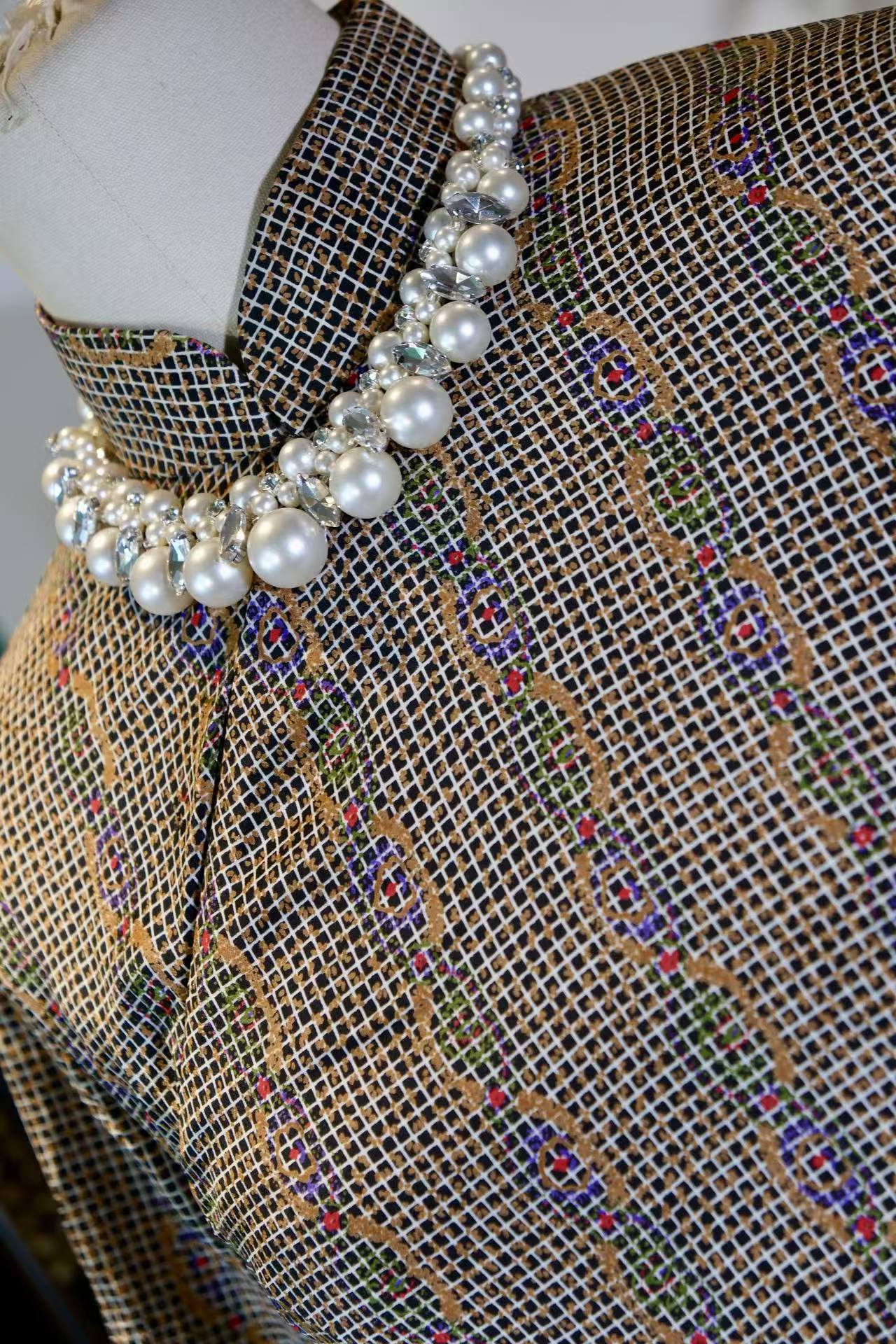
此件旗袍面料以细密的米色网格为基底,其上交织着金色波浪纹与彩色菱形纹样,形成独特的抽象几何印花。网格如经纬交织的秩序,暗合《考工记》“天有时,地有气,材有美,工有巧”的传统造物理念;金色波浪纹似水波流转,呼应《诗经》“河水清且涟漪”的自然意象,又带现代主义对线条的抽象提炼;彩色菱形纹则以红、蓝、绿等色点缀其间,如星子散落,打破网格的规整,暗藏“和而不同”的东方哲学。这种将传统纹样解构为几何符号的设计,既延续了民国时期“中西合璧”的审美脉络,又体现了六十年代台湾纺织业受西方现代艺术影响的创新尝试——彼时台湾作为亚洲“四小龙”之一,纺织业蓬勃发展,此类融合东方意蕴与现代形式的印花面料,正是时代浪潮下的艺术结晶。
二、古董衣的故事:时光里的优雅密码
六十年代的台湾,正处于传统与现代的碰撞期。这件旗袍的剪裁延续了民国旗袍的经典形制:立领端庄,短袖利落,收腰设计勾勒出女性曲线,既保留了东方的含蓄,又符合当时都市女性的日常需求。面料的选择尤为考究——台湾产的混纺面料,既保留了丝绸的光泽感,又具备耐磨性,是当时技术进步与实用美学的体现。
可以想见,这件旗袍曾属于一位台湾都市女性:她或许在台北的写字楼里工作,或在咖啡馆与友人闲谈,旗袍的几何印花在日光下流转,珍珠项链(图中搭配)与金线纹样相映成辉。她穿着它走过西门町的霓虹,也曾在阳明山的花海中驻足——这件旗袍不仅是衣物,更是六十年代台湾女性独立、优雅的精神象征,是“东方巴黎”旧梦与现代化进程交织的物质见证。
三、艺术风格与稀缺性:时代孤品的价值
从艺术风格而言,此旗袍融合了三种美学基因:一是中国传统纹样的抽象化(如网格与波浪纹对“回纹”“水纹”的简化),二是西方现代艺术的几何构成(受包豪斯风格影响),三是六十年代台湾本土的实用主义设计。这种多元融合使其成为研究战后亚洲服饰史的重要样本,正如学者王受之在《世界现代设计史》中所言:“六十年代的亚洲设计,是传统与现代对话的实验室。”
稀缺性方面,台湾产六十年代古董旗袍存世量极少。彼时台湾纺织业虽盛,但高档旗袍多为定制,且面料易损、保存难度大,能完整留存至今者凤毛麟角。此件旗袍面料图案清晰、色彩未褪,剪裁工艺精湛,实属难得。其价值不仅在于“古董”的时间标签,更在于它是特定历史时期、特定地域文化与艺术风格的物质载体,是不可复制的时代孤品。
四、结语:穿在身上的历史诗行
这件抽象几何印花旗袍,如同时光的切片,将六十年代台湾的都市风情、艺术思潮与女性形象凝固于经纬之间。它不仅是衣物,更是一部穿在身上的历史诗行,吟唱着东方与西方、传统与现代的永恒对话。对于收藏者而言,拥有它,便是拥有了一段可触摸的时代记忆,一份稀缺的艺术遗产。
Measurements / Size Guide:
Bust / Waist / Hips: 98/94/102 cm
Total Length: 110 cm
Detailed Description:
The fabric of this cheongsam (qipao) features a base of dense beige gridlines, interwoven with golden wave motifs and polychromatic diamond patterns, creating a unique abstract geometric print. The grid, reflecting the order of warp and weft, aligns with the traditional Chinese making philosophy from the Artificers' Record: "Heaven has its seasons, Earth has its vital energy, materials have their beauty, and craftsmanship has its ingenuity." The golden waves flow like rippling water, echoing the natural imagery of "clear and rippling river water" from the Book of Songs, while maintaining a modernist abstraction of line. The colored diamonds—dots of red, blue, and green—break the regularity of the grid like scattered stars, embodying the Eastern philosophy of "Harmony in Diversity." This deconstruction of traditional motifs into geometric symbols continues the "East-meets-West" aesthetic lineage of the Republican era, reflecting the innovative spirit of the 1960s Taiwanese textile industry influenced by Western modern art—a time when Taiwan, as one of the "Four Asian Tigers," saw a flourishing of textile arts that merged Eastern essence with modern form.
1960s Taiwan was at a crossroad of tradition and modernity. The tailoring of this qipao follows the classic Republican form: a dignified standing collar, crisp short sleeves, and a cinched waist that contours the feminine silhouette—preserving Eastern modesty while meeting the daily needs of urban women. The choice of fabric is particularly sophisticated—a Taiwanese-made blend that retains the luster of silk while offering durability, embodying the period's technological progress and functional aesthetics.
One can imagine this garment belonging to a Taiwanese urban woman: perhaps working in a Taipei office building or conversing with friends in a café, the geometric prints shimmering under the sunlight, her pearl necklace (as styled in the image) complementing the golden patterns. She walked through the neon lights of Ximending and paused amidst the flower blossoms of Yangmingshan. This qipao is more than clothing; it is a spiritual symbol of the independent and elegant Taiwanese woman of the 1960s—a material witness to the "Old Dream of the Orient's Paris" intertwined with the process of modernization.
Artistically, this qipao fuses three aesthetic genes: the abstraction of traditional Chinese motifs (simplifying "Hui" and "Water" patterns into grids and waves), the geometric composition of Western modern art (influenced by the Bauhaus style), and the pragmatic design of 1960s Taiwan. This pluralistic fusion makes it an essential sample for studying post-war Asian costume history. As scholar Wang Shouzhi noted in The History of Modern World Design: "Asian design in the 1960s was a laboratory for the dialogue between tradition and modernity."
In terms of scarcity, 1960s antique qipaos from Taiwan are exceptionally rare. Although the textile industry was prosperous then, high-end qipaos were mostly bespoke; due to the fragility of the fabrics and the difficulty of preservation, very few have survived in pristine condition. This piece, with its crisp patterns, unfaded colors, and masterful tailoring, is truly a rare find. Its value lies not just in the "antique" label, but in its status as a material carrier of a specific historical period, regional culture, and artistic style—an irreplaceable unique specimen.
This abstract geometric print qipao is like a slice of time, freezing the urban flair, artistic trends, and feminine silhouettes of 1960s Taiwan within its warp and weft. It is a series of historical verses worn on the body, singing an eternal dialogue between East and West, tradition and modernity. For the collector, to own it is to possess a touchable memory of an era and a rare artistic heritage.