深圳溯源
Couldn't load pickup availability
衣服尺寸:
胸围/腰围/臀围:112/96/118 厘米
衣长:105 厘米
细节描述:
在时尚的轮回中,有些衣物是时间的琥珀,封存着一个时代的气息与技艺。这件诞生于上世纪六十年代、由英国精纺羊毛织就、在香港剪裁成型的古董旗袍,便是如此一件承载着东西方文化交融印记的珍品。它不仅是一件衣物,更是一段历史的见证,一种美学的宣言,以及一份稀缺的艺术遗产。
图案:几何韵律与东方意境的交响
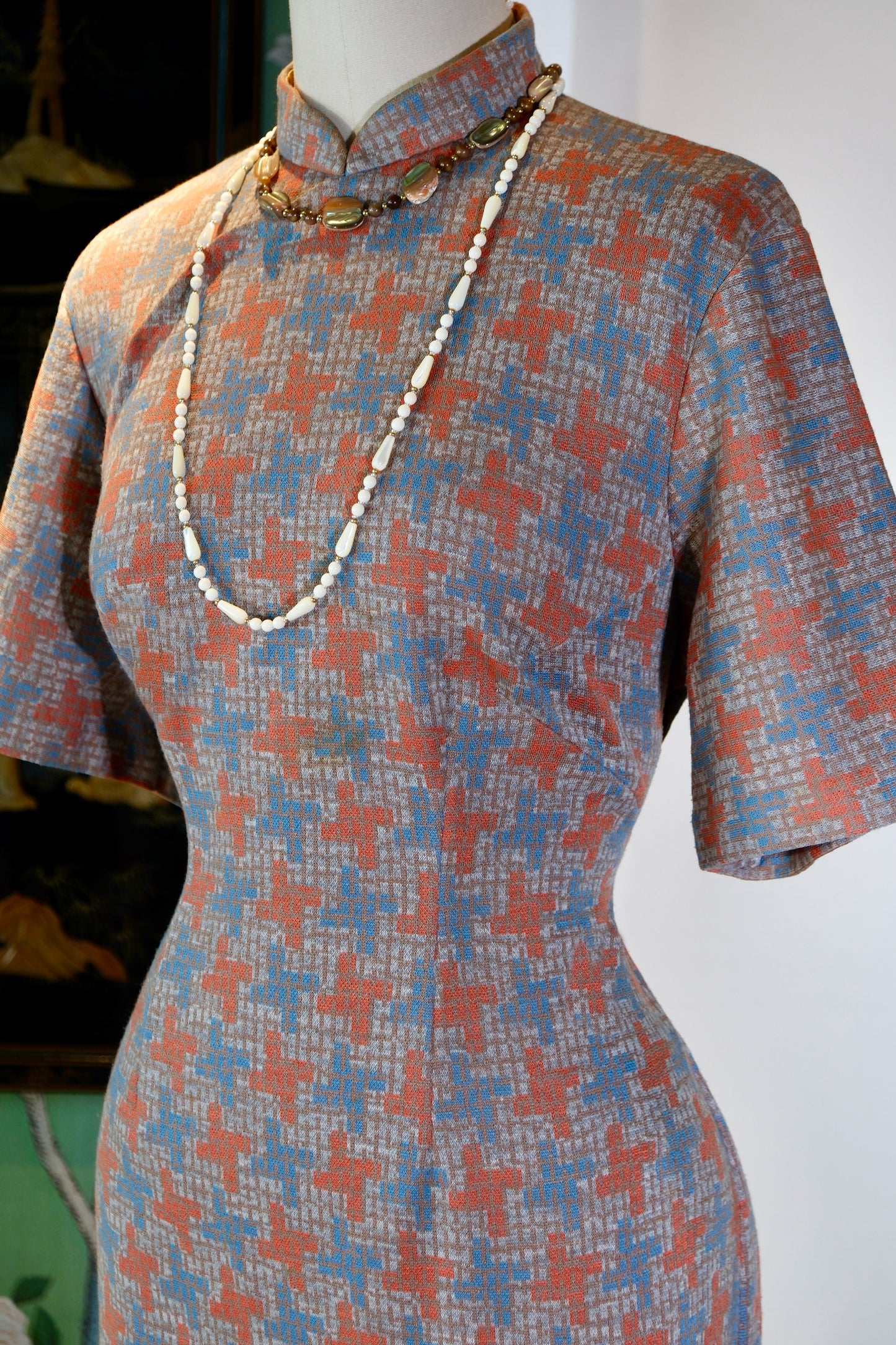
旗袍的面料图案是其最引人注目的视觉焦点。它并非传统旗袍中常见的花卉、龙凤或山水写意,而是采用了一种极具现代感的几何纹样——由橙色、蓝色与灰褐色交织而成的“千鸟格”变体。
这种图案在西方时尚史中源远流长,其雏形可追溯至古苏格兰低地的威尔士格纹,后经由英国纺织工业的改良与推广,成为绅士西装与高级时装的经典元素。然而,在这件旗袍上,千鸟格被赋予了全新的东方语境。橙色与蓝色的撞色搭配,打破了传统千鸟格的黑白或灰褐调性,显得更为活泼与现代,这正是六十年代“摇摆伦敦”时尚风潮的余韵,也是香港作为东西方文化交汇点的独特审美体现。图案的排列并非机械重复,而是通过色彩的微妙渐变与线条的交错,形成一种流动的韵律感,仿佛在静态的织物上演绎着动态的光影。
故事:港岛裁缝的黄金时代与英料的传奇
六十年代的香港,是旗袍制作的黄金时代。彼时,上海裁缝南迁,将海派旗袍的精湛技艺带至香江,与本地的粤式剪裁相融合,形成了独具特色的“港式旗袍”风格。这件旗袍正是这一历史背景下的产物。
其面料选用的是英国精纺羊毛。英国作为工业革命的先驱,其纺织业在二十世纪中叶仍处于世界领先地位。精纺羊毛以其细腻、挺括、光泽感强而著称,是高级定制服装的首选面料。在六十年代,能够使用英国进口精纺羊毛制作旗袍,本身就意味着穿着者的身份与品位。这种面料的选择,不仅体现了当时香港社会对西方物质的向往,也反映了旗袍作为一种“现代中式服装”在材质上的革新。
艺术风格:现代主义与东方传统的对话
这件旗袍的艺术风格,是六十年代现代主义设计与东方传统服饰美学的完美对话。
从廓形上看,它遵循了旗袍的经典剪裁——立领、斜襟、收腰、开衩,强调女性身体的曲线美。然而,其袖型采用了更为简洁的短袖设计,长度及膝,整体线条更为流畅利落,摒弃了传统旗袍的繁复装饰,体现了现代主义“少即是多”的设计理念。
面料的几何图案与服装的简约廓形相得益彰,共同营造出一种冷静、理性而又不失优雅的现代感。这种风格与同时期西方设计师如玛丽·奎恩特所倡导的“未来主义”时尚有着异曲同工之妙,却又深深植根于东方的审美土壤。
稀缺性:不可复制的时代印记
这件旗袍的稀缺性,首先体现在其材质的珍贵。英国精纺羊毛在六十年代已是奢侈品,如今更是难以寻觅。其次,其制作工艺的复杂性也决定了其不可复制性。港式旗袍讲究“量体裁衣”,每一件都是手工缝制,从打版、剪裁到缝制,需要经过数十道工序,耗时数周甚至数月。这种手工技艺在工业化生产的今天已近乎失传。
更重要的是,这件旗袍所承载的历史文化价值是不可复制的。它是六十年代香港社会风貌、东西方文化交流以及女性地位变迁的实物见证。正如学者王受之在《世界现代设计史》中所言:“设计是时代的镜子。”这件旗袍,正是那个时代最生动、最具体的镜子之一。
总而言之,这件1960年代的港产英料旗袍,是一件集艺术性、历史性与稀缺性于一身的珍品。它不仅是一件可以穿着的衣物,更是一件值得收藏与研究的艺术品。它静静地诉说着一个关于东西方文化交融、传统与现代对话的永恒故事。
Measurements / Size Guide:
Bust / Waist / Hips: 112/96/118 cm
Total Length: 105 cm
Detailed Description:
In the cycles of fashion, some garments act as amber to time, sealing the atmosphere and craftsmanship of an era. This antique cheongsam (qipao), woven from British worsted wool and tailored in Hong Kong during the 1960s, is such a treasure—bearing the marks of East-West cultural fusion. It is more than a garment; it is a witness to history, a declaration of aesthetics, and a rare artistic legacy.
The fabric pattern is the most striking visual focus of this cheongsam. Rather than the common floral, dragon, or landscape motifs of traditional qipaos, it employs a highly modern geometric pattern—a variation of the "Houndstooth" woven from orange, blue, and taupe threads.
This pattern has a long history in Western fashion, with origins tracing back to the ancient Scottish Lowlands. Through the refinement and promotion of the British textile industry, it became a classic element for gentlemen's suits and haute couture. However, on this cheongsam, the Houndstooth is granted an entirely new Eastern context. The bold orange and blue color-blocking breaks the traditional monochrome or muted tones of Houndstooth, appearing more vibrant and contemporary. This reflects the lingering charm of the "Swinging London" trend and the unique aesthetic of Hong Kong as a cultural crossroads. The arrangement is not a mechanical repetition but creates a fluid rhythm through subtle color gradients and interlacing lines, as if performing dynamic light and shadow upon a static fabric.
The 1960s was the golden age of cheongsam making in Hong Kong. During this time, tailors from Shanghai migrated south, bringing the exquisite skills of the Shanghainese qipao to the Fragrant River and merging them with local Cantonese tailoring to form the distinctive "Hong Kong-style qipao." This garment is a direct product of that historical background.
The fabric chosen is British worsted wool. As a pioneer of the Industrial Revolution, the UK's textile industry remained world-leading in the mid-20th century. Worsted wool is renowned for being delicate, crisp, and possessing a strong luster, making it the preferred material for bespoke clothing. In the 1960s, using imported British wool for a cheongsam was in itself a statement of the wearer’s status and taste. This choice reflects the aspiration for Western material quality in Hong Kong society at the time and the innovation of the cheongsam as a "modern Chinese garment."
The artistic style of this cheongsam is a perfect dialogue between 1960s modernist design and traditional Eastern costume aesthetics.
In terms of silhouette, it follows the classic qipao cut—standing collar, diagonal bodice, cinched waist, and side slits—emphasizing the curves of the female body. However, the sleeve style adopts a simpler short-sleeved design, and the length reaches the knee, making the overall lines smoother and sharper. By discarding the complex decorations of traditional qipaos, it embodies the modernist design philosophy of "less is more."
The geometric pattern of the fabric complements the minimalist silhouette, creating a sense of modern elegance that is calm and rational. This style shares a common spirit with the "Futurist" fashion advocated by Western designers like Mary Quant in the same period, yet it remains deeply rooted in Eastern aesthetic soil.
The scarcity of this cheongsam is first seen in the preciousness of its material. British worsted wool was a luxury in the 1960s and is even harder to find today. Secondly, the complexity of its production determines its unrepeatability. Hong Kong-style qipaos emphasize "tailoring to the body"; every piece is hand-sewn, requiring dozens of processes from pattern-making to finishing, taking weeks or even months. This manual skill has nearly vanished in today’s era of industrial mass production.
More importantly, the historical and cultural value carried by this cheongsam is irreplaceable. It is a physical witness to Hong Kong's social landscape, East-West cultural exchange, and the changing status of women in the 1960s. As scholar Wang Shouzhi noted in A History of Modern Design: "Design is the mirror of an era." This cheongsam is one of the most vivid and concrete mirrors of that time.
In conclusion, this 1960s Hong Kong-made British fabric cheongsam is a treasure combining artistry, history, and scarcity. It is not just a garment to be worn, but a work of art worthy of collection and research, silently telling an eternal story of cultural fusion and the dialogue between tradition and modernity.