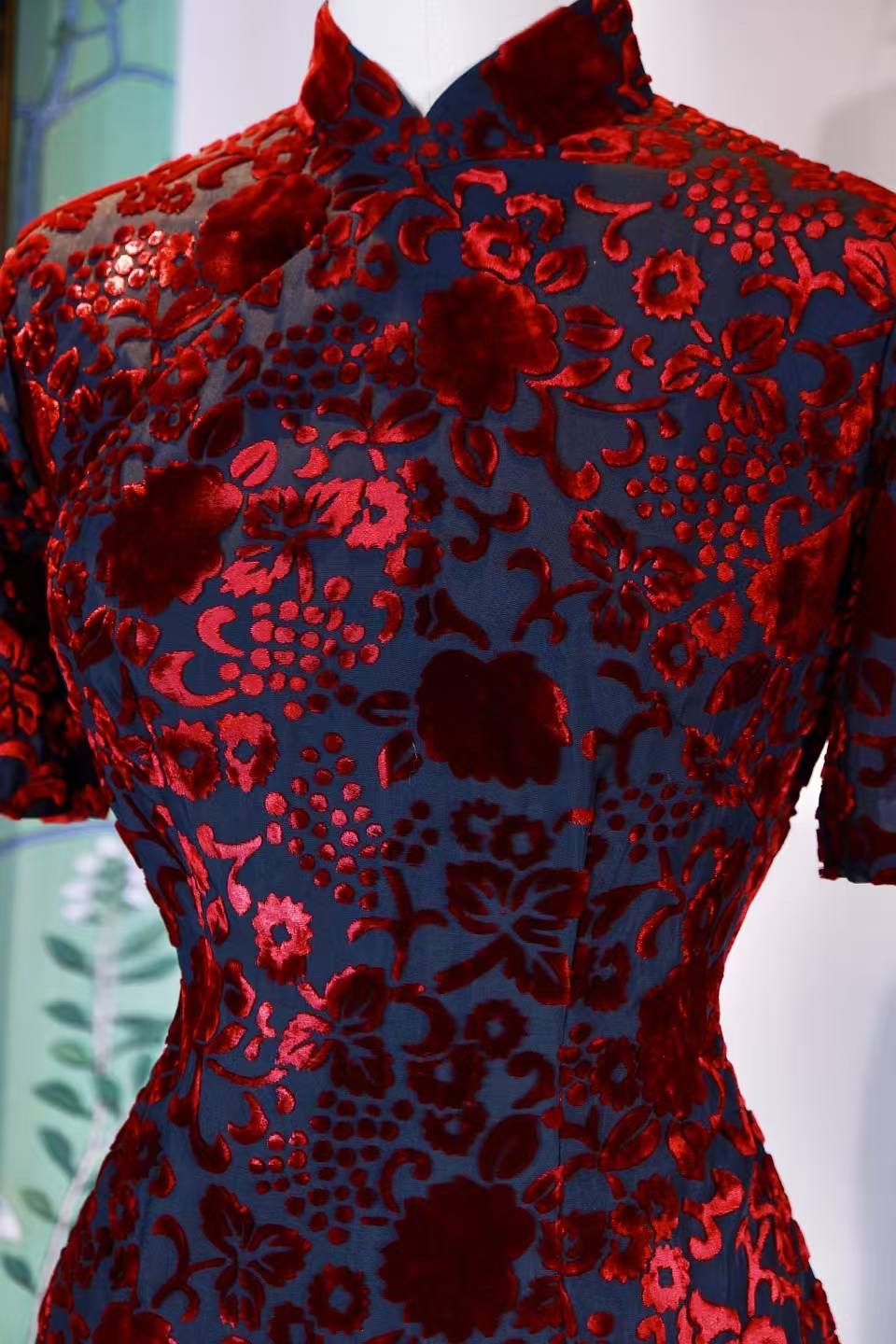
六十年代台湾制渐变烧花丝绒旗袍:黑底上的绛红诗学
此件台湾产古董旗袍,以烧花丝绒工艺于黑色薄纱上晕染出绛红花树,领口立起东方脊梁,短袖裁剪暗合六十年代摩登风潮,侧摆开衩处藏匿着步履间的风流——其上纹样非止装饰,更是一部以针线为笔的《草木子》。
旗袍周身满布缠枝花卉纹,绛红丝绒在光线流转中显化出深浅渐变:大朵牡丹雍容绽放于腰胯,恰合《诗经·卫风》“投我以木瓜,报之以琼琚”的珍重意象;小簇梅花、桃花穿插其间,如《楚辞》“桃李罗堂前”的春意盎然;藤蔓卷草蜿蜒盘绕,暗应《尔雅》“蔓蔓日茂”的生生不息。尤为难得者,花瓣边缘以烧花工艺剔透出蕾丝般的通透感,使厚重丝绒竟生出“隔云端”的朦胧诗意,此般工艺难度,非十年功者不可得。
黑色底色沉静如夜雨后青瓷,绛红花纹炽烈似烛火照影,此“青赤相济”之色谱,暗合《考工记》“青与赤谓之文”的传统审美。丝绒经烧花处理后,呈现出“透而愈显”的渐变效果——近观之,花瓣边缘如墨入水般自然晕染,远望则花树轮廓在黑底上浮凸如雕,此般“虚实相生”的视觉张力,正是六十年代台湾旗袍匠人对传统“晕染法”的创造性转化。
此袍非衣,实为一段凝固的时光:当指尖抚过丝绒花树,触到的是六十年代的月光,是《诗经》里的草木,更是台湾工坊里那缕再也追不回的烛火。
以下是您分享的关于六十年代台湾产渐变烧花丝绒旗袍的深度美学翻译:
🌹 Crimson Poetics on Black: A 1960s Taiwan Vintage Burnout Velvet Cheongsam with Gradient Florals
This vintage cheongsam from Taiwan utilizes the burnout velvet (Devoré) technique to diffuse crimson floral trees across a black sheer base. Its standing collar upholds the "Oriental spine," while the short-sleeve cut aligns with the 1960s modern trend, and the side slits conceal a rhythmic grace within every step. The patterns upon it are more than mere decoration; they are a botanical chronicle, Cao Mu Zi, written with needle and thread.
The garment is enveloped in scrolling floral motifs. Under the shifting light, the crimson velvet manifests a delicate gradient: grand peonies bloom majestically at the hip, echoing the imagery of cherished reciprocity in the Classic of Poetry: Wei Feng: "She threw me a papaya; I requited her with a precious jade." Clusters of plum and peach blossoms are interspersed, evoking the vibrant spring described in the Songs of Chu: "Peaches and plums line the front of the hall." The winding vines and scrolling grasses darkly reflect the eternal vitality found in Er Ya: "Spreading and luxuriant, flourishing day by day." Most remarkable is the burnout technique used at the petal edges to create a lace-like translucency, granting the substantial velvet a misty, poetic quality—as if glimpsed "beyond the clouds." Such technical difficulty could only be mastered by a craftsman with decades of experience.
The black background is as serene as celadon after a night rain, while the crimson patterns are as fierce as flickering candlelight. This "Blue-Black and Crimson" palette aligns with the traditional aesthetic in Kao Gong Ji: "The harmony of blue-black and crimson is what defines 'Wen' (refined pattern)." Through the burnout process, the velvet achieves a gradient effect that is "transparent yet more prominent." Up close, the petal edges bleed naturally like ink in water; from a distance, the silhouettes of the floral trees stand out in relief against the black base. This visual tension of "interplay between void and solid" is precisely the creative transformation of traditional "shading techniques" by Taiwanese cheongsam masters of the 1960s.
This robe is not merely a garment, but a frozen moment in time. When your fingertips brush past the velvet trees, you touch the moonlight of the 1960s, the flora of the Classic of Poetry, and that wisp of candlelight from a Taiwanese workshop that can never be chased back.